From the Blog

One photographer’s three year tour of NYC’s best rooftops

by KELSEY CAMPBELL-DOLLAGHAN, Gizmodo India, October 18, 2013
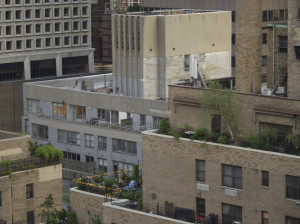
155 E 55th Street from 17th floor, 130 E 57th Street Photo: Stewart Mader Source: www.storiesaboveny.com

155 E 55th Street from 17th floor, 130 E 57th Street
Photo: Stewart Mader
Source: www.storiesaboveny.com

Even if you’ve lived in New York for decades, gaining access to a rooftop you’ve never explored can still be surprisingly fun: The burst of wind, the sound of traffic, and an entirely new vantage point on a city you’d think you’d be sick of after so many years. That’s the basic concept behind Stories Above New York, a visual archive of New York’s rooftop views that’s three years in the making.

SANY is the work of Stewart Mader, a photographer who started the project in early 2011. He shoots from a new rooftop roughly every week, picking unusual or hard-to-access spots he’s never been to. Those include the top of One World Trade Center and the Columbus Circle monument of Christopher Columbus, shot during the temporary installation of scaffolding around the statue. “New York is a giant city,” he said over email. “Even with 230 published photos so far, I haven’t even scratched the surface. I could be doing this five or ten years from now.”

Does Mader have a favorite? 550 Grand St, an apartment building that flanks the Williamsburg Bridge. It was built by workers’ unions to replace 65 tenements, and his wife’s parents lived there for 50 years. “The whole history of these buildings is emblematic of the kind of ingenuity that has made New York what it is today,” he adds. “We should be looking more closely at their history to solve the current, growing housing supply crisis.”

Read the original story

Stories Above New York website

Cool tool for a hot subject

by RONDA KAYSEN, Habitat, June 2012, p. 22-25

A year ago this month, New York City released an interactive map showing every solar power installation in the city. It’s not a robust picture. There are fewer than 500 solar installations citywide.

NYCSolarMap.com could change that. By providing property owners with detailed information about tax incentives, solar potential, and the payback period for an individual rooftop, NYCSolarMap could, if you’ll pardon the pun, lead to sunny skies for solar. In all, two-thirds of the city’s roofs could harness enough of the sun’s energy to make it worth the investment.

The City University of New York (CUNY) is leading local solar efforts and developed the map in partnership with the city and the federal Department of Energy. The site has had about 200,000 hits since it launched and gets about 60 visitors a day. “You’re always going to get the early adopters. However, to trigger mainstream adoption you need to make the case for solar by using data,” says Tria Case, director of sustainability for CUNY and the map’s lead developer. The map cost $660,000 to build and gives users the tools to make an informed decision about their own property. The map, created from photographs taken by airplane using a laser system called Lidar, also tracks solar thermal projects and eventually could become an energy map for the entire city.

Map Barriers

But there are barriers to installing solar. The city permitting process can be cumbersome. And not all buildings are good candidates. A property must have a large roof that’s in good condition. Above all, it needs ample sun. A building with too much shade will not get enough sunlight to generate energy. For that reason, buildings in boroughs other than Manhattan tend to be better candidates.

Then there are the financials. If a building is structured as a 501(c)(3) nonprofit, it won’t benefit from some of the tax incentives. And since most of the financial incentives come in the form of a rebate, a building’s owners need to either have enough cash to pay for the project up front or be able to qualify for a loan. […]

Read the full story

NYC Solar Map

Sustainable SUNY

Toi toi mon toit

par JOSSELIN THONNELIER, Urbanews.fr, le 21 mars 2012

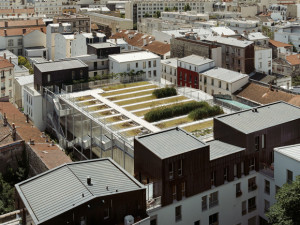
Jardin associatif aménagé sur le toit du gymnase, projet 47 Logements, gymnase et jardin associatif, secteur "Vignoles Est" Photo: TOA Source: www.toa-archi.com

La toiture du gymnase est investie par un jardin pédagogique public, projet “47 logements, gymnase et jardin associatif, secteur Vignoles Est”
Photo: TOA
Source: www.toa-archi.com

Jamais les toits n’avaient connu un tel engouement. Depuis la montée des eaux médiatiques entourant la réforme du droit à construire, l’idée de faire littéralement « la ville sur la ville » émerge peu à peu des enjeux relatifs à la crise du logement, mais également des réflexions sur l’avenir des métropoles post-carbone face à leur croissance et à leur étalement. Sur la capitale, ou l’on créé pour le moment 40 000 logements chaque année, lorsque le Programme du Grand Paris prévoit d’en construire 70 000 par an sur les vingt-cinq prochaines années, prendre de la hauteur sur l’existant est devenue une perspective de plus en plus crédible, sinon nécessaire, mobilisant l’idée d’une nouvelle approche de la ville verticale. Comment penser l’urbanisme non plus uniquement au pied des immeubles mais aussi «par le haut» ? Quelles formes, quels usages, quelles qualités et surtout quels droits donner à cet horizon de la ville ?

Paris futur laboratoire de «l’urbanisme par le haut» ?

Les équipes du Grand Paris ont été nombreuses à entrevoir les premiers jalons systématiques à l’extension verticale de la capitale face notamment à la raréfaction du foncier. Parmi elles, le travail de Michel Cantal Dupart revient de manière pragmatique sur les possibilités réservées, à plus ou moins courts termes, à l’ajout d’un nouvel étage sur certains immeubles :  «Sur douze rues étudiées, la réserve ou capacité foncière aérienne est d’environ 466 650 m2. En prenant en compte l’ensemble des difficultés à venir, la résistance des propriétaires et le temps nécessaire pour la maturation de ce projet, une réalisation d’environ 10% est possible dans les délais courts, soit 46 665m2.»

[Read more…]

A farm grows in Brooklyn…on a rooftop!

by LIZA DE GUIA, food. curated., July 20, 2010

Source: food. curated.


Brooklyn’s urban beekeepers

Breaking The Law For The Planet (part I)

by LIZA DE GUIA, food. curated., August 9, 2009

Source: food. curated.


“Watch Out Ladies” Honey Harvest (Part II)

by LIZA DE GUIA, food. curated., August 21, 2009

Source: food. curated.


The Brooklyn Grange: NYC’s biggest rooftop farm

by LIZA DE GUIA, food. curated., Jul 13, 2010

Source: food. curated.