From the Blog

Green roof fad comes to town

by HELEN YOUNG, The Australian, August, 18, 2012
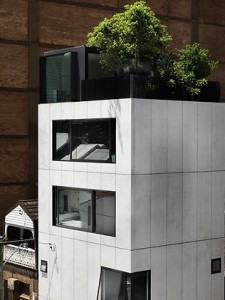
The Small House in Sydeny's Surry Hills. Photo: Trevor Mein Source: Supplied via The Australian

The Small House in Sydeny’s Surry Hills
Photo: Trevor Mein
Source: Supplied via The Australian

Imagine flying over a city where the rooftops below are living green, where plants and even vegetable gardens transform the lost spaces on top of buildings. It’s already happening around the world, and Australia is embracing the trend.

In Sydney’s Pyrmont, we’re standing on the rooftop of a heritage-listed building, surrounded by a vast garden sitting in the sky. M Central is an apartment block whose 2005 resurrection as a hip inner-city residence came a century after its construction as a wool store. Landscape architect Daniel Baffsky of 360 Degrees, who designed the 3000sq m communal garden, says the brief was to surprise rather than “have the ubiquitous pool and huge deck”.

Swaths of native foxtail grass lend an almost rural ambience at one end, their furry plumes swaying with the breeze. Bold succulents give textural contrast, while the centrepiece of a small lawn is a magnificent dragon’s blood tree. On the upper level, vine-covered arbours and wide timber boardwalks, shaded by tall tuckeroo trees, flank a covered events area. The sound of water tinkles gently.

The garden is beautiful, but also a social hub for M Central’s 400 residents, offering opportunities for interaction, from barbecues to dog walking.

“There’s no question about the environmental benefits of green roofs but the social benefits are not yet fully explored. Up on the roof everyone is equal,” Baffsky says.
[Read more…]

The Empire State Building gets a huge green roof!

by BETH BUCZYNSKI, EarthTechling, October 1st, 2013

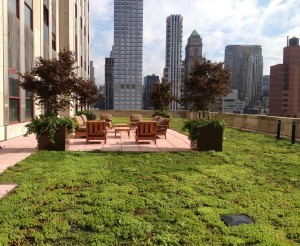
Green roof on the 21st floor
Photo: Xero Flor
Source: www.earthtechling.com

The Empire State Building, an architectural icon in New York City and beyond, just took a giant step forward in its quest to reduce energy consumption. The ‘World’s Most Famous Office Building’ now boasts four green roof systems, totally nearly 10,000 square feet.

For its green roof upgrade, the Empire State Building chose to install the Xero Flor Green Roof System for four rooftop areas: 21st floor east (3,450 square feet), 21st floor west (3,450 square feet), 25th floor northwest (1,000 square feet) and 30th floor west (1,200 square feet). The green roofs on the 21st floor feature rooftop patios with outdoor furniture for the enjoyment of office tenants.

As we’ve reported in the past, the Empire State Building is on a quest to become the most sustainable office building in America. In 2011, the building’s owners announced that they would purchase 100 percent of its power from renewable sources and then embarked on a massive retrofit plan that would earn the Empire State Building LEED Gold.

[Read more…]

Seeing green: Urban agriculture as green infrastructure

by CASSIM SHEPARD, Urban Omnibus, February 1st, 2012

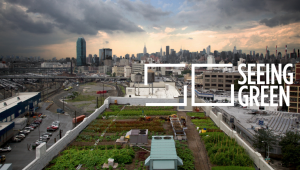
Image: Seein Green Source: www.urbanomnibus.net

Image: Seeing Green
Source: www.urbanomnibus.net

It’s easy to list the reasons why we are supposed to love urban agriculture: the food it yields is fresh and local; the farming it requires is fun and social; the effect on neighborhoods is revitalizing and healthy. Critics point to its inability to replace existing production and distribution channels for produce, but what if its impact extended beyond the small farm or immediate community? What if it could solve other problems? One of New York’s greatest environmental challenges is its combined sewage overflow (CSO) problem. Our outdated sewer system is designed to collect stormwater runoff, domestic sewage, and industrial wastewater in the same pipe on its way to a sewage treatment plant. When the rain is heavy, though, volume exceeds capacity and untreated wastewater flows right into our waterways. Green infrastructure is a term that refers to a wide range of technologies and systems to improve water quality through the capture and reuse of stormwater. But the policies that incentivize green infrastructure and those that govern urban agriculture are not coordinated. In some cases, urban agriculture is actively excluded from official definitions of green infrastructure. In an effort to support farming in the city and help scale it up, Tyler Caruso and Erik Facteau set out to prove scientifically the environmental benefits of rooftop and other urban farms, in particular their ability to manage stormwater, with their research project Seeing Green. In describing this project, Caruso and Facteau touch on issues that range from the effect of scientific research on public policy, the shift towards a definition of sustainability that includes performance alongside design, and the need to layer different registers of analysis in efforts to bring about a city that is more responsive to natural systems. […]

Read the original story

Tamil Nadu government pushes green thumb rule

by JULIE MARIAPPAN, Times News Network, September 23, 2013

CHENNAI: The soaring price of vegetables has caused much heartburn, but people in the state may soon get their greens for free.

If the state government has its way, residents could soon be plucking fresh vegetables from their own rooftop gardens. As part of the plan to soften the blow of food inflation, the government will distribute do-it-yourself rooftop garden kits to residents.

Encouraged by a few individuals who have responded to rising prices by growing vegetables on their balconies, the government plans to introduce the scheme in Chennai and Coimbatore to begin with.

“The opportunity to beat rising prices by growing vegetables at home has led to people trying their luck with gardening. The government wants to chip in with support,” a horticulture officer said. The horticulture department will roll out the scheme with support from Tamil Nadu Agriculture University.

People interested can apply online and the government will supply them with 20 UV stabilised 200 micron thickness polythene bags, 15kg of coir pith and manure, seeds for vegetables and greens, besides instruments, organic fertiliser and a 20sqm polythene sheet. It will make 20 bags available for each person at a subsidised price. Indian Overseas Bank offers loans to individuals for rooftop gardening.

[Read more…]

Lufa Farms launches second rooftop greenhouse

Press release via Reuters

43,000-square-foot greenhouse represents scalable approach for feeding cities

MONTREAL, QUEBEC–(Marketwired – Sept. 23, 2013) – Lufa Farms, which built the world’s first commercial rooftop greenhouse in early 2011, today unveiled its second greenhouse atop a newly constructed office building in the Montreal metropolitan area.

The greenhouse, located in Laval, will provide fresh produce to more than 6,000 people year round – about two times the yield of Lufa Farms’ first greenhouse in the Ahuntsic-Cartierville borough of Montreal. The company’s greenhouse system is scalable and can be replicated on new rooftops in any city.

“This greenhouse puts high-yield, rooftop agriculture within the reach of any new building development, in any city, on spaces public or private, anyplace in the world,” said Mohamed Hage, founder and president of Lufa Farms. “After almost five years of focus on the main issues of urban rooftop agriculture, we have solved how to cost-effectively grow food, distribute it, integrate it with local farming efforts, and do it all in an environmentally conscious, sustainable way. This doesn’t just change how food is grown, it changes how cities eat.”

Construction of the 43,000 square-foot greenhouse, visible from the 440 highway atop a new mixed-use commercial building, was the result of a collaboration between Lufa Farms, Le Groupe Montoni Division Construction, Inc. of Laval, and the Dutch company KUBO, a world-renowned greenhouse designer and manufacturer. The structure uses an innovative venting system to control pests and temperature and to optimize vital sunlight. The greenhouse also has a recirculating irrigation system for water and surface condensation.

[Read more…]

Nantes accueille le gotha mondial de la végétalisation des bâtiments

par JEAN-PHILIPPE DEFAWE, LeMoniteur.fr, 5 septembre 2013

Après Toronto, Mexico et avant Sydney en 2014, le Congrès mondial de la végétalisation du bâtiment (World Green Infrastructure Congress) se tiendra du 9 au 13 septembre à Nantes, capitale verte de l’Europe.

Avec quelque 1,5 millions de m2 de surfaces végétalisées, la France est le second marché mondial. Il était donc logique que ce congrès, où sont attendus quelques 600 experts du monde entier, se tienne en France. Logique encore que la ville d’accueil soit Nantes, première ville française élue « capitale verte de l’Europe » par la Commission européenne. « Par ailleurs, à Nantes, nous sommes sur un terreau propice à la vegétalisation des bâtiments avec, sur le territoire, le pôle de compétitivité du végétal, Vegépolys, et le cluster de l’éco-construction, Novabuild » justifie François Lassalle, directeur R&D de Sopranature (Soprema) et président de l’Association des toitures et des façades végétales (Adivet), organisateur du congrès.

Marché porteur mais à encadrer

Dans un marché du bâtiment plutôt morose, la végétalisation représente une niche porteuse même si, selon François Lassalle, « le rythme n’est plus aussi soutenu depuis deux-trois ans ». Comme tout marché nouveau, il est encore à encadrer. « Historiquement, les étancheurs sont présents sur ce marché et ils sont rejoints par les entreprises du paysage. Ce croisement entre bâtiment et végétal nécessite le respect d’une réglementation spécifique. Aujourd’hui, il existe des Règles professionnelles conjointes qui doivent être appliquées par tous les acteurs » précise François Lassalle.

[Read more…]