From the Blog

A staff of robots can clean and install solar panels

by DIANE CARDWELL, The New York Times, October 14, 2013
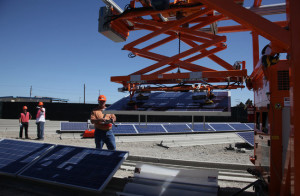
Rover, a robot, placing a solar panel in a track at Alion Energy, which is looking to shave labor costs. Photo: Jim Wilon (The New York Times) Source: www.nytimes.com

Rover, a robot, placing a solar panel in a track at Alion Energy, which is looking to shave labor costs.
Photo: Jim Wilon / The New York Times
Source: www.nytimes.com

RICHMOND, Calif. — In a dusty yard under a blistering August sun, Rover was hard at work, lifting 45-pound solar panels off a stack and installing them, one by one, into a concrete track. A few yards away, Rover’s companion, Spot, moved along a row of panels, washing away months of grit, then squeegeeing them dry.

But despite the heat and monotony — an alternative-energy version of lather-rinse-repeat — neither Rover nor Spot broke a sweat or uttered a complaint. They could have kept at it all day.

That is because they are robots, surprisingly low-tech machines that a start-up company called Alion Energy is betting can automate the installation and maintenance of large-scale solar farms.

Working in near secrecy until recently, the company, based in Richmond, Calif., is ready to use its machines in three projects in the next few months in California, Saudi Arabia and China. If all goes well, executives expect that they can help bring the price of solar electricity into line with that of natural gas by cutting the cost of building and maintaining large solar installations.

In recent years, the solar industry has wrung enormous costs from developing farms, largely through reducing the price of solar panels more than 70 percent since 2008. But with prices about as low as manufacturers say they can go, the industry is turning its attention to finding savings in other areas.

“We’ve been in this mode for the past decade in the industry of really just focusing on module costs because they used to be such a big portion of system costs,” said Arno Harris, chief executive of Recurrent Energy, a solar farm developer, and chairman of the board of the Solar Energy Industries Association. Now, Mr. Harris said, “Eliminating the physical plant costs is a major area of focus through eliminating materials and eliminating labor.” […]
Read the full story

Green roof fad comes to town

by HELEN YOUNG, The Australian, August, 18, 2012

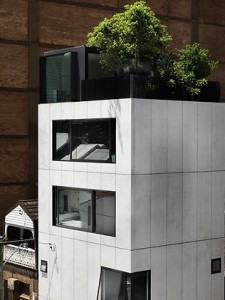
The Small House in Sydeny's Surry Hills. Photo: Trevor Mein Source: Supplied via The Australian

The Small House in Sydeny’s Surry Hills
Photo: Trevor Mein
Source: Supplied via The Australian

Imagine flying over a city where the rooftops below are living green, where plants and even vegetable gardens transform the lost spaces on top of buildings. It’s already happening around the world, and Australia is embracing the trend.

In Sydney’s Pyrmont, we’re standing on the rooftop of a heritage-listed building, surrounded by a vast garden sitting in the sky. M Central is an apartment block whose 2005 resurrection as a hip inner-city residence came a century after its construction as a wool store. Landscape architect Daniel Baffsky of 360 Degrees, who designed the 3000sq m communal garden, says the brief was to surprise rather than “have the ubiquitous pool and huge deck”.

Swaths of native foxtail grass lend an almost rural ambience at one end, their furry plumes swaying with the breeze. Bold succulents give textural contrast, while the centrepiece of a small lawn is a magnificent dragon’s blood tree. On the upper level, vine-covered arbours and wide timber boardwalks, shaded by tall tuckeroo trees, flank a covered events area. The sound of water tinkles gently.

The garden is beautiful, but also a social hub for M Central’s 400 residents, offering opportunities for interaction, from barbecues to dog walking.

“There’s no question about the environmental benefits of green roofs but the social benefits are not yet fully explored. Up on the roof everyone is equal,” Baffsky says.

[Read more…]

The Empire State Building gets a huge green roof!

by BETH BUCZYNSKI, EarthTechling, October 1st, 2013

Green roof on the 21st floor
Photo: Xero Flor
Source: www.earthtechling.com

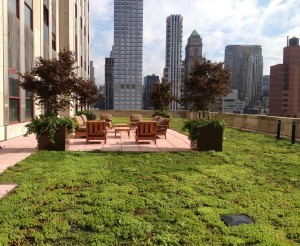
The Empire State Building, an architectural icon in New York City and beyond, just took a giant step forward in its quest to reduce energy consumption. The ‘World’s Most Famous Office Building’ now boasts four green roof systems, totally nearly 10,000 square feet.

For its green roof upgrade, the Empire State Building chose to install the Xero Flor Green Roof System for four rooftop areas: 21st floor east (3,450 square feet), 21st floor west (3,450 square feet), 25th floor northwest (1,000 square feet) and 30th floor west (1,200 square feet). The green roofs on the 21st floor feature rooftop patios with outdoor furniture for the enjoyment of office tenants.

As we’ve reported in the past, the Empire State Building is on a quest to become the most sustainable office building in America. In 2011, the building’s owners announced that they would purchase 100 percent of its power from renewable sources and then embarked on a massive retrofit plan that would earn the Empire State Building LEED Gold.

[Read more…]

Des étages en plus pour créer des logements

par TANCREDE BONORA, Slate.fr, 3 février 2012

Surélévation d'immeubles Image: Michel Cantal-Dupart Source: www.slate.fr

Surélévation d’immeubles
Image: Michel Cantal-Dupart
Source: www.slate.fr

Paris ne peut pas s’étendre indéfiniment, il doit se réinventer à l’intérieur de ses propres limites. Et si la solution se trouvait sur les toits?

Il faut débloquer le foncier», a asséné Nathalie Kosciusko-Morizet, ministre de l’Ecologie et du Logement, jeudi 2 février, sur les ondes de France Inter, après avoir commenté la mesure annoncée dimanche par Nicolas Sarkozy d’augmenter de 30% le coefficient d’occupation des sols (COS); selon elle, avec cette décision «la constructibilité augmente partout [y compris] les limites de hauteur, les limites de gabarit. (…) Ce n’est pas de l’étalement urbain, c’est tout le contraire».

Avec une des densités les plus élevées au monde (près de 22.000 hab/km contre seulement 13.500 pour Tokyo et près de 11.000 pour New York), Paris suffoque, ceinturé par un périphérique et un habitat de banlieue qui n’attire pas les jeunes urbains.

On crée pour l’instant 40.000 logements par an à Paris et le programme du Grand Paris projette d’en construire 70.000.

L’extension horizontale de la ville n’est plus une solution viable. Mais comment absorber la population parisienne de plus de 2.200.000 habitants tout en préservant la qualité de vie? Comment faire face à la pénurie des sols?

[Read more…]

Seeing green: Urban agriculture as green infrastructure

by CASSIM SHEPARD, Urban Omnibus, February 1st, 2012

Image: Seein Green Source: www.urbanomnibus.net

Image: Seeing Green
Source: www.urbanomnibus.net

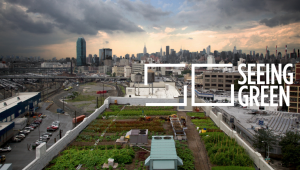
It’s easy to list the reasons why we are supposed to love urban agriculture: the food it yields is fresh and local; the farming it requires is fun and social; the effect on neighborhoods is revitalizing and healthy. Critics point to its inability to replace existing production and distribution channels for produce, but what if its impact extended beyond the small farm or immediate community? What if it could solve other problems? One of New York’s greatest environmental challenges is its combined sewage overflow (CSO) problem. Our outdated sewer system is designed to collect stormwater runoff, domestic sewage, and industrial wastewater in the same pipe on its way to a sewage treatment plant. When the rain is heavy, though, volume exceeds capacity and untreated wastewater flows right into our waterways. Green infrastructure is a term that refers to a wide range of technologies and systems to improve water quality through the capture and reuse of stormwater. But the policies that incentivize green infrastructure and those that govern urban agriculture are not coordinated. In some cases, urban agriculture is actively excluded from official definitions of green infrastructure. In an effort to support farming in the city and help scale it up, Tyler Caruso and Erik Facteau set out to prove scientifically the environmental benefits of rooftop and other urban farms, in particular their ability to manage stormwater, with their research project Seeing Green. In describing this project, Caruso and Facteau touch on issues that range from the effect of scientific research on public policy, the shift towards a definition of sustainability that includes performance alongside design, and the need to layer different registers of analysis in efforts to bring about a city that is more responsive to natural systems. […]

Read the original story

‘Innovative’ housing with rooftop farms set for southside

by EMILIE RAGUSO, Berkeleyside, October 17, 2013

A photo simulation of what the project’s rooftop farms could look like Image: Stanley Saitowitz / Natoma Architects Source: www.berkeleyside.com

A photo simulation of what the project’s rooftop farms could look like
Image: Stanley Saitowitz / Natoma Architects
Source: www.berkeleyside.com

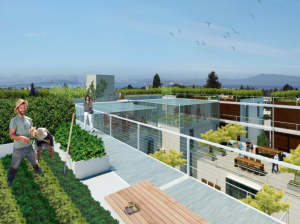
City zoning board members approved a 77-unit mixed-use housing development near downtown Berkeley late last week, expressing excitement about a “unique” design set to include more than a dozen working rooftop farm plots and a novel approach to parking.

“Garden Village,” at 2201 Dwight Way at Fulton Street, brings with it a number of innovative features, from its composition — it’s made up of 18 distinct but connected “volumes,” or towers, that range in height from 3 to 5 stories and are connected by open-air walkways; its more than 12,000 square feet of rooftop farming plots; and its small garage, which offers just enough space for a fleet of shared vehicles that will be rentable by tenants.

Without the car-sharing idea, the project would have required room for 71 vehicles. Instead, Berkeley-based developer Nautilus Group decided it would purchase a fleet of four to 10 automobiles and contract with a car-sharing operator called Getaround to run the “car-share pod” operation. (The city required Nautilus to pay for a parking demand study to bolster the justification for that approach.)

Zoning board Commissioner Shoshana O’Keefe described the concept as potentially “genius,” adding that the notion of projects that fold effective car-sharing programs into their plans “might be the magic solution” to the hairy issue of meeting parking demand efficiently in a densely-populated community.

[Read more…]