Revue de presse sur le thème “Habiter le Grand Paris”.
Learning from Chicago, Montréal, Paris
par BEATRICE JEROME, Le Monde.fr, 20 avril 2013
Christian de Portzamparc le dit sans colère. “Le Grand Paris ne peut pas se résumer à un projet de grand métro enterré. Il faut inventer un projet intelligent en surface.” Jean Nouvel est plus amer : “Sarkozy s’est laissé enfermer dans le grand métro de Christian Blanc [ex-secrétaire d’Etat au Grand Paris] qui s’est livré à un sabotage évident du travail des architectes.” L’urbaniste Michel Cantal-Dupart l’affirme sans détour : “Les architectes sont les cocus du Grand Paris.” “Il y avait un rêve formidable. Il a disparu”, lâche, dépité, Roland Castro.
Les grands noms de l’architecture française ne cachaient pas leurs désillusions, vendredi 19 avril, dans les couloirs du Palais de Tokyo, dans le 16e arrondissement. Quatre ans après la “consultation internationale” lancée à la demande de Nicolas Sarkozy sur le Grand Paris, à laquelle ils avaient pour la plupart participé, ils ont pourtant accepté de remettre leur ouvrage sur le métier. A la demande de l’Atelier international du grand Paris (AIGP), ils ont présenté leurs idées pour “habiter le grand Paris”. Quinze agences d’architectes ont rendu publiques leurs solutions pour produire 70 000 logements par an soit un doublement de l’effort actuel, en Ile-de-France.
L’arrière-pays francilien sera le laboratoire du Grand Paris : la plupart des architectes en sont convaincus. Si l’architecte hollandais Winy Maas propose de surélever les toits des immeubles hausmanniens parisiens ; si Roland Castro reste un ardent militant de la la requalification des quartiers sensibles de banlieue ; ou si Richard Rogers et Elisabeth de Portzamparc promeuvent chacun les gratte-ciels comme antidote à l’étalement urbain, la majorité des architectes s’aventure sur un autre terrain : la Grande Couronne et le péri-urbain sont les territoires d’avenir, disent-ils, pour inventer un nouveau modèle de métropole.
par NATHALIE MOUTARDE, lemoniteur.fr, 12 avril 2013
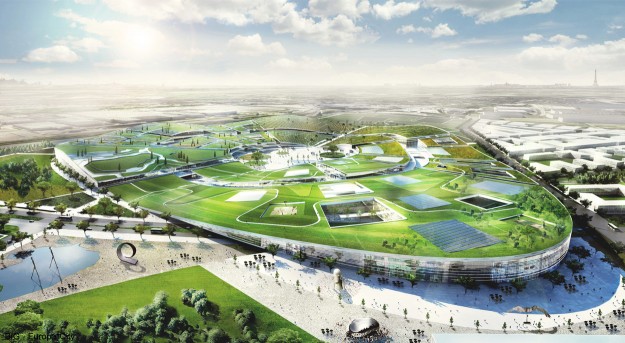
Europa City
Image: BIG
Source: www.lemoniteur.com
L’agence danoise d’architecture Bjarke Ingels Group (BIG) élaborera le master plan du projet Europa City. Ce complexe de près de 700 000 m2, implanté au cœur du Triangle de Gonesse (Val d’Oise), à proximité de l’aéroport de Roissy, regroupera commerces, hôtels, équipements culturels et de loisirs. Les premiers travaux pourraient démarrer en 2017.
Immochan, filiale immobilière du groupe Auchan, a retenu l’agence danoise d’architecture Bjarke Ingels Group (BIG) pour la réalisation du futur complexe commercial et de loisirs, Europa City, sur le Triangle de Gonesse (Val d’Oise), entre Paris et l’aéroport de Roissy. Ce choix a été entériné, le 12 avril, par un comité de pilotage co-présidé par le préfet de la région Ile-de-France, Jean Daubigny et le député-maire de Gonesse, Jean-Pierre Blazy. Il fait suite à une consultation internationale lancée en avril 2011 à laquelle ont également participé Manuelle Gautrand, Valode & Pistre et l’équipe norvégienne Snohetta (voir leurs propositions en images). « La force du projet de BIG est de concevoir Europa City comme un quartier de ville vivant, accessible, alliant centralité urbaine et paysage et offrant des espaces ouverts à tous de qualité. Nous avons aussi été séduits par la forme très douce du projet et sa grande modularité », déclare Christophe Dalstein, directeur d’Europa City.
by BRYN NELSON, The New York Times, April 2, 2013
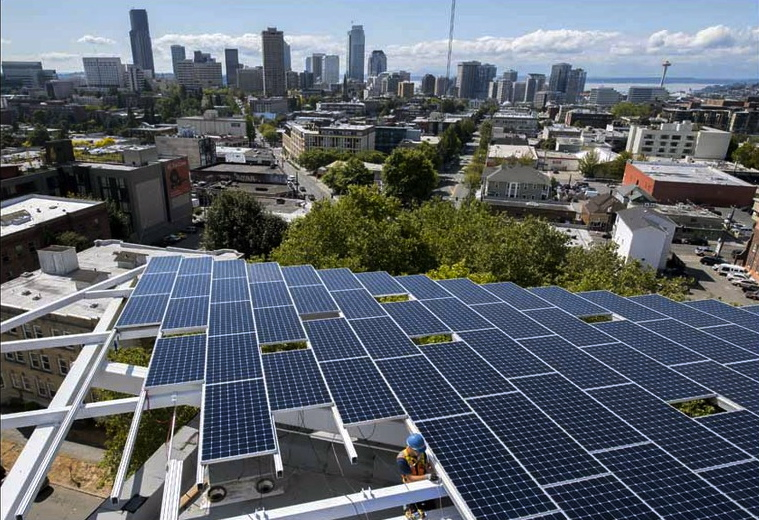
Solar roof under construction
Photo: John Stamets
Source: www.bullitcenter.org
SEATTLE — When an office building here that bills itself as the world’s greenest officially opens later this month, it will present itself as a “living building zoo,” with docents leading tours and smartphone-wielding tourists able to scan bar codes to learn about the artfully exposed mechanical and electrical systems.
Tenants have already begun moving into the six-story Bullitt Center, in advance of its grand opening on Earth Day, April 22. With the final touches nearly complete on the 50,000-square-foot office building at 1501 East Madison Street, at the edge of the city’s Capitol Hill neighborhood, its occupants are about to embark upon an unparalleled — and very public — experiment in sustainability.
Once settled in, they will be guinea pigs in a $30 million living laboratory distinguished by its composting toilets, strict energy and water budgets and a conspicuous lack of on-site parking. To earn its environmental bragging rights, the Bullitt Center must complete a rigorous one-year certification process called the Living Building Challenge, which requires both water and energy self-sufficiency, among a list of 20 demands.
Provided that the building clears a few remaining regulatory hurdles, all its water will be supplied by rainwater collected in a 56,000-gallon cistern before being filtered and disinfected. A rooftop array of photovoltaic panels, extending beyond the building like the brim of a graduation mortarboard, will produce an estimated 230,000 kilowatt-hours a year, hopefully just enough to break even for a building that is 83 percent more efficient than the city’s typical commercial site. […]
From Bullitt Center website:
by PAUL GOLDBERGER, Vanity Fair, February 22, 2013
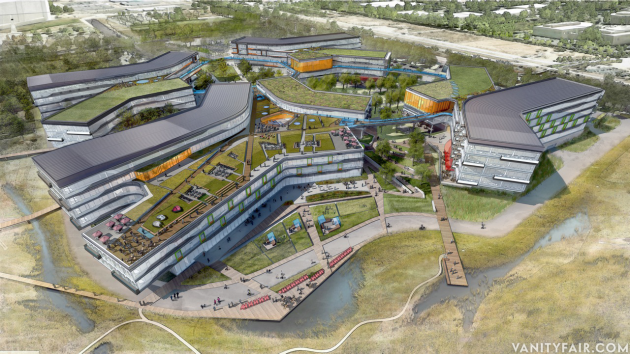
New “Googleplex” headquarters
Image: NBBJ
Source: www.vanityfair.com
Google occupies some of the most famous offices in the world—think cafés everywhere you look, treadmills with laptops attached to them, pool tables and bowling alleys, green buildings, and vegetable gardens—but not one of the places in which the company’s 35,000+ employees work has been built by the company. The core of the “Googleplex,” as the headquarters in Mountain View, California, is generally known, consists of a suburban office park once occupied by Silicon Graphics that Google remodeled to suit its needs; in New York, Google occupies (and owns) the enormous former Port Authority headquarters in Chelsea. The company has been similarly opportunistic around the world, taking over existing real estate and, well, Google-izing it. “We’ve been the world’s best hermit crabs: we’ve found other people’s shells, and we’ve improved them,” David Radcliffe, a civil engineer who oversees the company’s real estate, said to me. Under Radcliffe, the company’s home base in Mountain View has expanded to roughly 65 buildings.
For the last year or two, Google has been toying with taking the plunge and building something from scratch. In 2011 it went so far as to hire the German architect Christophe Ingenhoven to design a brand new, super-green structure on a site next to the Googleplex, but that was a false start: the company abandoned the project a year later, when it decided to build in another part of Mountain View, closer to San Francisco Bay, and went looking for another architect. Now Google has partnered with the Seattle-based firm NBBJ, a somewhat more conventional choice. And the renderings of the new project, which Google has made available to Vanity Fair, show something that looks, at first glance, like an updated version of one of the many suburban office parks that Google has made a practice of taking over and re-doing for its own needs.
by JOSEPH BERGER, The New York Times, April 3, 2013

Delroy Sampson breeds his own birds
Photo: Todd Heisler for The new York Times
Source: www.nytimes.com
When New Yorkers consider the subculture of people who raise pigeons on rooftops, many are likely to think of Terry Malloy, the longshoreman in the 1954 film “On the Waterfront” played by Marlon Brando. He was a classic rooftop breeder, rough-hewed, working-class and white ethnic to his toes.
But that image has long needed some alteration because in the dwindling world of rooftop fliers, as they are known, the men are as likely to be working-class blacks or Hispanics. Many were introduced to the hobby by Irish, Italian and other fliers of European descent, an unlikely camaraderie that evolved in neighborhoods like Bushwick, Canarsie and Ozone Park that were undergoing gradual racial shifts.
Ike Jones, an African-American who manages one of the last pigeon supply stores for its Italian-Jewish owner, Joey Scott, said he learned much of the craft when he was about 12. He then became a helper to George Coppola, an Italian rooftop breeder in Bedford-Stuyvesant.
“I was amazed at his coop,” said Mr. Jones, now 65. “He had electricity and running water, and I only had a box made of scrap wood. On Sunday his wife would cook spaghetti and meatballs and I would eat with them because I was always there.”
A new book, “The Global Pigeon,” by Colin Jerolmack, an assistant professor of sociology at New York University who spent three years hanging out with pigeon fliers, makes the point that pigeon breeding brought Italian-Americans and other ethnic whites “into contact with people of a different ethnic and age cohort with whom they were not voluntarily associating before.” […]
The Global Pigeon, by Colin Jerolmack