Learning from Chicago, Montréal, Paris

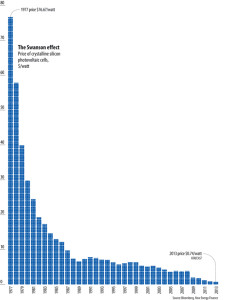
Cost of solar panels — 10 charts tell you everything

from Cost of Solar

Price of solar power Data source: Bloomberg New Energy Finance (BNEF) Source: www.costofsolar.com

Price of solar power
Data source: Bloomberg New Energy Finance (BNEF)
Source: www.costofsolar.com

1. The average cost of solar panels has gone from $76.67/watt in 1977 to just $0.698/watt today (the second figure is according to PVinsights, and is even lower than the 2013 projected price in the chart below).

Well, that basically tells you everything you need to know right there — the cost of solar panels today is about 100 times lower than the cost of solar panels in 1977 (even more than 100 times lower!) — but I promised 10 charts, so let’s dig in even further and throw on some other fun charts and graphs. […]
Read the full story


Catching sunlight, to sell it

by TESSA CHEEK, The Colorado Independent, December 16, 2013

Photo: Tessa Cheek Source: www.coloradoindependent.com

Photo: Tessa Cheek
Source: www.coloradoindependent.com

Xcel seeks to charge solar panel owners for using the grid, wants more homeowners to buy solar power from Xcel

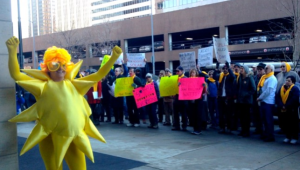
DENVER — More than 200 protesters gathered in downtown Skyline Park last Wednesday to amp up, march to Xcel Energy headquarters and deliver a petition signed by 30,000 Coloradans in favor of rooftop solar. The energy company recently announced it wants to charge Coloradans with rooftop solar for using the Xcel infrastructure grid — even if they’re using it mainly to provide power to other Xcel customers.

It’s not only solar-panel owners that oppose this idea, said Annie Lappe of the Vote Solar Initiative. “Four out of five Coloradans believe ratepayers with solar should get a fair credit for the energy they put back into the system. That means those same Coloradans also oppose Xcel’s proposed changes.”

The issue of how much solar owners are paid for the energy their homes kick back to the grid came to a head when Xcel submitted its 2014 green energy compliance plan to the Colorado Public Utilities Commission (CPUC). The plan proposed changes to so-called net metering. The proposal would draw credits from a fund specifically for green energy encouragement and it would ask future solar-installers to pay for their occasional use of the private grid Xcel owns and operates.

“It’s not a question of whether we incentivize rooftop solar, but how we do it,” said Ethnie Treick, manager of Policy Analysis at Xcel. “How do we provide solar energy to the most people?”

[Read more…]

Renewable energy support schemes now present in 127 countries, report finds

by IAN CLOVER, PV Magazine, 28 August, 2013

The Worldwatch Institute — an independent research organization based in Washington D.C. — reports that 127 countries worldwide have now enacted support schemes for renewable energy.

A trends report by the Worldwatch Institute has found that 127 countries worldwide now have renewable energy support schemes in place – up from just 48 as recently as mid-2005.

The report’s author, Evan Musolino, drew the analysis for his “Vital Signs Online” trend from data gleaned from “REN21’s Renewables 2013 Global Status Report”, which he co-authored.

In this latest work, Musolino also reports that 99 feed-in tariff (FIT) policies are currently in place worldwide at either national or state/provincial level, while quotas requiring a specified minimum share of renewable energy power production are evident in 76 countries; up from just 34 in 2004.

Despite the economic downturn leaving a number of countries mired in recession and hamstrung by shrinking budgets, investment in renewable energy development and expansion has generally followed an upward trend, particularly in the solar photovoltaics industry, which has seen module costs fall by as much as 80% since 2008, and 20% since 2012.

At the beginning of this year, 66 countries offered tax incentives on renewable energy development, the report finds. And as the technology has proliferated, so has regional diversity.

In the middle of the decade, 58% of countries that enacted renewable energy support schemes were located in Europe and Central Asia. Today, that figure is slightly more than a third of the global total, with East Asia and the Pacific (21%), and Latin America and the Caribbean (LAC) following closely.

[Read more…]

U.S. online startup makes going solar as easy as booking travel

by NICHOLA GROOM, Reuters, December 2, 2013

In a first on Monday, an online marketplace will allow U.S. homeowners to weigh options for going solar as easily as they can compare prices for airline tickets.

Geostellar, a startup backed by power producer NRG Energy Inc, is seeking to become the Expedia or Orbitz of the solar industry — a one-stop shop where consumers can not only compare the benefits of leasing solar panels versus buying them outright, but ultimately sign up to install a system.

Solar players including NRG, No. 1 U.S. installer SolarCity Corp, Boston-based solar loan provider Admirals Bank, manufacturer and financier Conergy, East Coast installer Roof Diagnostics and Connecticut’s Clean Energy Finance and Investment Authority will feature their products on the site, www.geostellar.com.

Geostellar hopes its platform will allow installers and financiers to lower the cost of acquiring new customers — a major goal in the fiercely competitive rooftop solar industry. Solar companies are laser focused on slashing costs so that they can deliver on their promise to save customers money on power bills by going solar.

Geostellar will make money by claiming a portion of a system’s total installed price – between 10 and 20 percent, Chief Executive David Levine said.

Geostellar, which was founded in 2010, got its start by selling data to solar companies that showed the solar energy potential of individual rooftops. Its early customers included solar financing companies SunRun, Sungevity and others, according to Levine.

[Read more…]

Farmer proves potential of rooftop planting

by Zhu Ningzhu (editor), English, news.cn, November 20, 2013

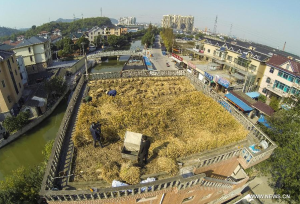
Farmers help villager Peng Qiugen harvest rice on the roof of Peng's house which had been converted into a rice field at Qilin Village of Shaoxing CitySource: www.news.cn

Farmers help villager Peng Qiugen harvest rice on the roof of Peng’s house which had been converted into a rice field at Qilin Village of Shaoxing City
Source: www.news.cn

Hangzhou (Xinhua) — In Chinese language, most farmers go “down” to the field to harvest crops, but one farmer from an eastern village in China goes “up” to the roof to reap rice.

Peng Qiugen, a “landless” farmer who transferred his land to a gardening company seven years ago, just harvested over 100 kg of rough rice on his 120-square-meter rooftop this week.

“My greatest wish is to save more land for China by promoting rooftop farming to more households,” Peng told Xinhua.

He calculated that a roof as large as his, if used for growing vegetables, can meet the daily demands of 20 people.

In Peng’s village, Qilin in east China’s Zhejiang Province, most farmers have circulated their land to scale planting individuals and companies in exchange for a steady income and an opportunity to try out other jobs that would presumably bring more economic gains.

Some have become factory workers, others have started businesses. For Peng, he has tried both and more, saying, “I accept any jobs within my ability that can improve the living conditions for my family.”

A wealthier material life, however, has never changed his passion for land and farming.

When he started to build his four-story house in 2006, he thought about transforming the roof into a piece of arable land.

[Read more…]

Elevated park at trade center site comes into view

by DAVID W. DUNLAP, The New York Times, November 20, 2013

A rendering of the new St. Nicholas Greek Orthodox Church, with conceptual images of a landscaped open space known as Liberty Park Image: Santiago Calatrava Source: www.nytimes.com

A rendering of the new St. Nicholas Greek Orthodox Church, with conceptual images of a landscaped open space known as Liberty Park
Image: Santiago Calatrava
Source: www.nytimes.com

The World Trade Center’s best-kept secret has finally come to light.

It is an elevated park, slightly larger than an acre and 25 feet above Liberty Street, that will command a panoramic view of the National September 11 Memorial when it opens to the public, probably in 2015.

Liberty Park, as it is called, is meant to offer a pleasant and accessible east-west crossing between the financial district and Battery Park City; to create a landscaped forecourt for the new St. Nicholas Greek Orthodox Church; to provide a gathering space for as many as 750 people at a time; to allow visitors to contemplate the whole memorial in a single sweeping glance from treetop level; and to serve as the roof of the trade center’s vehicle security center.

For the moment, the park is an empty concrete expanse. The pedestrian bridge over West Street that will connect it to Battery Park City — the bridge that survived the Sept. 11 attack — currently falls several yards short of its future landing spot.

While the general outlines of the park have been known for years, the Port Authority of New York and New Jersey has been sparing in its public discussion of the project, in part because not every detail of its design and construction has been settled.

But the Port Authority’s hand was forced somewhat last month when sumptuous images of St. Nicholas Church and Liberty Park appeared on the website of the architect Santiago Calatrava, who is designing the church. The park was rendered in sufficient detail that it was possible for the first time to understand its basic design. […]

Read the full story

Related articles :
Church Near Trade Center to Echo Landmarks of East
First Look: Santiago Calatrava’s Design for St. Nicholas Church