From the Blog

Living small Is the best revenge

by ROBIN FINN, The New York Times, February 28, 2013
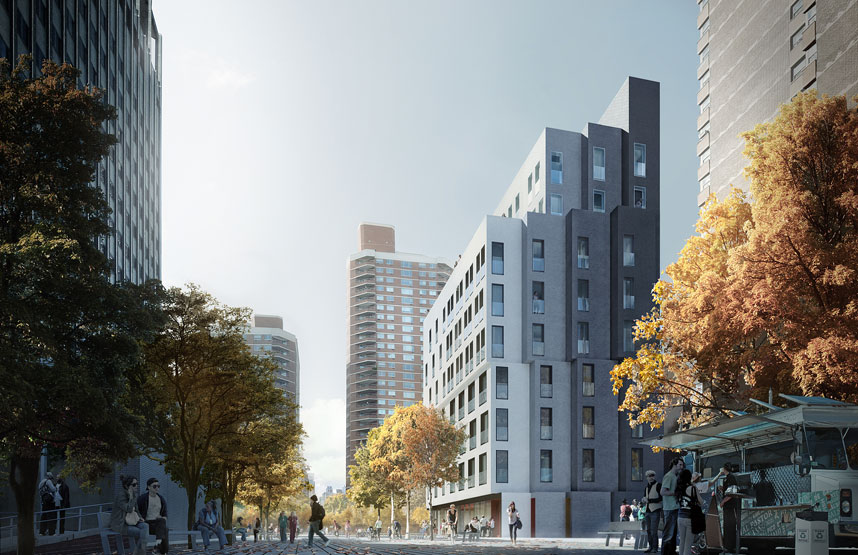
Looking West Source: nArchitecte.com

Looking West
Source: nArchitecte.com

Despite less-than-rhapsodic memories of miniaturized apartment living, the married architects Mimi Hoang and Eric Bunge designed the winner of the adAPT micro-unit competition sponsored by the New York City Housing and Preservation Department and endorsed by Mayor Michael R. Bloomberg.

Their entry, “My Micro NY,” features 55 prefabricated apartments, of 360 square feet or less, stacked in a 10-story building on East 27th Street in Kips Bay. The building does not stint on amenities, providing a common terrace, a laundry room and a bike room.

The couple’s firm, nArchitects, is based in a Dumbo loft, and they live in a Carroll Gardens town house, but for the competition they drew on their cohabitation in a tenement in Lower Manhattan.

The mission was to seize an opportunity to render a tight space habitable and, if possible, aesthetically pleasing.

“At first blush we weren’t so sure about entering,” Mr. Bunge said, “because we felt people should have more space than this. But that was before we understood that the alternatives out there are far worse. There are people living together in substandard apartments all over the city who would prefer to live alone but can’t afford to. So we said, ‘Wait a minute, let’s make a humane small space where people would want to live.’”

“This is a pilot program, and it doesn’t mean micro-units are going to be sprouting everywhere,” Ms. Hoang said. “But it’s incredibly exciting to be part of a progressive new residential prototype for New York that has social implications and is intended to help solve a social problem.
Read the article…

adAPT NYC Competition, winner announcement

[Read more…]

Solar panels rare amid the steeples

by KATE GALBRAITH, The International Herald Tribune (The New York Times), March 7, 2013

AUSTIN, TEXAS — More than three decades ago, after an energy crisis that gripped the world, a Catholic priest in the Texas city of Lubbock took a stand for the environment. His congregation needed a new church. So the priest, the Rev. Joe James, anchored the building deep in the earth to optimize insulation. He also ordered five wind turbines for the church grounds. The largest was called Big Bird, because it stood 80 feet tall.

“I don’t feel as though we are free to waste,” Father James told a videographer at the time. Staring earnestly into the camera, he argued that saving money was not the only reason for energy conservation.

Father James, who still lives near Lubbock, was an outlier. In the intervening years, few churches have made energy saving a priority. Experts say that churches, like other houses of worship, face particular challenges in going green because of unusual architecture and an often slow decision-making culture. Even Father James’s wind turbines got dismantled in the 1990s, after he had moved on.

Still, as the likely effects of climate change on people and nature become clearer, some religious leaders are increasing their engagement. Pope Benedict XVI, who stepped down last week, has been hailed as the “green pope.” He put solar panels on the roof of a Vatican auditorium, though they are out of sight of the general public. Last year, he also acquired an electric car to get around the grounds of his summer residence. Environmentalists will be eager to see whether the next pope makes green issues a priority.

The Church of England has a goal of reducing its carbon footprint 42 percent by 2020 and 80 percent by 2050.

Read the article… 

TEDx Adelaide: Steffen Lehmann – Cities of the future

by TEDxTalks, November 22, 2011

“Today’s problems cannot be solved if we still think the way we thought when we created them.” — Albert Einstein.

Steffen Lehmann presented innovative and bold ideas that could transform our energy-hungry cities to greener urban centres. He argues that we need better models for rapid urbanisation, which include innovative housing typologies for inner-city living and re-engineering of outdated construction methods, including adaptive re-use of existing buildings, by using lightweight low carbon construction systems.

For over 20 years, Steffen Lehmann has been at the forefront of innovative sustainable architecture and urbanism. He is director of the Research Centre for Sustainable Design & Behaviour (sd+b) at the University of South Australia; and he holds the UNESCO Chair for Sustainable Urban Development for Asia and the Pacific (since 2008).

In the spirit of ideas worth spreading, TEDx is a program of local, self-organized events that bring people together to share a TED-like experience. At a TEDx event, TEDTalks video and live speakers combine to spark deep discussion and connection in a small group. These local, self-organized events are branded TEDx, where x = independently organized TED event. The TED Conference provides general guidance for the TEDx program, but individual TEDx events are self-organized.* (*Subject to certain rules and regulations).

Les grandes villes du monde: Chicago

par Maude Cournoyer-Gendron, Villes Régions Monde, février 2013

1. Introduction

Depuis les dernières années, différentes firmes privées ou organismes internationaux ont mis en place des palmarès afin de classer les villes du monde (consulter la capsule introductive pour plus de détails sur les palmarès et la méthodologie menant aux choix des villes retenues). L’objectif poursuivi dans cette série de capsules est d’explorer les réalités historiques, géographiques, économiques, sociales et urbaines de différentes grandes villes du monde qui se retrouvent dans les grands palmarès de ville. La notion de ville mondiale sous-entend à la fois une grande relation avec les autres villes du globe, avec un rôle de point de relai dans l’économie mondiale, mais aussi une importance sur différents plans soit économique, culturel ou politique (Braudel 1979; Friedmann 1986; Dolfus 1996; Sassen 2001).

Cet intérêt pour les villes mondiales dépasse la sphère académique. Depuis les dernières années, plusieurs grandes firmes font à leur tour un exercice de hiérarchisation des villes du monde en publiant différents palmarès. Dans le cadre de ces capsules, la ville de Chicago a été sélectionnée puisque, bien qu’elle ne soit pas une des plus grandes villes en termes de population, elle a une place dans différents palmarès, en plus d’être la troisième ville en importance aux États-Unis, avec Los Angeles et New York.

Pour faire état de cette grande ville du monde, Chicago est d’abord parmi les autres villes mondiales à l’aide des six palmarès retenus pour cette série de capsules. Un survol des données factuelles de la ville est ensuite fait, combiné à une description sommaire de son histoire, de sa géographie, et de son économie. Les principaux enjeux urbains qui prennent forme dans la ville sont par la suite identifiés, et finalement une revue de la littérature récente, portant spécifiquement sur la ville ou la région, est faite. Cette capsule, comme l’ensemble de celles qui font partie de cette série, veut être un document introductif, dressant des pistes de recherche pour qui voudra entreprendre une étude plus approfondie. Les matériaux et analyses dont il est fait mention sont le résultat d’une recherche documentaire sur internet, combinée à une recherche d’articles scientifiques et de monographies sur les principales bases de données.

Lire la suite…

Version PDF

Des logements attrapent la lumière pour tendre vers l’énergie positive

par MILENA CHESSA et ERIC LEYSENS, lemoniteur.fr, 26 février 2013

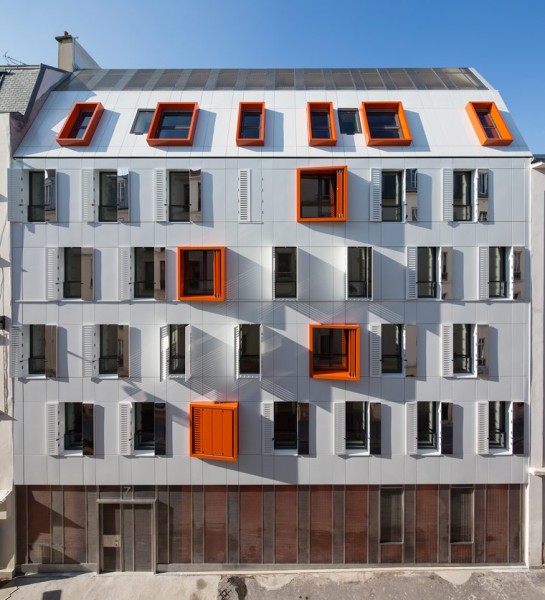
Façade est sur rue. Photo: Luc Boegly Source: www.lemoniteur.fr

Façade est sur rue.
Photo: Luc Boegly
Source: www.lemoniteur.fr

La Régie immobilière de la Ville de Paris (RIVP) a inauguré le 25 février une opération de 17 logements sociaux dans le 11e arrondissement. Panneaux photovoltaïques, miroirs réflecteurs et puits de lumière, les solutions techniques mises en œuvre par l’agence d’architecture Baudouin Bergeron permettent d’estampiller le bâtiment Bepos.

Livré vendredi 22 février, habité samedi 23, inauguré lundi 25. Le bâtiment situé au 7, rue Guénot à Paris (11e) était très attendu. D’autant qu’il avait attiré l’attention dès sa conception en 2009, en s’annonçant comme le premier immeuble de logement social à énergie positive de la capitale (voir notre article). L’objectif affiché par le maître d’ouvrage, la RIVP, était de « démontrer la faisabilité technique et économique d’un [tel] bâtiment dans le tissu urbain parisien ». « Cette demande inhabituelle nous a poussé dans nos retranchements, explique l’architecte Hélène Bergeron, associée à Laurence Baudouin. Nous avons travaillé avec le bureau d’étude thermique Pouget Consultants dès les esquisses pour que l’immeuble consomme peu et évite les systèmes trop technologiques, trop compliqués, nécessitant trop d’entretien. Ici, pas de ventilation double-flux, les habitants sont libres d’ouvrir la fenêtre s’ils ont chaud et de la refermer s’ils ont froid. »

Produire sur le toit autant que l’énergie consommée dessous

Le maître d’ouvrage et le maître d’œuvre parlent de bâtiment à énergie positive car, dans les simulations, les 33 kWh d’énergie primaire/m².an produits par les 127 m² de panneaux photovoltaïques installés en toiture dépassent la consommation des cinq postes pris en compte par la réglementation thermique – chauffage, ECS, éclairage, ventilation et auxiliaires – qui s’élève à 32 kWhep/m².an. « Il était nécessaire de produire sur le toit autant que l’énergie consommée sous le toit », rappellent les architectes.

Mais ce bâtiment peut-il prétendre au label Bepos qui impose que les consommations électrodomestiques (téléviseurs, ordinateurs,…) figurent dans le bilan énergétique ? Pour cet immeuble situé en centre urbain dense et s’élevant sur six niveaux, l’exigence imposée par le nouveau label est que la consommation non renouvelable – électrodomestique inclus – ne dépasse pas de plus 70 kWhep/m².an la production électrique photovoltaïque (pour comprendre le détail du calcul, voir notre article). Le bilan énergétique du bâtiment coïncidant bien avec cet écart à l’énergie positive, il pourra être estampillé Bepos.

Les occupants devront normalement assumer des charges de chauffage (air et eau) trois fois inférieures à celles qu’ils auraient dû payer dans un bâtiment RT 2005. Pierre Aidenbaum, président de la Régie immobilière de la Ville de Paris, espère que cet immeuble de 17 logements sociaux aujourd’hui réalisé devienne une « référence » et un « exemple pour le secteur privé ».

FOCUS
Fiche technique

Maîtrise d’ouvrage : Régie immobilière de la Ville de Paris (RIVP).

Maîtrise d’œuvre : Baudouin Bergeron architectes, architectes. Pouget Consultants, BET thermique ; LGX Ingénierie, BET TCE et économie.

Entreprise générale : Francilia.

Entreprises sous-traitantes : Snipca (plomberie et chauffage), CTP (peinture), Vibig (cloisons doublages), Batei (étanchéité), Da Silva frères (isolation thermique extérieure), Vertikal (volets et stores), RMJ (installation de production photovoltaïque), Samson (serrurerie), Batex (bardages métalliques), Ducloux (murs à ossature bois et charpente), Coralec (électricité, hors photovoltaïque), Oleolift (appareils élévateurs).

Surfaces : 1453 m2 Shon, 1765 m2 Shob, 1033 m2 Shab.

Coût des travaux : 3,1 millions d’euros HT.

Lire l’article original

In the book bag, more garden tools

by LISA W. FODERARO, The New York Times, November 23, 2012

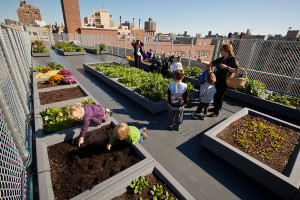
Children at the 2,400-square-foot Fifth Street Farm, a garden atop three East Village schools Photo: Ángel Franco Source: The New York Times

Children at the 2,400-square-foot Fifth Street Farm, a garden atop three East Village schools
Photo: Ángel Franco for The New York Times
Source: The New York Times

In the East Village, children planted garlic bulbs and harvested Swiss chard before Thanksgiving. On the other side of town, in Greenwich Village, they learned about storm water runoff, solar energy and wind turbines. And in Queens, students and teachers cultivated flowers that attract butterflies and pollinators.

Across New York City, gardens and miniature farms — whether on rooftops or at ground level — are joining smart boards and digital darkrooms as must-have teaching tools. They are being used in subjects as varied as science, art, mathematics and social studies. In the past two years, the number of school-based gardens registered with the city jumped to 232, from 40, according to GreenThumb, a division of the parks department that provides schools with technical support.

But few of them come with the credential of the 2,400-square-foot garden at Avenue B and Fifth Street in the East Village, on top of a red-brick building that houses three public schools: the Earth School, Public School 64 and Tompkins Square Middle School. Michael Arad, the architect who designed the National September 11 Memorial in Lower Manhattan, was a driving force behind the garden, called the Fifth Street Farm.

The idea took shape four years ago among parents and teachers, when Mr. Arad’s son was still a student at the Earth School. The family has since moved from the neighborhood to Queens, but Mr. Arad, president of a nonprofit corporation that oversaw the garden, stayed on. The farm, with dozens of plants ranging from leeks to lemon balm, opened Oct. 19. Already, students have learned about bulbs and tubers, soil science and nutrition, while the cafeteria has cooked up fresh kale and spinach for lunch.

Read the article…