From the Blog

Reducing your carbon footprint

by SUSAN STELLIN, The  New York Times, February 15, 2013

Many people believe that Hurricane Sandy made the consequences of climate change painfully clear, so it might be tempting to think that stricter emissions standards and renewable-energy investments could lead to a less stormy future. But while these high-level policy initiatives are important, changes on the home front matter, too.

“Residential housing accounts for 29 percent of all the energy used in New York State,” said Frank Murray Jr., the president and chief executive of the New York State Energy Research and Development Authority, which goes by the acronym Nyserda. That includes a lot of home printers with their power on 24/7 and lights illuminating empty rooms.

If the virtue of reducing your carbon footprint is not enough of an incentive, the United States Department of Energy estimates that the typical American family spends about $2,000 a year on utility bills. Changing some energy habits might not drastically reduce your total bill, but even small savings add up over the years — and your home would be less of a drain on the grid.

Turn Down, Screw In, Unplug

Many energy-saving strategies are free or inexpensive, and technology makes it easier to follow through on advice most people have heard, but don’t always heed. ‘Smart’ power strips, for example, automatically shut down power to electronics that aren’t in use — like your printer or DVD player — but also have outlets marked “always on” for devices that need continuous power, like a DVR. Other advanced power strips come with a remote control, so you can switch them off without crawling around on the floor. A quick scan of your home is likely to reveal appliances that can be unplugged, like a window air-conditioner in the winter or a gaming console the kids no longer use. […]
Read the original story

Nyserda’s Recommandations

Nyserda’s “bulbology” page

The great air race

by ROBIN FINN, The New York Times, February 22, 2013

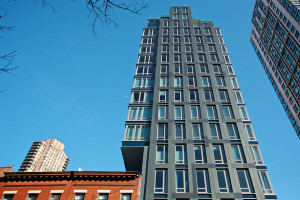
Air rights were pertinent to the development of Isis Condominium on East 77th Street Photo: Benjamin Norman Source: New York Times

Air rights were pertinent to the development of Isis Condominium on East 77th Street
Photo: Benjamin Norman for The New York Times
Source: The New York Times

Because a room with a view has always been preferable to one without, the price of air in New York City is becoming more expensive. Yes, the air is for sale, but not on sale.

And not the dodgy urban air the city’s eight million inhabitants breathe as they scurry around the boulevards, but the rarefied and fast-disappearing air overhead where condominium towers do not fear to tread, and rooms with sunlit windows can make the lucrative difference between a legal three-bedroom residence and a mere two-bedroom with a den/office.

With Manhattan’s skyscraper-proof bedrock in finite supply and the city’s fixation on housing and envelope-pushing office buildings on the upswing — and also the impetus behind the proposed rezoning of 70 blocks around Grand Central Terminal called Midtown East — the sky is not only the limit, it’s the solution. Ubiquitous developers-about-town like Gary Barnett, Harry B. Macklowe and the Zeckendorf brothers are all not-so-secret members of the air appreciation society.

“When I tell people outside of New York that I’m buying air from other building owners, they look at me as if I’ve lost my mind,” said Kenneth S. Horn, the president of Alchemy Properties. His 18-story Isis Condominium at 303 East 77th Street acquired air rights from two adjacent tenements; it cantilevers eight feet above the roofs of both of them beginning at the sixth floor. The payoff for this complex and expensive undertaking is 360-degree views, more spacious apartments, abundant light and higher resale value. […]

Read the original story

Ville-Marie: ménage dans les règles d’urbanisme

par MAXIME BERGERON, La Presse, 5 février 2013

L’arrondissement de Ville-Marie gèle en partie l’attribution des permis de construction jusqu’à la fin du mois de mars, le temps de finir le ménage dans ses règles d’urbanisme kafkaïennes.

Le conseil de cet arrondissement, qui englobe le centre-ville et le Vieux-Montréal, a adopté hier en première lecture un projet omnibus modifiant plus de 600 articles du règlement d’urbanisme. Les changements touchent une foule de sujets, du zonage à la hauteur des immeubles, en passant par l’agriculture urbaine.

Toutes les nouvelles toitures devront être écologiques. Il pourra notamment s’agir de toits «blancs» ou végétaux.

«Le règlement actuel existe depuis 20 ans et il avait clairement besoin d’être modernisé», a résumé à La Presse Affaires Bruno Collin, chef d’équipe à la division d’urbanisme, après la tenue du conseil.

Selon les règles actuelles, il existe quatre familles d’utilisation du territoire: résidentielle, commerciale, industrielle et institutionnelle. Celles-ci sont divisées en 53 catégories, qui sont ensuite subdivisées en 118 types de zones. C’est autant que dans les cinq arrondissements de New York réunis, et ce, pour le seul arrondissement de Ville-Marie!

«En plus d’être très rigide, cette approche complexifie énormément le règlement et le rend pratiquement incompréhensible pour les usagers, souligne un sommaire décisionnel publié hier. Par exemple, le propriétaire d’un bâtiment situé au coin des rues Wellington et Prince doit se référer à six listes différentes uniquement pour identifier les usages permis sur sa propriété.»

La cartographie actuelle de Ville-Marie est si compliquée qu’on ne peut la lire à une échelle inférieure à 1: 5000. Il faut consulter la carte sur deux feuillets de 30 po sur 25 po au minimum, et les erreurs d’interprétation sont fréquentes.

Bruno Collin et son équipe ont travaillé pendant huit mois à simplifier cette structure d’organisation du territoire. Ils sont partis du principe de la mixité des usages, ce qui leur a permis de réduire de 118 à 27 les types de zones. La nouvelle carte de l’arrondissement est lisible sur une feuille de 11 po sur 17 po, se réjouit-on.

Le projet de règlement d’urbanisme sera soumis à une série de consultations et de présentations au cours des prochaines semaines. D’ici à son adoption finale, prévue le 25 mars, un gel partiel de l’attribution des permis de construction et d’occupation a été décrété.

L’arrondissement estime que de 10% à 20% des demandes de permis seront touchées par le gel.

En plus de simplifier la structure d’attribution des permis, le nouveau règlement d’urbanisme de l’arrondissement de Ville-Marie propose une trentaine de nouvelles dispositions. En voici cinq:

  • Les nouvelles constructions devront inclure davantage de stationnements pour vélos, et ceux-ci devront être facilement accessibles.
  • Toutes les nouvelles toitures devront être écologiques. Il pourra notamment s’agir de toits «blancs» ou végétaux.
  • L’implantation de jardins communautaires, de parcs et d’écoles sera permise partout sur le territoire de l’arrondissement.
  • L’insonorisation des nouvelles constructions résidentielles devra être accrue dans les zones bruyantes.
  • Des stationnements pour les petites voitures seront créés.

Article original

In organic-hungry Hong Kong, corn as high as an elevator’s climb

by MARY HUI, The New York Times, October 3, 2012

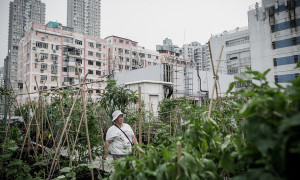
Plots like the rooftop City Farm are sprouting across Hong Kong amid fears of tainted imports Photo: Philippe Lopez (Agence France-Presse) Source: The New York Times

Plots like the rooftop City Farm are sprouting across Hong Kong amid fears of tainted imports
Photo: Philippe Lopez (Agence France-Presse)
Source: The New York Times

HONG KONG — Kimbo Chan knows all about the food scandals in China: the formaldehyde that is sometimes sprayed on Chinese cabbages, the melamine in the milk and the imitation soy sauce made from hair clippings. That is why he is growing vegetables on a rooftop high above the crowded streets of Hong Kong.

“Some mainland Chinese farms even buy industrial chemicals to use on their crops,” Mr. Chan said. “Chemicals not meant for agricultural uses at all.”

As millions of Hong Kong consumers grow increasingly worried about the purity and safety of the fruits, vegetables, meats and processed foods coming in from mainland China, more of them are striking out on their own by tending tiny plots on rooftops, on balconies and in far-flung, untouched corners of highly urbanized Hong Kong.

“Consumers are asking, will the food poison them?” said Jonathan Wong, a professor of biology and the director of the Hong Kong Organic Resource Center. “They worry about the quality of the food. There is a lack of confidence in the food supply in China.”

Organic food stores are opening across the city, and there is growing demand in the markets for organic produce despite its higher prices. There are about 100 certified organic farms in Hong Kong. Seven years ago, there were none.

There is no official count of rooftop farms in Hong Kong, but they are clearly part of an international trend. New York has many commercialized rooftop farms established by companies like Gotham Greens, Bright Farms and Brooklyn Grange. In Berlin, an industrial-size rooftop vegetable and fish farm is in the pipeline. In Tokyo, a farm called Pasona O2 takes urban farming a step further: Vegetables are grown not only on roofs, but also in what was an underground bank vault. […]

Read the original story

See also:


Manhattan’s rooftop bars: Heaven’s gates

by FRANK BRUNI, The New York Times, July 22, 2010

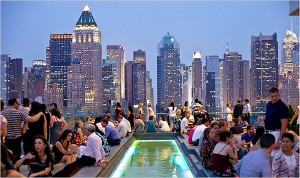
The scene at Press, the rooftop bar of the new Ink48 hotel Photo: Andrew Sullivan for The New York Times Source: The New York Times

The scene at Press, the rooftop bar of the new Ink48 hotel
Photo: Andrew Sullivan for The New York Times
Source: The New York Times

Shaken or stirred? Red or white? Draft or bottled? For most of the year these are the biggest questions confronting the thirsty New Yorker. And no answer is wrong.

But when the sun is strong and the days are long, an additional, equally important pair of options crops up, and the choice between them can make or break a good night.

Stay down or go up?

I speak of the rooftop bar, an institution with special relevance to New York City, where the roofs are higher, the views longer, the promise grander. In this vertical wonderland it seems only right to ascend.

But doing so is dicey, as recent skyward excursions reminded me. On a rooftop bar you indeed inch closer to heaven. But you can also wind up a whole lot closer to hell.

So a primer is in order: a set of instructions on what to hope for, what to brace for, and when, how, why and where a rooftop can be most pleasurable or insufferable. Icarus headed toward the sun in a heedless fashion — and more or less got burned. Don’t make the same mistake.

Know for starters that many of the city’s most vaunted rooftop bars don’t merely have velvet ropes, they have velvet barricades — sometimes in the form of oddly restrictive admission policies, sometimes in the form of random, inexplicable hours. […]

Read the original article

Video: Tipsy Diaries: Rooftop Remedies

Huge rooftop farm is set for Brooklyn

LISA W. FODERARO, The New York Times, April 5, 2012

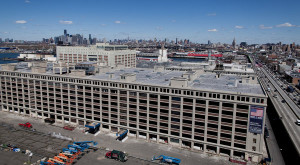
An old Navy warehouse in Sunset Park will be home to a hydroponic greenhouse of up to 100,000 square feet. The developer says it will be the largest such greenhouse in the country Photo: Eric Michael Johnson for The New York Times Source: The New York Times

An old Navy warehouse in Sunset Park will be home to a hydroponic greenhouse of up to 100,000 square feet. The developer says it will be the largest such greenhouse in the country
Photo: Eric Michael Johnson for The New York Times
Source: The New York Times

Brooklyn is fast becoming the borough of farms. On Thursday, Bright Farms, a private company that develops greenhouses, announced plans to create a sprawling greenhouse on a roof in Sunset Park that is expected to yield a million pounds of produce a year — without using any dirt.

The hydroponic greenhouse, at a former Navy warehouse that the city’s Economic Development Corporation acquired last year, will occupy up to 100,000 square feet of rooftop space. Construction is scheduled to start in the fall, with the first harvest expected next spring.

When finished, the greenhouse will rank as the largest rooftop farm in the United States — and possibly the world, Bright Farms officials say. This spring, Brooklyn Grange, another rooftop farm developer, is set to open a 45,000-square-foot commercial operation at the Brooklyn Navy Yard.

“Brooklyn was an agricultural powerhouse in the 19th century, and it has now become a local food scene second to none,” said Paul Lightfoot, the chief executive of Bright Farms. “We’re bringing a business model where food is grown and sold right in the community.”

Mr. Lightfoot said that the company was in talks with supermarket chains that would potentially commit to buying produce from the Sunset Park farm, which will include a variety of lettuces, tomatoes and herbs. “We’re looking for a long-term contract with one client who operates grocery stores,” he said.

Read the article…