From the Blog

Eskenazi Hospital prepares to open

by JOHN RUSSELL, The Indianapolis Star, November 16, 2013
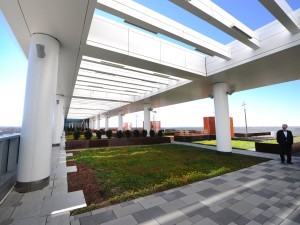
Sky Farm on the roof of the new Eskenazi Health Hospital.  Photo: Matt Kryger / The Star Source: www.indystar.com

Sky Farm on the roof of the new Eskenazi Health Hospital
Photo: Matt Kryger / The Star
Source: www.indystar.com

Rooftop vegetable garden, sculptures add unique touches to Wishard’s replacement

Indiana has never seen a hospital quite like this.

From the spiraling wooden sculpture suspended from the ceiling in the main concourse to the vegetable garden on the roof, the brand-new Eskenazi Hospital keeps you wondering what you will see around the next corner.

The $754 million hospital, which will serve mostly poor and underinsured patients, is nearly ready to open, after four years of planning and construction. The public can tour the hospital from 11 a.m. to 5 p.m. today.

The massive complex, spread out on 37 acres, will replace Wishard Hospital, a deteriorating hodgepodge of buildings, some a century old. On Dec. 7, an army of hospital workers will move patients from the old building to the new one a block away.

The new hospital is the latest addition to Indiana’s hospital construction boom over the last decade, a period in which more than $1 billion in new facilities sprouted up around Central Indiana, from specialty heart clinics to luxurious medical centers in the suburbs.

Each of Indiana’s dozens of hospitals seems to have a distinctive personality, from the luxurious Indiana University Health North Hospital in Carmel, with posh fireplace lounges and cherry wood bassinets, to the kid-friendly Riley Hospital for Children, with its signature red wagons and play rooms.

The feel at Eskenazi Hospital is bright and welcoming. Sunlight pours through windows in every patient room, waiting room and hallway. The public areas are filled with colorful art, from historical oil paintings to whimsical photographs of the city.

The goal, officials say, is to be comforting for people entering the doors for what is often a frightening, high-stress experience.

“We want this to be the most patient-friendly, family-friendly, simple-to-use hospital you can find,” said Matthew R. Gutwein, president and chief executive of Marion County Health and Hospital Corp., which operates the hospital.

[Read more…]

Rooftopping: Tom Ryaboi & Almost (I’ll make ya) Famous

by DEBS SLATER, 500px, April 24, 2012

Photo: Tom Ryaboi Source: www.500px.com

Photo: Tom Ryaboi
Source: www.500px.com

A year has passed since Tom Ryaboi clicked the shutter, captured a photo, and with it changed the course of his life. Here he is to tell us the story about the incredible response to one single shot.

One year ago today I took a photograph that would change my life. A single frame turned my whole world upside down, and brought on a storm of media attention, praise, criticism, confusion, wonder, and doubt. After one hell of a ride this past year, I think today is a good day to finally tell this photo’s story…

The birth of a movement?

I guess this all started in 2007, when photography became a full time obsession for me. That summer I returned from Europe where I learned to use my first DSLR (Canon Rebel XT), and leaving the house without a camera was just not an option anymore.

I was shooting some street just before sunset when I came across a construction site on a busy Toronto intersection. It didn’t seem like there were any workers around, but the gate was wide open. I thought I could get a cool vantage point to shoot the skyline so I just went for it, found the stairs and climbed to the very top.

The building wasn’t very high, perhaps 15 or 16 storeys, but when I got to the top and opened the door to the roof I got an instant rush of adrenaline, like I just opened the door to a secret world of wonder. The city was right in my face, like I’ve never seen it before; the sun was setting and all the lights were starting to turn on. The noise from the street was muted, the cars and people moved about in what seemed like slow motion, it was like a Eric Satie song. It was magical.

[Read more…]

A staff of robots can clean and install solar panels

by DIANE CARDWELL, The New York Times, October 14, 2013

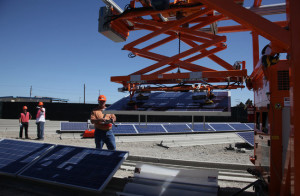
Rover, a robot, placing a solar panel in a track at Alion Energy, which is looking to shave labor costs. Photo: Jim Wilon (The New York Times) Source: www.nytimes.com

Rover, a robot, placing a solar panel in a track at Alion Energy, which is looking to shave labor costs.
Photo: Jim Wilon / The New York Times
Source: www.nytimes.com

RICHMOND, Calif. — In a dusty yard under a blistering August sun, Rover was hard at work, lifting 45-pound solar panels off a stack and installing them, one by one, into a concrete track. A few yards away, Rover’s companion, Spot, moved along a row of panels, washing away months of grit, then squeegeeing them dry.

But despite the heat and monotony — an alternative-energy version of lather-rinse-repeat — neither Rover nor Spot broke a sweat or uttered a complaint. They could have kept at it all day.

That is because they are robots, surprisingly low-tech machines that a start-up company called Alion Energy is betting can automate the installation and maintenance of large-scale solar farms.

Working in near secrecy until recently, the company, based in Richmond, Calif., is ready to use its machines in three projects in the next few months in California, Saudi Arabia and China. If all goes well, executives expect that they can help bring the price of solar electricity into line with that of natural gas by cutting the cost of building and maintaining large solar installations.

In recent years, the solar industry has wrung enormous costs from developing farms, largely through reducing the price of solar panels more than 70 percent since 2008. But with prices about as low as manufacturers say they can go, the industry is turning its attention to finding savings in other areas.

“We’ve been in this mode for the past decade in the industry of really just focusing on module costs because they used to be such a big portion of system costs,” said Arno Harris, chief executive of Recurrent Energy, a solar farm developer, and chairman of the board of the Solar Energy Industries Association. Now, Mr. Harris said, “Eliminating the physical plant costs is a major area of focus through eliminating materials and eliminating labor.” […]

Read the full story

Green roof fad comes to town

by HELEN YOUNG, The Australian, August, 18, 2012

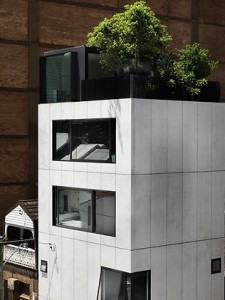
The Small House in Sydeny's Surry Hills. Photo: Trevor Mein Source: Supplied via The Australian

The Small House in Sydeny’s Surry Hills
Photo: Trevor Mein
Source: Supplied via The Australian

Imagine flying over a city where the rooftops below are living green, where plants and even vegetable gardens transform the lost spaces on top of buildings. It’s already happening around the world, and Australia is embracing the trend.

In Sydney’s Pyrmont, we’re standing on the rooftop of a heritage-listed building, surrounded by a vast garden sitting in the sky. M Central is an apartment block whose 2005 resurrection as a hip inner-city residence came a century after its construction as a wool store. Landscape architect Daniel Baffsky of 360 Degrees, who designed the 3000sq m communal garden, says the brief was to surprise rather than “have the ubiquitous pool and huge deck”.

Swaths of native foxtail grass lend an almost rural ambience at one end, their furry plumes swaying with the breeze. Bold succulents give textural contrast, while the centrepiece of a small lawn is a magnificent dragon’s blood tree. On the upper level, vine-covered arbours and wide timber boardwalks, shaded by tall tuckeroo trees, flank a covered events area. The sound of water tinkles gently.

The garden is beautiful, but also a social hub for M Central’s 400 residents, offering opportunities for interaction, from barbecues to dog walking.

“There’s no question about the environmental benefits of green roofs but the social benefits are not yet fully explored. Up on the roof everyone is equal,” Baffsky says.

[Read more…]

The Empire State Building gets a huge green roof!

by BETH BUCZYNSKI, EarthTechling, October 1st, 2013

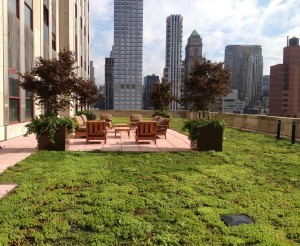
Green roof on the 21st floor
Photo: Xero Flor
Source: www.earthtechling.com

The Empire State Building, an architectural icon in New York City and beyond, just took a giant step forward in its quest to reduce energy consumption. The ‘World’s Most Famous Office Building’ now boasts four green roof systems, totally nearly 10,000 square feet.

For its green roof upgrade, the Empire State Building chose to install the Xero Flor Green Roof System for four rooftop areas: 21st floor east (3,450 square feet), 21st floor west (3,450 square feet), 25th floor northwest (1,000 square feet) and 30th floor west (1,200 square feet). The green roofs on the 21st floor feature rooftop patios with outdoor furniture for the enjoyment of office tenants.

As we’ve reported in the past, the Empire State Building is on a quest to become the most sustainable office building in America. In 2011, the building’s owners announced that they would purchase 100 percent of its power from renewable sources and then embarked on a massive retrofit plan that would earn the Empire State Building LEED Gold.

[Read more…]

Des étages en plus pour créer des logements

par TANCREDE BONORA, Slate.fr, 3 février 2012

Surélévation d'immeubles Image: Michel Cantal-Dupart Source: www.slate.fr

Surélévation d’immeubles
Image: Michel Cantal-Dupart
Source: www.slate.fr

Paris ne peut pas s’étendre indéfiniment, il doit se réinventer à l’intérieur de ses propres limites. Et si la solution se trouvait sur les toits?

Il faut débloquer le foncier», a asséné Nathalie Kosciusko-Morizet, ministre de l’Ecologie et du Logement, jeudi 2 février, sur les ondes de France Inter, après avoir commenté la mesure annoncée dimanche par Nicolas Sarkozy d’augmenter de 30% le coefficient d’occupation des sols (COS); selon elle, avec cette décision «la constructibilité augmente partout [y compris] les limites de hauteur, les limites de gabarit. (…) Ce n’est pas de l’étalement urbain, c’est tout le contraire».

Avec une des densités les plus élevées au monde (près de 22.000 hab/km contre seulement 13.500 pour Tokyo et près de 11.000 pour New York), Paris suffoque, ceinturé par un périphérique et un habitat de banlieue qui n’attire pas les jeunes urbains.

On crée pour l’instant 40.000 logements par an à Paris et le programme du Grand Paris projette d’en construire 70.000.

L’extension horizontale de la ville n’est plus une solution viable. Mais comment absorber la population parisienne de plus de 2.200.000 habitants tout en préservant la qualité de vie? Comment faire face à la pénurie des sols?

[Read more…]