by LIZA DE GUIA, food. curated., July 20, 2010
Source: food. curated.
From the Blog
by LIZA DE GUIA, food. curated., August 9, 2009
Source: food. curated.
by LIZA DE GUIA, food. curated., August 21, 2009
Source: food. curated.
by CAROL VOGEL, The New York Times, May 10, 2013
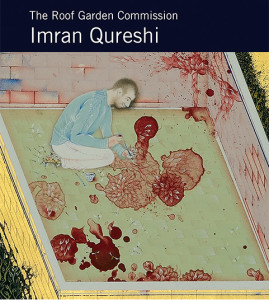
Source: www.metmuseum.org
In 1998 when Ellsworth Kelly became the first living artist to exhibit on the roof of the Metropolitan Museum of Art, he called the picture-postcard setting “an instant background.” When his sculptures — as tall as 14 feet — were installed there they looked enormous and the skyscrapers behind them tiny. Mr. Kelly compared this reversal of scale to Chinese landscape painting in the way it played with perspective.
This year’s exhibition on the Met’s roof garden, which opens Tuesday, is also a study in perspective, but this time the beauty and impact will be the diminutive nature of its creation. The Pakistani artist Imran Qureshi, who is known for his painstaking brushwork in the style of the 16th- and 17th-century Mughal miniaturists, is conceiving a site-specific painting that will be directly on the surface of the roof garden. His creation will relate not only to some of his earlier work, but also to the nature he has discovered in Central Park, whose vistas are an integral part of the setting. (Through Nov. 3, 212-535-7710, metmuseum.org)
Source: The Metropolitan Museum of Art
Other story about the installation : Savagery, Mulled in Airy Precincts
by DIANE CARDWELL, The New York Times, May 1, 2013
MOUNTAIN VIEW, Calif. — When Bertrand Piccard was growing up in Switzerland, heady discussions about the boundless potential for human endeavor were standard fare.
His grandfather, a physicist and friend of Albert Einstein and Marie Curie, had invented a special capsule so he and a partner could be first to reach the stratosphere in a balloon. His father, an engineer, helped design the submarine that made him and an American naval officer the first to plunge undersea to the earth’s crust.
“All the most incredible things seemed to be completely normal,” Mr. Piccard, a psychiatrist trained in hypnosis, said last week at Moffett Field at the NASA Ames Research Center here, preparing for his next expedition. “I thought this was the normal way to live and I was very disappointed to see that there are a lot of people who are afraid of the unknown, afraid of the doubts, afraid of the question marks.”
He went on to become part of the team that was first to circumnavigate the globe nonstop in a balloon. But when a propane shortage nearly ended his record-setting ride in 1999, he began dreaming of a way to fly day and night without fuel, an idea that has reached fruition in a featherweight solar airplane set for an initial voyage across the United States starting on Friday, weather permitting. His brainchild, the Solar Impulse, will not be the first sun-powered plane to fly; its chief distinction is its ability to go through the night. […]
by JAMES CONAWAY, National Geographic Traveler, September 2010 issue
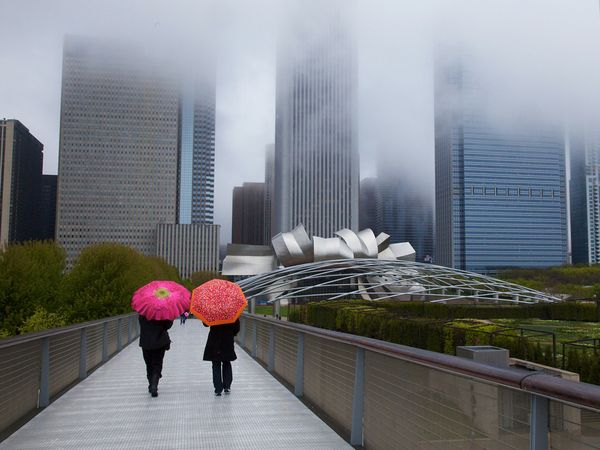
The Nichols Bridgeway extends over the world’s largest green roof to Millennium Park
Photo: Melissa Farlow
Source: www.travel.nationalgeographic.com
From aging industrial capital to model of livability and environmental stewardship, Chicago is becoming our kind of town.
Phil Ponce, local TV news anchor, peers at the amazing array of sausages dangling from overhead racks in Gene’s Deli in north Chicago’s Lincoln Square. “Chicago’s not the city of big shoulders,” he jokes, referring to poet Carl Sandburg’s early-20th-century characterization of what was then America’s industrial capital, “but rather the city of pig shoulders.” (And that refers not just to actual pork, he later explains, but also to the long line of Chicago politicians convicted of taking bribes.)
It’s Sunday afternoon, and the sidewalks are jammed in this longtime enclave of sausage-loving Germans and Eastern Europeans. Recent years have seen a growing ethnic diversity among residents, as well as an influx of shops and galleries. Yet, a steel archway labeled “Lincoln Square” lets the world know that pride in the neighborhood—pig shoulders and all—is stronger than ever.
“A few years ago people here decided they didn’t want big developments,” Ponce says, explaining that condos were prevented from taking over the local movie theater, though locals welcomed new residents moving into renovated apartments. “There are more than 50 neighborhoods in Chicago just as distinct and as cherished as this one,” he adds, vital components in the overall good vibe of this historic Midwestern metropolis.