From the Blog

A staff of robots can clean and install solar panels

by DIANE CARDWELL, The New York Times, October 14, 2013
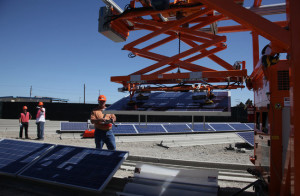
Rover, a robot, placing a solar panel in a track at Alion Energy, which is looking to shave labor costs. Photo: Jim Wilon (The New York Times) Source: www.nytimes.com

Rover, a robot, placing a solar panel in a track at Alion Energy, which is looking to shave labor costs.
Photo: Jim Wilon / The New York Times
Source: www.nytimes.com

RICHMOND, Calif. — In a dusty yard under a blistering August sun, Rover was hard at work, lifting 45-pound solar panels off a stack and installing them, one by one, into a concrete track. A few yards away, Rover’s companion, Spot, moved along a row of panels, washing away months of grit, then squeegeeing them dry.

But despite the heat and monotony — an alternative-energy version of lather-rinse-repeat — neither Rover nor Spot broke a sweat or uttered a complaint. They could have kept at it all day.

That is because they are robots, surprisingly low-tech machines that a start-up company called Alion Energy is betting can automate the installation and maintenance of large-scale solar farms.

Working in near secrecy until recently, the company, based in Richmond, Calif., is ready to use its machines in three projects in the next few months in California, Saudi Arabia and China. If all goes well, executives expect that they can help bring the price of solar electricity into line with that of natural gas by cutting the cost of building and maintaining large solar installations.

In recent years, the solar industry has wrung enormous costs from developing farms, largely through reducing the price of solar panels more than 70 percent since 2008. But with prices about as low as manufacturers say they can go, the industry is turning its attention to finding savings in other areas.

“We’ve been in this mode for the past decade in the industry of really just focusing on module costs because they used to be such a big portion of system costs,” said Arno Harris, chief executive of Recurrent Energy, a solar farm developer, and chairman of the board of the Solar Energy Industries Association. Now, Mr. Harris said, “Eliminating the physical plant costs is a major area of focus through eliminating materials and eliminating labor.” […]
Read the full story

Seeing green: Urban agriculture as green infrastructure

by CASSIM SHEPARD, Urban Omnibus, February 1st, 2012

Image: Seein Green Source: www.urbanomnibus.net

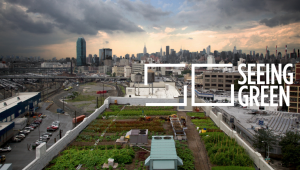
Image: Seeing Green
Source: www.urbanomnibus.net

It’s easy to list the reasons why we are supposed to love urban agriculture: the food it yields is fresh and local; the farming it requires is fun and social; the effect on neighborhoods is revitalizing and healthy. Critics point to its inability to replace existing production and distribution channels for produce, but what if its impact extended beyond the small farm or immediate community? What if it could solve other problems? One of New York’s greatest environmental challenges is its combined sewage overflow (CSO) problem. Our outdated sewer system is designed to collect stormwater runoff, domestic sewage, and industrial wastewater in the same pipe on its way to a sewage treatment plant. When the rain is heavy, though, volume exceeds capacity and untreated wastewater flows right into our waterways. Green infrastructure is a term that refers to a wide range of technologies and systems to improve water quality through the capture and reuse of stormwater. But the policies that incentivize green infrastructure and those that govern urban agriculture are not coordinated. In some cases, urban agriculture is actively excluded from official definitions of green infrastructure. In an effort to support farming in the city and help scale it up, Tyler Caruso and Erik Facteau set out to prove scientifically the environmental benefits of rooftop and other urban farms, in particular their ability to manage stormwater, with their research project Seeing Green. In describing this project, Caruso and Facteau touch on issues that range from the effect of scientific research on public policy, the shift towards a definition of sustainability that includes performance alongside design, and the need to layer different registers of analysis in efforts to bring about a city that is more responsive to natural systems. […]

Read the original story

‘Innovative’ housing with rooftop farms set for southside

by EMILIE RAGUSO, Berkeleyside, October 17, 2013

A photo simulation of what the project’s rooftop farms could look like Image: Stanley Saitowitz / Natoma Architects Source: www.berkeleyside.com

A photo simulation of what the project’s rooftop farms could look like
Image: Stanley Saitowitz / Natoma Architects
Source: www.berkeleyside.com

City zoning board members approved a 77-unit mixed-use housing development near downtown Berkeley late last week, expressing excitement about a “unique” design set to include more than a dozen working rooftop farm plots and a novel approach to parking.

“Garden Village,” at 2201 Dwight Way at Fulton Street, brings with it a number of innovative features, from its composition — it’s made up of 18 distinct but connected “volumes,” or towers, that range in height from 3 to 5 stories and are connected by open-air walkways; its more than 12,000 square feet of rooftop farming plots; and its small garage, which offers just enough space for a fleet of shared vehicles that will be rentable by tenants.

Without the car-sharing idea, the project would have required room for 71 vehicles. Instead, Berkeley-based developer Nautilus Group decided it would purchase a fleet of four to 10 automobiles and contract with a car-sharing operator called Getaround to run the “car-share pod” operation. (The city required Nautilus to pay for a parking demand study to bolster the justification for that approach.)

Zoning board Commissioner Shoshana O’Keefe described the concept as potentially “genius,” adding that the notion of projects that fold effective car-sharing programs into their plans “might be the magic solution” to the hairy issue of meeting parking demand efficiently in a densely-populated community.

[Read more…]

One photographer’s three year tour of NYC’s best rooftops

by KELSEY CAMPBELL-DOLLAGHAN, Gizmodo India, October 18, 2013

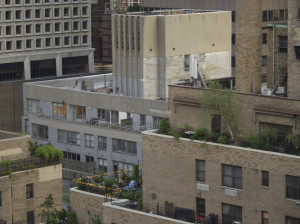
155 E 55th Street from 17th floor, 130 E 57th Street Photo: Stewart Mader Source: www.storiesaboveny.com

155 E 55th Street from 17th floor, 130 E 57th Street
Photo: Stewart Mader
Source: www.storiesaboveny.com

Even if you’ve lived in New York for decades, gaining access to a rooftop you’ve never explored can still be surprisingly fun: The burst of wind, the sound of traffic, and an entirely new vantage point on a city you’d think you’d be sick of after so many years. That’s the basic concept behind Stories Above New York, a visual archive of New York’s rooftop views that’s three years in the making.

SANY is the work of Stewart Mader, a photographer who started the project in early 2011. He shoots from a new rooftop roughly every week, picking unusual or hard-to-access spots he’s never been to. Those include the top of One World Trade Center and the Columbus Circle monument of Christopher Columbus, shot during the temporary installation of scaffolding around the statue. “New York is a giant city,” he said over email. “Even with 230 published photos so far, I haven’t even scratched the surface. I could be doing this five or ten years from now.”

Does Mader have a favorite? 550 Grand St, an apartment building that flanks the Williamsburg Bridge. It was built by workers’ unions to replace 65 tenements, and his wife’s parents lived there for 50 years. “The whole history of these buildings is emblematic of the kind of ingenuity that has made New York what it is today,” he adds. “We should be looking more closely at their history to solve the current, growing housing supply crisis.”

Read the original story

Stories Above New York website

Cool tool for a hot subject

by RONDA KAYSEN, Habitat, June 2012, p. 22-25

A year ago this month, New York City released an interactive map showing every solar power installation in the city. It’s not a robust picture. There are fewer than 500 solar installations citywide.

NYCSolarMap.com could change that. By providing property owners with detailed information about tax incentives, solar potential, and the payback period for an individual rooftop, NYCSolarMap could, if you’ll pardon the pun, lead to sunny skies for solar. In all, two-thirds of the city’s roofs could harness enough of the sun’s energy to make it worth the investment.

The City University of New York (CUNY) is leading local solar efforts and developed the map in partnership with the city and the federal Department of Energy. The site has had about 200,000 hits since it launched and gets about 60 visitors a day. “You’re always going to get the early adopters. However, to trigger mainstream adoption you need to make the case for solar by using data,” says Tria Case, director of sustainability for CUNY and the map’s lead developer. The map cost $660,000 to build and gives users the tools to make an informed decision about their own property. The map, created from photographs taken by airplane using a laser system called Lidar, also tracks solar thermal projects and eventually could become an energy map for the entire city.

Map Barriers

But there are barriers to installing solar. The city permitting process can be cumbersome. And not all buildings are good candidates. A property must have a large roof that’s in good condition. Above all, it needs ample sun. A building with too much shade will not get enough sunlight to generate energy. For that reason, buildings in boroughs other than Manhattan tend to be better candidates.

Then there are the financials. If a building is structured as a 501(c)(3) nonprofit, it won’t benefit from some of the tax incentives. And since most of the financial incentives come in the form of a rebate, a building’s owners need to either have enough cash to pay for the project up front or be able to qualify for a loan. […]

Read the full story

NYC Solar Map

Sustainable SUNY

Wrigley Field’s planned renovation threatens a Chicago rooftop tradition

by CLAIRE SUDDATH, BloombergBusinessweek, September 5, 2013

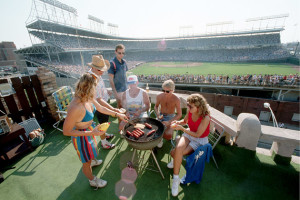
Wrigleyville rooftop, 1989 Photo: Jim Sugar/Corbis Source: www.businessweek.com

Wrigleyville rooftop, 1989
Photo: Jim Sugar/Corbis
Source: www.businessweek.com

Eric Wolverton is drinking a beer at a Cubs game. Actually, near a Cubs game. As 40,500 people—a near-sellout crowd—settled into their hard plastic seats at Chicago’s Wrigley Field, Wolverton perched on the bleachers on a rooftop across the street. He paid $124, roughly the cost of a field-level ticket at other Major League ballparks, for the privilege of cheering on the Cubs from atop 3643 N. Sheffield Ave., one of the 16 for-profit spectator spaces that make up the Wrigleyville Rooftops Association. The Cubs, who currently have the league’s third-worst record, are playing the third in a four-game series against the Dodgers, who’ve already beaten them twice. “You don’t go to a Cubs game to watch good baseball; you go to see Wrigley,” Wolverton says, and the ballpark, he adds, is best viewed from above. “Everyone talks about how historic Wrigley is, how going to a game is like stepping back in time,” he says. “And it is.” “But,” interjects Mike Gordon, Wolverton’s friend and fellow Cubs die-hard, “that place is a dump.”

[Read more…]