From the Blog

Catching sunlight, to sell it

by TESSA CHEEK, The Colorado Independent, December 16, 2013
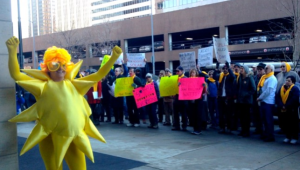
Photo: Tessa Cheek Source: www.coloradoindependent.com

Photo: Tessa Cheek
Source: www.coloradoindependent.com

Xcel seeks to charge solar panel owners for using the grid, wants more homeowners to buy solar power from Xcel

DENVER — More than 200 protesters gathered in downtown Skyline Park last Wednesday to amp up, march to Xcel Energy headquarters and deliver a petition signed by 30,000 Coloradans in favor of rooftop solar. The energy company recently announced it wants to charge Coloradans with rooftop solar for using the Xcel infrastructure grid — even if they’re using it mainly to provide power to other Xcel customers.

It’s not only solar-panel owners that oppose this idea, said Annie Lappe of the Vote Solar Initiative. “Four out of five Coloradans believe ratepayers with solar should get a fair credit for the energy they put back into the system. That means those same Coloradans also oppose Xcel’s proposed changes.”

The issue of how much solar owners are paid for the energy their homes kick back to the grid came to a head when Xcel submitted its 2014 green energy compliance plan to the Colorado Public Utilities Commission (CPUC). The plan proposed changes to so-called net metering. The proposal would draw credits from a fund specifically for green energy encouragement and it would ask future solar-installers to pay for their occasional use of the private grid Xcel owns and operates.

“It’s not a question of whether we incentivize rooftop solar, but how we do it,” said Ethnie Treick, manager of Policy Analysis at Xcel. “How do we provide solar energy to the most people?”
[Read more…]

U.S. online startup makes going solar as easy as booking travel

by NICHOLA GROOM, Reuters, December 2, 2013

In a first on Monday, an online marketplace will allow U.S. homeowners to weigh options for going solar as easily as they can compare prices for airline tickets.

Geostellar, a startup backed by power producer NRG Energy Inc, is seeking to become the Expedia or Orbitz of the solar industry — a one-stop shop where consumers can not only compare the benefits of leasing solar panels versus buying them outright, but ultimately sign up to install a system.

Solar players including NRG, No. 1 U.S. installer SolarCity Corp, Boston-based solar loan provider Admirals Bank, manufacturer and financier Conergy, East Coast installer Roof Diagnostics and Connecticut’s Clean Energy Finance and Investment Authority will feature their products on the site, www.geostellar.com.

Geostellar hopes its platform will allow installers and financiers to lower the cost of acquiring new customers — a major goal in the fiercely competitive rooftop solar industry. Solar companies are laser focused on slashing costs so that they can deliver on their promise to save customers money on power bills by going solar.

Geostellar will make money by claiming a portion of a system’s total installed price – between 10 and 20 percent, Chief Executive David Levine said.

Geostellar, which was founded in 2010, got its start by selling data to solar companies that showed the solar energy potential of individual rooftops. Its early customers included solar financing companies SunRun, Sungevity and others, according to Levine.

[Read more…]

Elevated park at trade center site comes into view

by DAVID W. DUNLAP, The New York Times, November 20, 2013

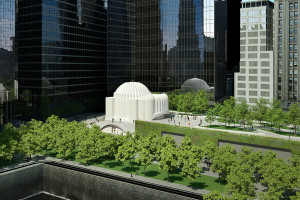
A rendering of the new St. Nicholas Greek Orthodox Church, with conceptual images of a landscaped open space known as Liberty Park Image: Santiago Calatrava Source: www.nytimes.com

A rendering of the new St. Nicholas Greek Orthodox Church, with conceptual images of a landscaped open space known as Liberty Park
Image: Santiago Calatrava
Source: www.nytimes.com

The World Trade Center’s best-kept secret has finally come to light.

It is an elevated park, slightly larger than an acre and 25 feet above Liberty Street, that will command a panoramic view of the National September 11 Memorial when it opens to the public, probably in 2015.

Liberty Park, as it is called, is meant to offer a pleasant and accessible east-west crossing between the financial district and Battery Park City; to create a landscaped forecourt for the new St. Nicholas Greek Orthodox Church; to provide a gathering space for as many as 750 people at a time; to allow visitors to contemplate the whole memorial in a single sweeping glance from treetop level; and to serve as the roof of the trade center’s vehicle security center.

For the moment, the park is an empty concrete expanse. The pedestrian bridge over West Street that will connect it to Battery Park City — the bridge that survived the Sept. 11 attack — currently falls several yards short of its future landing spot.

While the general outlines of the park have been known for years, the Port Authority of New York and New Jersey has been sparing in its public discussion of the project, in part because not every detail of its design and construction has been settled.

But the Port Authority’s hand was forced somewhat last month when sumptuous images of St. Nicholas Church and Liberty Park appeared on the website of the architect Santiago Calatrava, who is designing the church. The park was rendered in sufficient detail that it was possible for the first time to understand its basic design. […]

Read the full story

Related articles :
Church Near Trade Center to Echo Landmarks of East
First Look: Santiago Calatrava’s Design for St. Nicholas Church

Arizona’s new fee puts a dent in rooftop solar economics

by MATTHEW PHILIPS for Businessweek, Mashable, November 24, 2013

Source: www.mashable.com

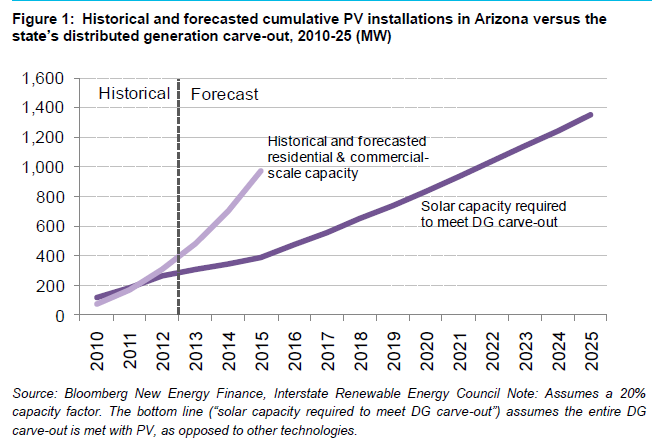
Historical and forecasted cumulative PV installations in Arizona versus the state’s distributed generation carve-outm, 2010-2025 (MW)
Image source: www.mashable.com

Last week, Arizona regulators gave the state’s largest utility, Arizona Public Service, the authority to charge homeowners with solar panels on their roofs a fee for plugging into the grid and in some cases, selling electricity back onto it. Beginning next year, homeowners who install rooftop solar systems will have to pay a monthly levy — the first ever in the U.S. — equal to $0.70 per kilowatt of installed capacity.

That’s well below the $8 per kw that APS had initially sought. Depending on how big their home system is, the fee will end up costing consumers anywhere from $3 to $6 a month, according to a report by Bloomberg New Energy Finance. APS had hoped to be able to charge about $50 a month per home. The 18,000 rooftop solar systems already present in APS’s service territory will be grandfathered; only those installed after Dec. 31 will be subject to the levy.

“This is a body blow for the Arizona solar industry, not a knockout punch,” says Stefan Linder, an analyst with Bloomberg New Energy Finance. “While this fixed fee will cut into the economics of residential solar, for many homeowners it will still make financial sense to go solar.”

The Solar Energy Industries Association claims that a typical rooftop solar system saves a homeowner about $5 to $10 per month; other estimates put it closer to $20.

The decision by the Arizona Corporation Commission is the first stab at resolving a contentious fight that’s been brewing for years between the solar industry and public utilities. Arizona, the second-largest solar market in the U.S., behind California, has been viewed as a critical battleground in deciding whether utilities would be able to squeeze money out of homeowners who no longer buy electricity from them — and in many cases, actually get paid for pushing supplemental power generated by their solar panels back onto the grid.

[Read more…]

Klyde Warren Park, Dallas

by LAURA MIRVISS, Architectural Record, August 2013

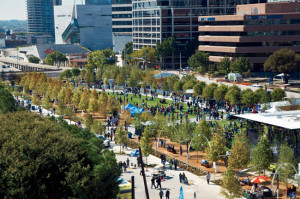
The ambitious Klyde Warren Park covers a 1,200-foot-long stretch of the Woodall Rodgers Freeway. A serene, 2,400-square-foot concert pavilion by Thomas Phifer and Partners is open on all sides Photo: Dillon Diers Photography Source: www.archrecord.construction.com

The ambitious Klyde Warren Park covers a 1,200-foot-long stretch of the Woodall Rodgers Freeway. A serene, 2,400-square-foot concert pavilion by Thomas Phifer and Partners is open on all sides
Photo: Dillon Diers Photography
Source: www.archrecord.construction.com

Decked out in Dallas: A sprawling rectangular park on top of a major freeway unites an up-and-coming residential neighborhood with the burgeoning Arts District.

 As in many American cities, large highways slice through downtown Dallas. Sidewalks seem intermittent, parking lots abundant, and locals respond with strange looks when asked the best way to walk to a nearby bar or restaurant.

But Dallas is pouring millions of dollars into changing all that. In the past decade, the city has quietly inserted a handful of small green gardens between downtown office towers and condos, providing small reprieves from the expanses of asphalt and concrete. As part of this initiative, over ten years ago, local civic leaders began talking to a team of designers and engineers about coming up with a scheme for uniting the city’s fractured downtown by covering over an existing freeway with a park.

Now, $110 million later, the design team, Jacobs Engineering Group, along with landscape architect The Office of James Burnett, has delivered something radical—5.2 acres of green space laid across an eight-lane highway. The Woodall Rodgers Freeway, oriented northeast-southwest and depressed to minimize traffic noise, ran underneath a number of perpendicular at-grade bridges used as cross streets. The park now fills the gaps between the bridges to create a 1,200-by-200-foot three-block-long deck between Pearl and St. Paul streets. “You only realize you’re near a freeway at the ends of the park,” says principal James Burnett. “You can’t hear the roar of traffic below.”

[Read more…]

Eskenazi Hospital prepares to open

by JOHN RUSSELL, The Indianapolis Star, November 16, 2013

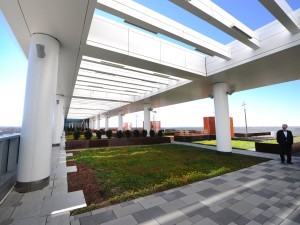
Sky Farm on the roof of the new Eskenazi Health Hospital.  Photo: Matt Kryger / The Star Source: www.indystar.com

Sky Farm on the roof of the new Eskenazi Health Hospital
Photo: Matt Kryger / The Star
Source: www.indystar.com

Rooftop vegetable garden, sculptures add unique touches to Wishard’s replacement

Indiana has never seen a hospital quite like this.

From the spiraling wooden sculpture suspended from the ceiling in the main concourse to the vegetable garden on the roof, the brand-new Eskenazi Hospital keeps you wondering what you will see around the next corner.

The $754 million hospital, which will serve mostly poor and underinsured patients, is nearly ready to open, after four years of planning and construction. The public can tour the hospital from 11 a.m. to 5 p.m. today.

The massive complex, spread out on 37 acres, will replace Wishard Hospital, a deteriorating hodgepodge of buildings, some a century old. On Dec. 7, an army of hospital workers will move patients from the old building to the new one a block away.

The new hospital is the latest addition to Indiana’s hospital construction boom over the last decade, a period in which more than $1 billion in new facilities sprouted up around Central Indiana, from specialty heart clinics to luxurious medical centers in the suburbs.

Each of Indiana’s dozens of hospitals seems to have a distinctive personality, from the luxurious Indiana University Health North Hospital in Carmel, with posh fireplace lounges and cherry wood bassinets, to the kid-friendly Riley Hospital for Children, with its signature red wagons and play rooms.

The feel at Eskenazi Hospital is bright and welcoming. Sunlight pours through windows in every patient room, waiting room and hallway. The public areas are filled with colorful art, from historical oil paintings to whimsical photographs of the city.

The goal, officials say, is to be comforting for people entering the doors for what is often a frightening, high-stress experience.

“We want this to be the most patient-friendly, family-friendly, simple-to-use hospital you can find,” said Matthew R. Gutwein, president and chief executive of Marion County Health and Hospital Corp., which operates the hospital.

[Read more…]