From the Blog

Arizona rooftop solar customers could face new tax

by  AMANDA H. MILLER, CleanEnergyAuthority, May 6, 2014
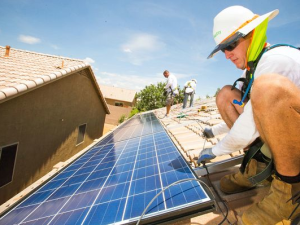
Solar in Arizona Photo: Arizona Republic Source: www.cleanenergyauthority.com

Solar in Arizona
Photo: Arizona Republic
Source: www.cleanenergyauthority.com

Homeowners who are leasing rooftop solar arrays in Arizona could be hit with an average $152 a year property tax bill they weren’t counting on when they decide to go solar.

The state department of revenue recently reinterpreted a tax policy that exempts rooftop solar equipment from property tax, determining that the exemption only applies to those who own their solar arrays, not people who lease solar panels.

The state Department of Revenue said the leased panels are merchant power plants and the leasing companies should pay tax on them.

Those taxes would flow through to customers.

Solar leasing accounts for the majority of the distributed solar generation in Arizona and is widely adopted by middle class residents who can’t afford to buy complete systems outright.

Most who lease rooftop solar systems save $60 to $120 a year over buying all of their power from Arizona Public Service. The new property tax would erase the cost benefit of going solar, solar advocates say.

“Arizona is breaking new ground for being an extremely strange political environment,” said Bryan Miller, vice president of public policy for solar leasing company Sunrun and president of The Alliance for Solar Choice.
[Read more…]

A Farm Grows in Brooklyn – on the Roof

by MARK J. MILLER, for National Geographic, April 29, 2014

This story is part of National Geographic‘s special eight-month “Future of Food” series.

U.S. cities lead a rooftop-farming movement that’s spreading around the globe.

For most urban dwellers, visiting a working farm requires a journey into the countryside. But in a growing number of world capitals, a farm is just a short elevator ride away—on the roof.

In Singapore, Amsterdam, Hong Kong, Tokyo, and Montreal as well as several U.S. cities, farms have been built atop multistory buildings.

“Five years ago, there were virtually no rooftop farms,” Steven Peck, founder and president of Green Roofs for Healthy Cities, told National Geographic. “Now they are starting to appear across the globe.”

Peck says that as fossil fuels become more expensive and the number of urban dwellers continues to rise, urban farming will help feed the population without increasing the cost and pollution of food transport.

Rooftop farming was born out of the green-roof movement, in which building owners partially or completely cover roofs with vegetation atop special waterproof membranes. Green roofs use plants and flowers to provide insulation, create a habitat for local wildlife, help control runoff, put more oxygen into the atmosphere—and provide a welcome, verdant break from urban drabness.

Rooftop farms take the green-roof concept a step further, with plots that provide fruits and vegetables for local residents and the chance for urban volunteers to become part-time farmers.

[Read more…]

Rooftop dog park in NW provides unique amenity

by STEPHEN TSCHIDA, April 28, 2014

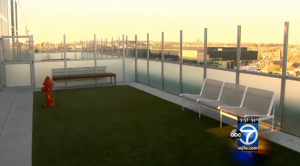
Rooftop dog park of the City Market at O apartment complex in Northwest Washington
Source: WJLA / ABC 7

WASHINGTON (WJLA) – The first Erin Siegel does when she gets home is walk her dogs Darla and Theo. But the three of them don’t want to head for the street. Instead, they aim for the sky.

Siegel is a resident of the City Market at O apartment complex in Northwest Washington. It’s a dazzling new development over a once grungy parking lot. What was it that really hooked Siegel on this complex? The roof.

“You get the views of the city and you get the ability to play with your dogs, socialize them, get exercise,” she said.

The complex’s developers wondered what to do with a large roof area before deciding to let it go to the dogs. The ultimate amenity is the rooftop dog park. There are special areas for big dogs and little dogs, as well as lookout so that tenants’ four-legged friends can take in the spectacular view.

“It’s been fabulous,” City Market at O developer Richard Lake said. “It’s been absolutely amazing. Nearly forty percent of our renters have dogs.”

Just off the top-floor doggie playground is another special room with dog washing equipment for both large and small canines.

“This was a huge deciding factor in us coming here,” tenant Abby Slitor said. “It was relatively the same price as for amenities and everything else, and this is obviously an awesome amenity to have in the city.”

While the area around the apartment complex at 7th and O NW has improved, the neighborhood that was once a hotbed for drug and gang activity can still be a bit rough around the edges. City Market tenant Christin Carey said her dog Bogey’s occasional need for a night time bathroom trip is much safer on the roof than the street.

“As a woman I don’t want to be out in the dark alone,” she said.

Read the original story


A roof grows on Barclays

by ELIOT BROWN, The Wall Street Journal, April 6, 2014

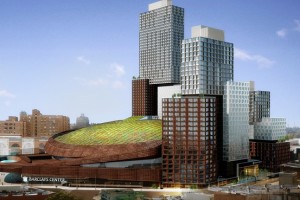
The dome of Barclays Center is going green. Here a rendering of the project, which is still being designed.  Image: Shop Architects PC Source: http://online.wsj.com

The dome of Barclays Center is going green. Here a rendering of the project, which is still being designed.
Image: Shop Architects PC
Source: The Wall Street Journal

Brooklyn’s Barclays Center is slated to get a lot greener on the outside and possibly become a quieter neighbor in the process.

Barclays developer Forest City Ratner Cos. is planning to coat the arena’s giant dome with a 130,000-square-foot “green roof” composed of small plants and a soil-like cover, resurrecting an idea that was cut years ago in an effort to contain costs.

Forest City officials said the effort is being driven by the next development phase at the site, known as Atlantic Yards, which calls for 6,400 apartments to be built in 15 towers—three that would surround the arena. By swapping a sprawling white roof with an expanse of greenery, the apartments should become more marketable, the company believes.

“We wanted to do the amenity for the benefits to the community and the residents that this green roof will bring, rather than having that traditional arena roof,” said Linda Chiarelli, an executive vice president at Forest City.

[Read more…]

Car companies take expertise in battery power beyond the garage

by TOOD WOODY, The New York Times, March 25, 2014

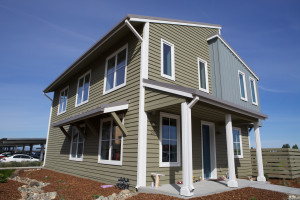
A home by Honda and the University of California, Davis, is expected to make more energy than it consumes. Photo: Thor Swift for The New York Times Source: www.nytimes.com

A home by Honda and the University of California, Davis, is expected to make more energy than it consumes.
Photo: Thor Swift for The New York Times
Source: www.nytimes.com

DAVIS, Calif. — As more homeowners generate their own electricity from solar panels, they still need power from a utility after the sun goes down.

Now, automakers say they may have an answer, by storing that carbon-free energy in electric car batteries for later use.

Honda on Tuesday is introducing an experimental house in this environmentally conscious community to showcase technologies that allow the dwelling to generate more electricity than it consumes.

It is one example of the way solar companies and carmakers are converging on a common goal: to create the self-sufficient home, with a car’s battery as the linchpin.

With buildings and transportation accounting for 44 percent of the United States’ greenhouse gas emissions, car companies increasingly view all-electric and hydrogen fuel-cell cars as vehicles that will meet environmental mandates and lead to development of new energy services and products beyond the garage.

[Read more…]

Terrace for sale, includes condo

by JULIE SATOW, The New York Times, March 20, 2014

The developers of 215 Sullivan Street in the Village promote its “lushly landscaped backyard”. Photo: Watson & Company Source: www.nytimes.com

The developers of 215 Sullivan Street in the Village promote its “lushly landscaped backyard”.
Photo: Watson & Company
Source: www.nytimes.com

After a seemingly endless winter, the first hints of spring have teased us with a day or two of temperatures over 60 degrees. That fleeting glimpse of warmth sent many New Yorkers flying out of doors to enjoy the sunshine. For my part, I sipped my morning coffee at home last week and stared wistfully out the window at a neighbor’s balcony.

In our concrete jungle, there is a hefty dollar value attached to having your own garden oasis — even the smallest of shrubberies carries a price tag. And with so many residents suffering from a vitamin D deficiency these days, brokers are promoting listings that can claim specks of green, even if they’re barely large enough to hold a bonsai.

Yet there are some listings for which the warmer weather was made.

Downtown, the average price of a luxury condominium with a terrace is $8.3 million; that compares with just $6 million for those without terraces, according to Vanderbilt Appraisal. And developers are doing whatever they can to take advantage of that pricing edge.

[Read more…]