by JAMES CONAWAY, National Geographic Traveler, September 2010 issue
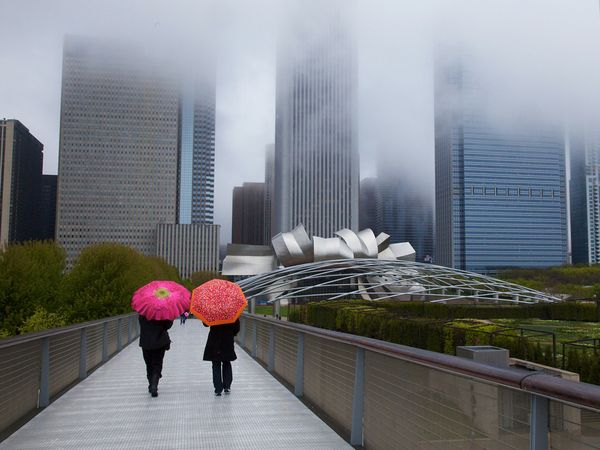
The Nichols Bridgeway extends over the world’s largest green roof to Millennium Park
Photo: Melissa Farlow
Source: www.travel.nationalgeographic.com
From aging industrial capital to model of livability and environmental stewardship, Chicago is becoming our kind of town.
Phil Ponce, local TV news anchor, peers at the amazing array of sausages dangling from overhead racks in Gene’s Deli in north Chicago’s Lincoln Square. “Chicago’s not the city of big shoulders,” he jokes, referring to poet Carl Sandburg’s early-20th-century characterization of what was then America’s industrial capital, “but rather the city of pig shoulders.” (And that refers not just to actual pork, he later explains, but also to the long line of Chicago politicians convicted of taking bribes.)
It’s Sunday afternoon, and the sidewalks are jammed in this longtime enclave of sausage-loving Germans and Eastern Europeans. Recent years have seen a growing ethnic diversity among residents, as well as an influx of shops and galleries. Yet, a steel archway labeled “Lincoln Square” lets the world know that pride in the neighborhood—pig shoulders and all—is stronger than ever.
“A few years ago people here decided they didn’t want big developments,” Ponce says, explaining that condos were prevented from taking over the local movie theater, though locals welcomed new residents moving into renovated apartments. “There are more than 50 neighborhoods in Chicago just as distinct and as cherished as this one,” he adds, vital components in the overall good vibe of this historic Midwestern metropolis.