From the Blog

High-rise urban farming

by AFP Relaxnews, The Star Online, January 13, 2014

Rooftop farming at Whole Foods Market in Brooklyn Photo: Gotham-Greens / AFP Source: www.thestar.com.my

Rooftop farming at Whole Foods Market in Brooklyn
Photo: Gotham-Greens / AFP
Source: www.thestar.com.my

Agriculture reaches for the skies in New York’s pioneering commercial greenhouse atop a supermarket.

Will supermarkets soon be growing their own produce on the roof? It might sound unusual, but it could be the future of the food commerce industry as the urban farming trend goes high-rise and spreads to metropolises all over the world.

One of the latest companies to test out the concept is global chain Whole Foods, which opened its first Brooklyn location Third and 3rd last month, featuring a 20,000-square foot (about 1,860sq m) greenhouse on the roof.

Designed, built and operated by urban agricultural specialist Gotham Greens, the project is thought to be the first commercial-sized greenhouse integrated into a supermarket.

The greenhouse will produce over 200 tonnes of fresh produce, including leafy greens and tomatoes, per year, and recirculating irrigation systems will capture water for re-use. It is the second New York construction by Gotham Greens, following a 15,000-square foot (about 1,400sq m) rooftop greenhouse built by the company in 2010.
[Read more…]

California installed more rooftop solar in 2013 than previous 30 years combined

by KILEY KROH, ThinkProgress, January 2, 2014

2013 was a banner year for clean energy and the U.S. solar industry was no exception. California, the nation’s solar standout, more than doubled its rooftop solar installations last year from 1,000 megawatts (MW) to 2,000 MW. To put this number in perspective, writes Bernadette Del Chiaro of the California Solar Energy Industries Association, it took California over 30 years to build the first 1,000 MW of rooftop solar.

“When utility-scale solar projects are added in, California’s total solar power picture well-exceeds 4,000 MW today — nearly twice as much installed capacity as exists at California’s last remaining nuclear power plant, Diablo Canyon,” according to Del Chiaro.

And California isn’t alone in its rooftop solar surge. “About 200,000 U.S. homes and businesses added rooftop solar in the past two years alone — about 3 gigawatts of power and enough to replace four or five conventionally-sized coal plants,” Bloomberg reported.

As record numbers of homes and businesses decide to go solar, utility companies are growing increasingly uneasy about the threat it poses to their existing business model. If more customers install solar panels or adopt energy efficiency measures, a utility will sell fewer units of energy — especially during peak demand when energy costs are the highest. Therefore, utilities will increase their energy prices to cover costs such as grid maintenance and labor and as prices go up, more customers will look to energy efficiency and distributed energy resources to reduce their energy bills, perpetuating the cycle.

[Read more…]

Analysis: Clouds over Hawaii’s rooftop solar growth hint at U.S. battle

by NICHOLA GROOM, Reuters, via Chicago Tribune, December 16, 2013

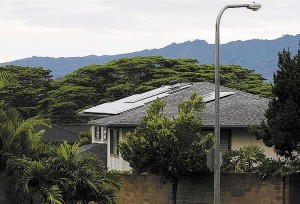
A view of houses with solar panels in the Mililani neighbourhood on the island of Oahu in Mililani, Hawaii  Photo: Hugh Gentry, Reuters Source: www.chicagotribune.com

A view of houses with solar panels in the Mililani neighbourhood on the island of Oahu in Mililani, Hawaii
Photo: Hugh Gentry, Reuters
Source: www.chicagotribune.com

(Reuters) – When Gloria Adams signed a contract to install a rooftop solar power system on her Oahu home in late August, she looked forward to lower electric bills and a return on her investment in the years ahead.

She never dreamed that she would have to stop the project, get the Hawaiian Electric Company’s permission before she could proceed, and possibly help pay for any upgrades to her neighborhood’s electricity circuits to handle the extra load.

Her home improvement ran afoul of a rule that went into effect in September.

The regulation requires homeowners on Oahu – Hawaii’s most populous island – to get the utility’s approval before installing photovoltaic (PV) rooftop solar systems.

In areas like Mililani, where Adams lives, the utility’s power circuits have reached a threshold where it would be dangerous to add PV systems without investing in upgrades to the distribution system.

“We didn’t anticipate having to pay HECO when we took this on,” Adams said. “They are acting like they got caught with their pants down, saying, ‘We don’t know how to deal with this.'”

What’s happening in Hawaii is a sign of battles to come in the rest of the United States, solar industry and electric utility executives said. The conflict is the latest variation on what was a controversial issue this year in top solar markets California and Arizona. It was a hot topic at a solar industry conference last week: how to foster the growth of rooftop solar power while easing the concerns of regulated utilities that see its rise as a threat.

[Read more…]

Cost of solar panels — 10 charts tell you everything

from Cost of Solar

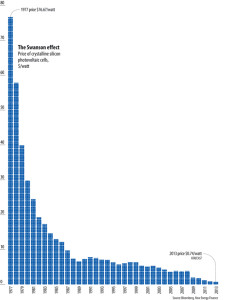
Price of solar power Data source: Bloomberg New Energy Finance (BNEF) Source: www.costofsolar.com

Price of solar power
Data source: Bloomberg New Energy Finance (BNEF)
Source: www.costofsolar.com

1. The average cost of solar panels has gone from $76.67/watt in 1977 to just $0.698/watt today (the second figure is according to PVinsights, and is even lower than the 2013 projected price in the chart below).

Well, that basically tells you everything you need to know right there — the cost of solar panels today is about 100 times lower than the cost of solar panels in 1977 (even more than 100 times lower!) — but I promised 10 charts, so let’s dig in even further and throw on some other fun charts and graphs. […]

Read the full story


Catching sunlight, to sell it

by TESSA CHEEK, The Colorado Independent, December 16, 2013

Photo: Tessa Cheek Source: www.coloradoindependent.com

Photo: Tessa Cheek
Source: www.coloradoindependent.com

Xcel seeks to charge solar panel owners for using the grid, wants more homeowners to buy solar power from Xcel

DENVER — More than 200 protesters gathered in downtown Skyline Park last Wednesday to amp up, march to Xcel Energy headquarters and deliver a petition signed by 30,000 Coloradans in favor of rooftop solar. The energy company recently announced it wants to charge Coloradans with rooftop solar for using the Xcel infrastructure grid — even if they’re using it mainly to provide power to other Xcel customers.

It’s not only solar-panel owners that oppose this idea, said Annie Lappe of the Vote Solar Initiative. “Four out of five Coloradans believe ratepayers with solar should get a fair credit for the energy they put back into the system. That means those same Coloradans also oppose Xcel’s proposed changes.”

The issue of how much solar owners are paid for the energy their homes kick back to the grid came to a head when Xcel submitted its 2014 green energy compliance plan to the Colorado Public Utilities Commission (CPUC). The plan proposed changes to so-called net metering. The proposal would draw credits from a fund specifically for green energy encouragement and it would ask future solar-installers to pay for their occasional use of the private grid Xcel owns and operates.

“It’s not a question of whether we incentivize rooftop solar, but how we do it,” said Ethnie Treick, manager of Policy Analysis at Xcel. “How do we provide solar energy to the most people?”

[Read more…]

Arizona’s new fee puts a dent in rooftop solar economics

by MATTHEW PHILIPS for Businessweek, Mashable, November 24, 2013

Source: www.mashable.com

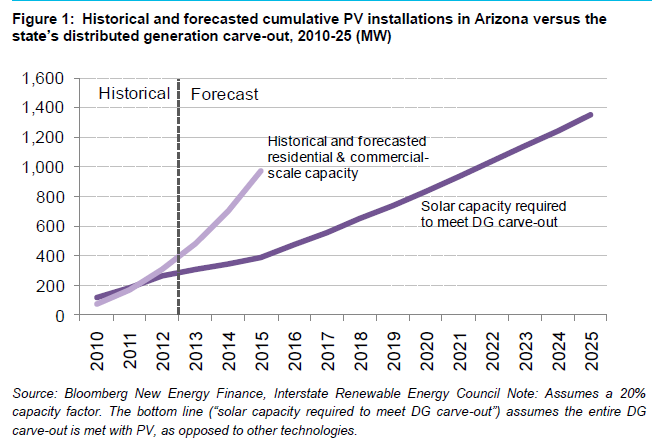
Historical and forecasted cumulative PV installations in Arizona versus the state’s distributed generation carve-outm, 2010-2025 (MW)
Image source: www.mashable.com

Last week, Arizona regulators gave the state’s largest utility, Arizona Public Service, the authority to charge homeowners with solar panels on their roofs a fee for plugging into the grid and in some cases, selling electricity back onto it. Beginning next year, homeowners who install rooftop solar systems will have to pay a monthly levy — the first ever in the U.S. — equal to $0.70 per kilowatt of installed capacity.

That’s well below the $8 per kw that APS had initially sought. Depending on how big their home system is, the fee will end up costing consumers anywhere from $3 to $6 a month, according to a report by Bloomberg New Energy Finance. APS had hoped to be able to charge about $50 a month per home. The 18,000 rooftop solar systems already present in APS’s service territory will be grandfathered; only those installed after Dec. 31 will be subject to the levy.

“This is a body blow for the Arizona solar industry, not a knockout punch,” says Stefan Linder, an analyst with Bloomberg New Energy Finance. “While this fixed fee will cut into the economics of residential solar, for many homeowners it will still make financial sense to go solar.”

The Solar Energy Industries Association claims that a typical rooftop solar system saves a homeowner about $5 to $10 per month; other estimates put it closer to $20.

The decision by the Arizona Corporation Commission is the first stab at resolving a contentious fight that’s been brewing for years between the solar industry and public utilities. Arizona, the second-largest solar market in the U.S., behind California, has been viewed as a critical battleground in deciding whether utilities would be able to squeeze money out of homeowners who no longer buy electricity from them — and in many cases, actually get paid for pushing supplemental power generated by their solar panels back onto the grid.

[Read more…]