From the Blog

Urban gardening for city slickers

by MICHAEL KELLY, Independent.ie, February 25, 2013

Photo: Urban Farm Source: www.urbanfarm.ie

Photo: Urban Farm
Source: www.urbanfarm.ie

There is always a tendency to consider food growing as something that always has to happen in a field or large garden – GIYing is, unfortunately, often considered the preserve of country people or farmers. In reality, it’s an equally viable hobby in an urban environment.

In fact, if we are to provide a genuine alternative to the modern food chain, then food growing is something that is going to have to happen in much smaller spaces.

I visited two projects in Dublin recently that really challenge your assumptions about where food can be produced. The first is Kaethe Burt O’Dea’s blink-and-you-miss-it community garden on Sitric Road in Stoneybatter. The second is what you might call a ‘hyper-urban’ food growing space on the roof of the Chocolate Factory on Kings Inn Street, a stone’s throw from O’Connell St.

The Sitric Community Garden is literally a street corner, a sliver of green space at the end of a terrace of two-up/two-down houses.
[Read more…]

Car companies take expertise in battery power beyond the garage

by TOOD WOODY, The New York Times, March 25, 2014

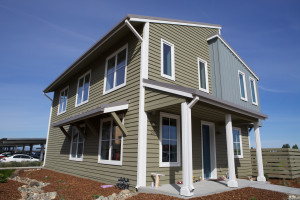
A home by Honda and the University of California, Davis, is expected to make more energy than it consumes. Photo: Thor Swift for The New York Times Source: www.nytimes.com

A home by Honda and the University of California, Davis, is expected to make more energy than it consumes.
Photo: Thor Swift for The New York Times
Source: www.nytimes.com

DAVIS, Calif. — As more homeowners generate their own electricity from solar panels, they still need power from a utility after the sun goes down.

Now, automakers say they may have an answer, by storing that carbon-free energy in electric car batteries for later use.

Honda on Tuesday is introducing an experimental house in this environmentally conscious community to showcase technologies that allow the dwelling to generate more electricity than it consumes.

It is one example of the way solar companies and carmakers are converging on a common goal: to create the self-sufficient home, with a car’s battery as the linchpin.

With buildings and transportation accounting for 44 percent of the United States’ greenhouse gas emissions, car companies increasingly view all-electric and hydrogen fuel-cell cars as vehicles that will meet environmental mandates and lead to development of new energy services and products beyond the garage.

[Read more…]

Grow a beautiful garden with ecofriendly greywater

by LEIGH JERRARD, Houzz, March 20, 2014

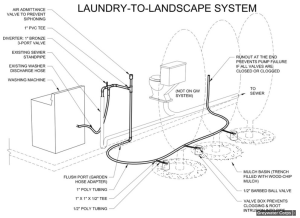
Laundry-to-Landscape System Image: Greywater Corps Source: www.houzz.com

Laundry-to-Landscape System
Image: Greywater Corps
Source: www.houzz.com

You’re probably irrigating your yard with drinking water, since the same water that comes out of your kitchen faucet also comes out of your hose bibs. But do your plants need drinking water? It turns out that most plants are perfectly happy with gently used water from showers, bathtubs, laundry and sinks — or greywater (also “graywater”). This works out well, because the average American household uses about half its water indoors and the other half outside for irrigation. Some households can cut their water bills almost in half by irrigating with greywater.

Now that large swaths of the country are facing historic drought conditions — and the possibility that these droughts are the new normal — it especially doesn’t make sense to send usable water down the drain. You can recapture that water and use it again. There are other benefits to greywater, too. It reduces a home’s carbon footprint, since moving and treating water consumes a tremendous amount of power. It protects the aquatic ecosystems from whence your water comes. It reduces loads on sewage systems (which lowers the carbon footprint) and puts water back into the local aquifer, which is better than dumping it into rivers, lakes and oceans. If you’re on a septic tank, it reduces loads on the system, prolonging your service intervals. And it helps grow a beautiful and bountiful garden.

Greywater systems don’t look like normal irrigation. For one thing, there’s stuff in it — small amounts of soap, hair, laundry lint etc. You can either process the water and try to filter everything out, or you can use larger pipes and emitters and send the water to your garden as is. The latter is the better option — ideally, a greywater system should be low tech and dependable, with a minimum of parts to break and filters to maintain.

[Read more…]

How rooftop farming will change how we eat: Mohamed Hage at TEDx UdeM

Présentation de Mohamed Hage, président fondateur des Fermes Lufa lors de la conférence TEDx UdeM le 11 mars 2012.

Site TEDx UdeM


Pullman factory to feature rooftop greenhouses, solar panels, wind turbine

by QUINN FORD, DNAinfo Chicago, March 4, 2014

Rendering of the factory Renderings: William McDonough+Partners Source: www.chicago.curbed.com

The factory will include a wind turbine, solar panels and rooftop greenhouse
Renderings: William McDonough+Partners
Source: www.chicago.curbed.com

Construction on an environmentally-friendly manufacturing plant is officially underway on the city’s South Side.

Method, a company which boasts natural, nontoxic cleaning products, held an official groundbreaking ceremony for a $33 million plant being built in the Pullman neighborhood.

The plant, which was announced in July, is scheduled to open early next year and will be the company’s first manufacturing facility in the United States.

The company was lured to the South Side neighborhood in part by $9 million in city Tax Increment Financing funds as well as $1.1 million in state tax credits over 10 years.

The project will evenutally create nearly 100 jobs in the area once the factory is complete. Ald. Anthony Beale (9th) said the plant will provide a big economic boost to a neighborhood originally developed as a factory town.

“There hasn’t been a manufacturing company on the South Side in the city of Chicago for almost 30 years,” Beale said, prompting applause.

The plant’s plans call for a 230-foot wind turbine and solar panels that the company said will meet half the plant’s energy needs. Plans also call for greenhouses to cover the building’s roof, which company officials said will be rented out to vendors to grow fresh fruit and vegetables.

[Read more…]

Rooftop farm produces up to 10 times more than traditional farms

by EILEEN POH, Channel NewsAsia, February 14, 2014

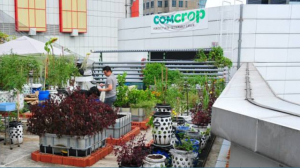
Comcrop is a vegetable and fish farm located on the rooftop of *SCAPE. (Photo: Photo: Comcrop Source: www.channelnewsasia.com

Comcrop is a vegetable and fish farm located on the rooftop of *SCAPE.
Photo: Comcrop
Source: www.channelnewsasia.com

Tucked away in the heart of Orchard Road is a vegetable and fish farm called Comcrop located on the rooftop of *SCAPE. With 6,000 square feet of space, it can produce eight to 10 times more than traditional farms over the same area by using vertical farming techniques.

Tucked away in the heart of Orchard Road is a uncommon sight for Singapore’s main shopping belt.

A vegetable and fish farm called Comcrop is located on the rooftop of *SCAPE.

With 6,000 square feet of space, it can produce eight to 10 times more than traditional farms over the same area by using vertical farming techniques.

The farm also uses aquaponics, a self-sustaining system that breaks down by-products from tilapia, a type of fish, which are utilised by plants as nutrients. The clean water is then fed back to the plants.

[Read more…]