From the Blog

Vegetated roofs sprouting up across North America

by Construction Canada, May 21, 2014

Green Roofs for Healthy Cities’ (GRHC’s) new survey suggests a 10 per cent growth in vegetated roofing assemblies across North America.

Data is collected from GRHC’s members on the size, location, and type of green roofs that have been installed within the year.

“We are pleased to see the continued expansion of the green roof market,” GRHC president Steven W. Peck said. “The industry’s continued growth is fuelled by the multiple public and private benefits green roofs bring, such as stormwater management, reducing the urban heat island, energy savings, and green jobs.”

Overall, responses demonstrate 596,580 m2 (6,421,538 sf) of green roofing was installed last year on 950 projects. Toronto, Montréal, and Calgary made the top 10, with Washington, D.C., taking the first spot.


Read the 2013 Annual Green Roof Industry Survey

Read the original story

Cover story: The magical rooftops of New York

by  MINA KANEKO and FRANCOISE MOULY, The New Yorker, May 12, 2014

“I painted a future that’s completely achievable,” Eric Drooker says of this week’s cover, “A Bright Future.” “All the technology for it already exists,” he adds. “What’s lacking is the political power to make it happen. In New York especially, the city has so much potential. When you fly overhead, you see that New York’s mostly a sea of flat, empty rooftops, with the streets in between as small alleys.”

“That was one of the things I loved best about being a kid in New York, spending time on rooftops. No one ever used them, which was amazing to me. You’d think that people would hang out there and grow gardens. You have these amazing views, and you have the whole city to yourself; it’s a magical place.”

Cover of the May 19, 2014 edition of The New Yorker Image: Eric Drooker Source: www.newyorker.com

Cover of the May 19, 2014 edition of The New Yorker
Image: Eric Drooker
Source: www.newyorker.com

See more covers celebrating New York rooftops and read the original story 

Potagers 101

par CAROLE THIBAUDEAU, La Presse, 13 mai 2014

Comme tout espace vert, le potager combat les îlots de chaleur et charme par sa beauté et ses parfums Photo: Digital / Thinkstock  Source: www.lapresse.ca

Comme tout espace vert, le potager combat les îlots de chaleur et charme par sa beauté et ses parfums
Photo: Digital / Thinkstock
Source: www.lapresse.ca

Un ménage montréalais sur deux cultive au moins un petit quelque chose de comestible, plant de tomate sur le balcon, fraises en jardinière ou potager plus complexe.

«On arrive à 51% des ménages ou 42% des Montréalais, suivant l’un ou l’autre des sondages*», précise Gaëlle Janvier, chargée de projet chez Alternatives, une ressource en agriculture urbaine à Montréal.

«Produire localement des denrées est en train d’entrer dans les moeurs, affirme l’agronome Claude Vallée, professeur à l’Institut de technologie agroalimentaire (ITA), campus de Saint-Hyacinthe. C’est beaucoup plus qu’un engouement passager.»

Pour la plupart des jardiniers amateurs, il s’agit d’«un savoir-faire redécouvert, et non pas hérité des parents», observe Marie Eisenman, cofondatrice des Urbainculteurs, qui distribuent les sacs de géotextile Smart Pots.

[Read more…]

Students can learn to garden in series of University of Maryland-hosted workshops

by MADELEINE LIST, The Diamondback, February 20, 2013

Photo: Diana Daisey Source: www.diamondbackonline.com

Photo: Diana Daisey
Source: www.diamondbackonline.com

Most students have to rely on the dining halls or fast food options for food, but some will soon learn how to grow their own.

All it takes are the right tools and techniques and a little bit of guidance. And that’s where Melissa Avery steps in.

Last Tuesday, nearly 20 students gathered at the Apiary for the first in a series of winter workshops about gardening. The Arboretum and Botanical Garden and a collaboration of the university’s Community Gardens hosted the workshop, called Gardening 101. Avery, master gardener in training, instructed attendees on the basics of gardening, and answered questions from students about how to raise their own plants.

Because winter isn’t the season for planting, people interested in gardening have a few weeks before spring to learn the basics, said Yixin Chen, communications manager for the public health garden and sophomore nutritional science major.

“It’s a great way for people who are interested in gardening to realize, ‘Oh yeah, I can do this.’ Having that knowledge is a big first step,” she said.

Georgia Handforth, a co-manager at the Rooftop Community Garden and a senior communications and sociology major, said it’s beneficial for students to learn how to grow their own plants on the campus.

[Read more…]

Corporate roof garden trend gains pace

by SARAH COSGROVE, Hosticulture Week, May 2, 2014

Battersea Power Station office and residential roof gardens Image: Andy Sturgeon Source: www.hortweek.com

Battersea Power Station office and residential roof gardens
Image: Andy Sturgeon
Source: www.hortweek.com

Benefits of green roofs increasingly recognised by developers reinvigorating dead spaces, say leading garden designers.

Businesses are increasingly investing in roof gardens on top of corporate buildings to boost their business and benefit staff.

John Lewis opens a roof garden on its Oxford Street store on 3 May to celebrate its 150th anniversary, while garden designer Andy Sturgeon has revealed his designs for three Battersea Power Station office and residential roof gardens.

Construction is underway for the Gillespies-designed Sky Garden on top of London’s “Walkie Talkie” building (20 Fenchurch Street) and at a public roof garden on the new Canary Wharf Crossrail station.

RHS young designer of the year 2013 Tony Woods designed the John Lewis garden, with his company Garden Club London building it. The garden will be open to the public for 15 weeks for a series of events including a World Cup party.

Woods designed around a pop-up juice bar, restaurants and a kitchen and toilet block that had been airlifted onto the roof, where schoolchildren will grow vegetables and salads. Home-grown strawberries, rosemary and lavender will go to the caterers.

[Read more…]

Urban farms in Taipei and Tokyo improve office life

by WEN-JAY YING, Untapped Cities, February 25, 2014

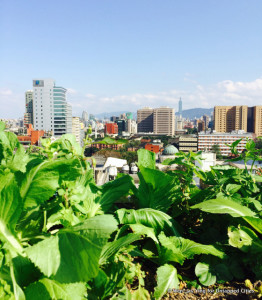
Winkler Partners Law Firm office houses one of the first rooftop gardens in Taipei Photo: Wen-Jay Ying Source: www.untappedcities.com

Winkler Partners Law Firm office houses one of the first rooftop gardens in Taipei
Photo: Wen-Jay Ying
Source: www.untappedcities.com

Walking out onto the roof of Winkler Partners Law Firm, arugula and strawberry plants frame the silhouette of buildings and mountain tops that make up the Taipei skyline. “Here’s my business card. That side is how I make money, the other is how I spend money,” says Robin Winkler, an American expat and our host for the day. The card states Winkler Partners Law Firm and the flip side reads Wild at Heart Legal Defense Association. His hobby, Wild at Heart, is the first environmental legal defense fund in Taipei, but his day job isn’t too bad either. The Winkler Partners office houses one of the first rooftop gardens in Taipei.

Robin shows us three rainwater tanks that are used to water plants during droughts. In Taiwan, precipitation varies dramatically and rainwater tanks are essential to help with both flooding and dry spells. The rooftop also has a compost toilet, which surprisingly has no smell. The matter is stored in tubs that will eventually be used to feed their plants.

There are passionfruit trees, strawberries plants, leafy greens, and about forty other edible plants and 300 other species that find a home on the law firm’s rooftop garden. Employees are encouraged to help out with the garden. Robin and his colleagues wanted a space to share information about plants and to make the office a place where you could take a break from… well, the office. It’s their alternative to the common workplace culture and a symbol for jobs with dignity. Ideas for a greener Taiwan extend further than their urban oasis, with intentions to share horticulture with the community through composting workshops and youth education programs.

[Read more…]