From the Blog

Des logements attrapent la lumière pour tendre vers l’énergie positive

par MILENA CHESSA et ERIC LEYSENS, lemoniteur.fr, 26 février 2013
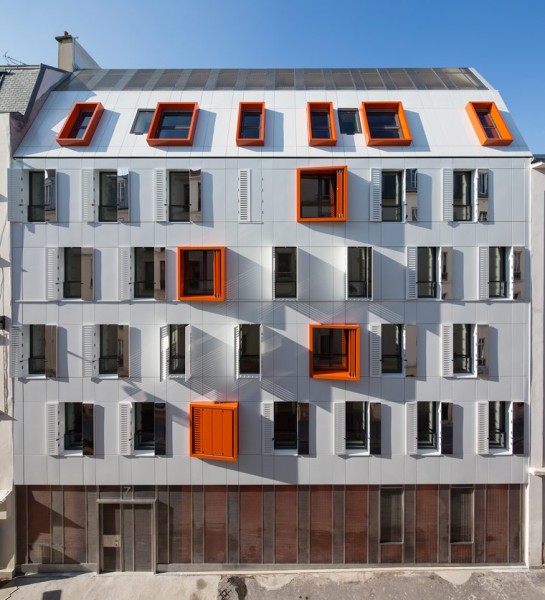
Façade est sur rue. Photo: Luc Boegly Source: www.lemoniteur.fr

Façade est sur rue.
Photo: Luc Boegly
Source: www.lemoniteur.fr

La Régie immobilière de la Ville de Paris (RIVP) a inauguré le 25 février une opération de 17 logements sociaux dans le 11e arrondissement. Panneaux photovoltaïques, miroirs réflecteurs et puits de lumière, les solutions techniques mises en œuvre par l’agence d’architecture Baudouin Bergeron permettent d’estampiller le bâtiment Bepos.

Livré vendredi 22 février, habité samedi 23, inauguré lundi 25. Le bâtiment situé au 7, rue Guénot à Paris (11e) était très attendu. D’autant qu’il avait attiré l’attention dès sa conception en 2009, en s’annonçant comme le premier immeuble de logement social à énergie positive de la capitale (voir notre article). L’objectif affiché par le maître d’ouvrage, la RIVP, était de « démontrer la faisabilité technique et économique d’un [tel] bâtiment dans le tissu urbain parisien ». « Cette demande inhabituelle nous a poussé dans nos retranchements, explique l’architecte Hélène Bergeron, associée à Laurence Baudouin. Nous avons travaillé avec le bureau d’étude thermique Pouget Consultants dès les esquisses pour que l’immeuble consomme peu et évite les systèmes trop technologiques, trop compliqués, nécessitant trop d’entretien. Ici, pas de ventilation double-flux, les habitants sont libres d’ouvrir la fenêtre s’ils ont chaud et de la refermer s’ils ont froid. »

Produire sur le toit autant que l’énergie consommée dessous

Le maître d’ouvrage et le maître d’œuvre parlent de bâtiment à énergie positive car, dans les simulations, les 33 kWh d’énergie primaire/m².an produits par les 127 m² de panneaux photovoltaïques installés en toiture dépassent la consommation des cinq postes pris en compte par la réglementation thermique – chauffage, ECS, éclairage, ventilation et auxiliaires – qui s’élève à 32 kWhep/m².an. « Il était nécessaire de produire sur le toit autant que l’énergie consommée sous le toit », rappellent les architectes.

Mais ce bâtiment peut-il prétendre au label Bepos qui impose que les consommations électrodomestiques (téléviseurs, ordinateurs,…) figurent dans le bilan énergétique ? Pour cet immeuble situé en centre urbain dense et s’élevant sur six niveaux, l’exigence imposée par le nouveau label est que la consommation non renouvelable – électrodomestique inclus – ne dépasse pas de plus 70 kWhep/m².an la production électrique photovoltaïque (pour comprendre le détail du calcul, voir notre article). Le bilan énergétique du bâtiment coïncidant bien avec cet écart à l’énergie positive, il pourra être estampillé Bepos.

Les occupants devront normalement assumer des charges de chauffage (air et eau) trois fois inférieures à celles qu’ils auraient dû payer dans un bâtiment RT 2005. Pierre Aidenbaum, président de la Régie immobilière de la Ville de Paris, espère que cet immeuble de 17 logements sociaux aujourd’hui réalisé devienne une « référence » et un « exemple pour le secteur privé ».

FOCUS
Fiche technique

Maîtrise d’ouvrage : Régie immobilière de la Ville de Paris (RIVP).

Maîtrise d’œuvre : Baudouin Bergeron architectes, architectes. Pouget Consultants, BET thermique ; LGX Ingénierie, BET TCE et économie.

Entreprise générale : Francilia.

Entreprises sous-traitantes : Snipca (plomberie et chauffage), CTP (peinture), Vibig (cloisons doublages), Batei (étanchéité), Da Silva frères (isolation thermique extérieure), Vertikal (volets et stores), RMJ (installation de production photovoltaïque), Samson (serrurerie), Batex (bardages métalliques), Ducloux (murs à ossature bois et charpente), Coralec (électricité, hors photovoltaïque), Oleolift (appareils élévateurs).

Surfaces : 1453 m2 Shon, 1765 m2 Shob, 1033 m2 Shab.

Coût des travaux : 3,1 millions d’euros HT.
Lire l’article original

In the book bag, more garden tools

by LISA W. FODERARO, The New York Times, November 23, 2012

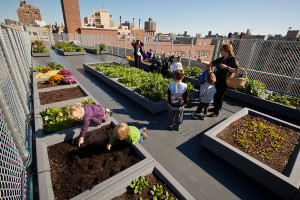
Children at the 2,400-square-foot Fifth Street Farm, a garden atop three East Village schools Photo: Ángel Franco Source: The New York Times

Children at the 2,400-square-foot Fifth Street Farm, a garden atop three East Village schools
Photo: Ángel Franco for The New York Times
Source: The New York Times

In the East Village, children planted garlic bulbs and harvested Swiss chard before Thanksgiving. On the other side of town, in Greenwich Village, they learned about storm water runoff, solar energy and wind turbines. And in Queens, students and teachers cultivated flowers that attract butterflies and pollinators.

Across New York City, gardens and miniature farms — whether on rooftops or at ground level — are joining smart boards and digital darkrooms as must-have teaching tools. They are being used in subjects as varied as science, art, mathematics and social studies. In the past two years, the number of school-based gardens registered with the city jumped to 232, from 40, according to GreenThumb, a division of the parks department that provides schools with technical support.

But few of them come with the credential of the 2,400-square-foot garden at Avenue B and Fifth Street in the East Village, on top of a red-brick building that houses three public schools: the Earth School, Public School 64 and Tompkins Square Middle School. Michael Arad, the architect who designed the National September 11 Memorial in Lower Manhattan, was a driving force behind the garden, called the Fifth Street Farm.

The idea took shape four years ago among parents and teachers, when Mr. Arad’s son was still a student at the Earth School. The family has since moved from the neighborhood to Queens, but Mr. Arad, president of a nonprofit corporation that oversaw the garden, stayed on. The farm, with dozens of plants ranging from leeks to lemon balm, opened Oct. 19. Already, students have learned about bulbs and tubers, soil science and nutrition, while the cafeteria has cooked up fresh kale and spinach for lunch.

Read the article…

Reducing your carbon footprint

by SUSAN STELLIN, The  New York Times, February 15, 2013

Many people believe that Hurricane Sandy made the consequences of climate change painfully clear, so it might be tempting to think that stricter emissions standards and renewable-energy investments could lead to a less stormy future. But while these high-level policy initiatives are important, changes on the home front matter, too.

“Residential housing accounts for 29 percent of all the energy used in New York State,” said Frank Murray Jr., the president and chief executive of the New York State Energy Research and Development Authority, which goes by the acronym Nyserda. That includes a lot of home printers with their power on 24/7 and lights illuminating empty rooms.

If the virtue of reducing your carbon footprint is not enough of an incentive, the United States Department of Energy estimates that the typical American family spends about $2,000 a year on utility bills. Changing some energy habits might not drastically reduce your total bill, but even small savings add up over the years — and your home would be less of a drain on the grid.

Turn Down, Screw In, Unplug

Many energy-saving strategies are free or inexpensive, and technology makes it easier to follow through on advice most people have heard, but don’t always heed. ‘Smart’ power strips, for example, automatically shut down power to electronics that aren’t in use — like your printer or DVD player — but also have outlets marked “always on” for devices that need continuous power, like a DVR. Other advanced power strips come with a remote control, so you can switch them off without crawling around on the floor. A quick scan of your home is likely to reveal appliances that can be unplugged, like a window air-conditioner in the winter or a gaming console the kids no longer use. […]

Read the original story

Nyserda’s Recommandations

Nyserda’s “bulbology” page

In organic-hungry Hong Kong, corn as high as an elevator’s climb

by MARY HUI, The New York Times, October 3, 2012

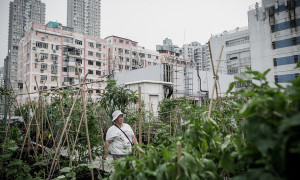
Plots like the rooftop City Farm are sprouting across Hong Kong amid fears of tainted imports Photo: Philippe Lopez (Agence France-Presse) Source: The New York Times

Plots like the rooftop City Farm are sprouting across Hong Kong amid fears of tainted imports
Photo: Philippe Lopez (Agence France-Presse)
Source: The New York Times

HONG KONG — Kimbo Chan knows all about the food scandals in China: the formaldehyde that is sometimes sprayed on Chinese cabbages, the melamine in the milk and the imitation soy sauce made from hair clippings. That is why he is growing vegetables on a rooftop high above the crowded streets of Hong Kong.

“Some mainland Chinese farms even buy industrial chemicals to use on their crops,” Mr. Chan said. “Chemicals not meant for agricultural uses at all.”

As millions of Hong Kong consumers grow increasingly worried about the purity and safety of the fruits, vegetables, meats and processed foods coming in from mainland China, more of them are striking out on their own by tending tiny plots on rooftops, on balconies and in far-flung, untouched corners of highly urbanized Hong Kong.

“Consumers are asking, will the food poison them?” said Jonathan Wong, a professor of biology and the director of the Hong Kong Organic Resource Center. “They worry about the quality of the food. There is a lack of confidence in the food supply in China.”

Organic food stores are opening across the city, and there is growing demand in the markets for organic produce despite its higher prices. There are about 100 certified organic farms in Hong Kong. Seven years ago, there were none.

There is no official count of rooftop farms in Hong Kong, but they are clearly part of an international trend. New York has many commercialized rooftop farms established by companies like Gotham Greens, Bright Farms and Brooklyn Grange. In Berlin, an industrial-size rooftop vegetable and fish farm is in the pipeline. In Tokyo, a farm called Pasona O2 takes urban farming a step further: Vegetables are grown not only on roofs, but also in what was an underground bank vault. […]

Read the original story

See also:


Huge rooftop farm is set for Brooklyn

LISA W. FODERARO, The New York Times, April 5, 2012

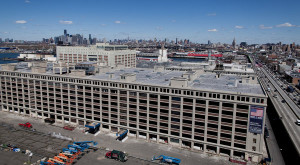
An old Navy warehouse in Sunset Park will be home to a hydroponic greenhouse of up to 100,000 square feet. The developer says it will be the largest such greenhouse in the country Photo: Eric Michael Johnson for The New York Times Source: The New York Times

An old Navy warehouse in Sunset Park will be home to a hydroponic greenhouse of up to 100,000 square feet. The developer says it will be the largest such greenhouse in the country
Photo: Eric Michael Johnson for The New York Times
Source: The New York Times

Brooklyn is fast becoming the borough of farms. On Thursday, Bright Farms, a private company that develops greenhouses, announced plans to create a sprawling greenhouse on a roof in Sunset Park that is expected to yield a million pounds of produce a year — without using any dirt.

The hydroponic greenhouse, at a former Navy warehouse that the city’s Economic Development Corporation acquired last year, will occupy up to 100,000 square feet of rooftop space. Construction is scheduled to start in the fall, with the first harvest expected next spring.

When finished, the greenhouse will rank as the largest rooftop farm in the United States — and possibly the world, Bright Farms officials say. This spring, Brooklyn Grange, another rooftop farm developer, is set to open a 45,000-square-foot commercial operation at the Brooklyn Navy Yard.

“Brooklyn was an agricultural powerhouse in the 19th century, and it has now become a local food scene second to none,” said Paul Lightfoot, the chief executive of Bright Farms. “We’re bringing a business model where food is grown and sold right in the community.”

Mr. Lightfoot said that the company was in talks with supermarket chains that would potentially commit to buying produce from the Sunset Park farm, which will include a variety of lettuces, tomatoes and herbs. “We’re looking for a long-term contract with one client who operates grocery stores,” he said.

Read the article…

Challenging the reputation of hospital food on a rooftop farm

by ANEMONA HARTOCOLLIS, The New York Times, October 18, 2012

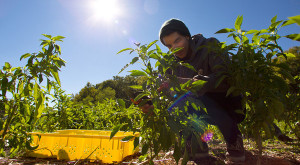
At Stony Brook University Hospital, a farm has been a team effort. Interns like Nadeem Marghoob plant and harvest the crops Photo: Uli Seit for The New York Times Source: The New York Times

At Stony Brook University Hospital, a farm has been a team effort. Interns like Nadeem Marghoob plant and harvest the crops
Photo: Uli Seit for The New York Times
Source: The New York Times

STONY BROOK, N.Y. — The weather report said the first frost was coming, and the farmer and her three helpers skittered around the rooftop garden snipping the tenderest plants — basil, green peppers, a few heirloom tomatoes — so they would not be ruined. Over the next few days, they would be chopped into sauces and garnishes and served up in covered dishes by room service waiters wearing dapper black suits.

But this was not a hotel in the more trendy precincts of Manhattan or San Francisco. It was Stony Brook University Hospital, in the middle of Suffolk County, Long Island, where a rooftop farm is feeding patients and challenging the reputation of hospital food as mushy, tasteless and drained of nutrients. (No, Jell-O is not growing on the roof.) But the sick, who have bigger problems than whether their broccoli is local and sustainable, can be tough customers.

“Swiss chard went over well, kale maybe not so much,” said Josephine Connolly-Schoonen, executive director of the nutrition division at the hospital. “When people are not feeling well, they want their comfort foods.”

Hundreds of hospitals across the country host a farmer’s market, have a garden on their grounds that supplies fresh produce or buy at least some of their food from local farms, ranches and cooperatives, according to a survey by Health Care Without Harm, an international coalition of health care groups.

Read the article…