From the Blog

Catching sunlight, to sell it

by TESSA CHEEK, The Colorado Independent, December 16, 2013
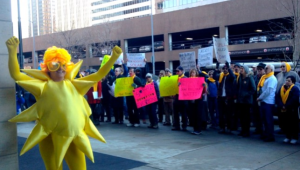
Photo: Tessa Cheek Source: www.coloradoindependent.com

Photo: Tessa Cheek
Source: www.coloradoindependent.com

Xcel seeks to charge solar panel owners for using the grid, wants more homeowners to buy solar power from Xcel

DENVER — More than 200 protesters gathered in downtown Skyline Park last Wednesday to amp up, march to Xcel Energy headquarters and deliver a petition signed by 30,000 Coloradans in favor of rooftop solar. The energy company recently announced it wants to charge Coloradans with rooftop solar for using the Xcel infrastructure grid — even if they’re using it mainly to provide power to other Xcel customers.

It’s not only solar-panel owners that oppose this idea, said Annie Lappe of the Vote Solar Initiative. “Four out of five Coloradans believe ratepayers with solar should get a fair credit for the energy they put back into the system. That means those same Coloradans also oppose Xcel’s proposed changes.”

The issue of how much solar owners are paid for the energy their homes kick back to the grid came to a head when Xcel submitted its 2014 green energy compliance plan to the Colorado Public Utilities Commission (CPUC). The plan proposed changes to so-called net metering. The proposal would draw credits from a fund specifically for green energy encouragement and it would ask future solar-installers to pay for their occasional use of the private grid Xcel owns and operates.

“It’s not a question of whether we incentivize rooftop solar, but how we do it,” said Ethnie Treick, manager of Policy Analysis at Xcel. “How do we provide solar energy to the most people?”
[Read more…]

Farmer proves potential of rooftop planting

by Zhu Ningzhu (editor), English, news.cn, November 20, 2013

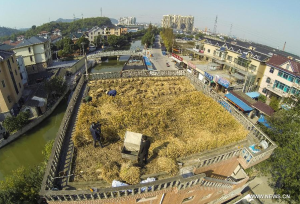
Farmers help villager Peng Qiugen harvest rice on the roof of Peng's house which had been converted into a rice field at Qilin Village of Shaoxing CitySource: www.news.cn

Farmers help villager Peng Qiugen harvest rice on the roof of Peng’s house which had been converted into a rice field at Qilin Village of Shaoxing City
Source: www.news.cn

Hangzhou (Xinhua) — In Chinese language, most farmers go “down” to the field to harvest crops, but one farmer from an eastern village in China goes “up” to the roof to reap rice.

Peng Qiugen, a “landless” farmer who transferred his land to a gardening company seven years ago, just harvested over 100 kg of rough rice on his 120-square-meter rooftop this week.

“My greatest wish is to save more land for China by promoting rooftop farming to more households,” Peng told Xinhua.

He calculated that a roof as large as his, if used for growing vegetables, can meet the daily demands of 20 people.

In Peng’s village, Qilin in east China’s Zhejiang Province, most farmers have circulated their land to scale planting individuals and companies in exchange for a steady income and an opportunity to try out other jobs that would presumably bring more economic gains.

Some have become factory workers, others have started businesses. For Peng, he has tried both and more, saying, “I accept any jobs within my ability that can improve the living conditions for my family.”

A wealthier material life, however, has never changed his passion for land and farming.

When he started to build his four-story house in 2006, he thought about transforming the roof into a piece of arable land.

[Read more…]

Elevated park at trade center site comes into view

by DAVID W. DUNLAP, The New York Times, November 20, 2013

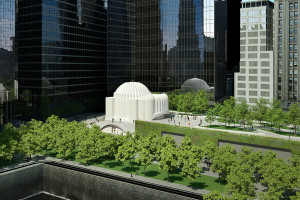
A rendering of the new St. Nicholas Greek Orthodox Church, with conceptual images of a landscaped open space known as Liberty Park Image: Santiago Calatrava Source: www.nytimes.com

A rendering of the new St. Nicholas Greek Orthodox Church, with conceptual images of a landscaped open space known as Liberty Park
Image: Santiago Calatrava
Source: www.nytimes.com

The World Trade Center’s best-kept secret has finally come to light.

It is an elevated park, slightly larger than an acre and 25 feet above Liberty Street, that will command a panoramic view of the National September 11 Memorial when it opens to the public, probably in 2015.

Liberty Park, as it is called, is meant to offer a pleasant and accessible east-west crossing between the financial district and Battery Park City; to create a landscaped forecourt for the new St. Nicholas Greek Orthodox Church; to provide a gathering space for as many as 750 people at a time; to allow visitors to contemplate the whole memorial in a single sweeping glance from treetop level; and to serve as the roof of the trade center’s vehicle security center.

For the moment, the park is an empty concrete expanse. The pedestrian bridge over West Street that will connect it to Battery Park City — the bridge that survived the Sept. 11 attack — currently falls several yards short of its future landing spot.

While the general outlines of the park have been known for years, the Port Authority of New York and New Jersey has been sparing in its public discussion of the project, in part because not every detail of its design and construction has been settled.

But the Port Authority’s hand was forced somewhat last month when sumptuous images of St. Nicholas Church and Liberty Park appeared on the website of the architect Santiago Calatrava, who is designing the church. The park was rendered in sufficient detail that it was possible for the first time to understand its basic design. […]

Read the full story

Related articles :
Church Near Trade Center to Echo Landmarks of East
First Look: Santiago Calatrava’s Design for St. Nicholas Church

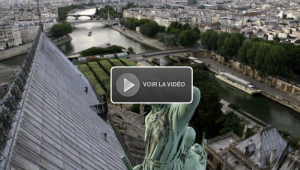
Sur les toits de Paris

Sur les toits de ParisDiffusion sur France 5 d’un documentaire sur les toits de Paris le 17 novembre dernier.

Visionnement en ligne disponible jusqu’au 24 novembre (non disponible hors France).

Redifusion

24 novembre 2013, 16h05
16 décembre 2013, 16h35

Résumé

Contrairement aux boulevards et aux monuments, les toits de Paris, loin des images de carte postale, font partie d’un monde méconnu, inaccessible pour la plupart des habitants et des touristes de la ville lumière. Mais quelques privilégiés ont fait de ce jardin secret leur univers quotidien. C’est le cas de Thomas, funambule qui cherche à capter avec son appareil photo l’âme de la capitale. Michaël Blassel est quant à lui l’un des rares à pouvoir accéder au dôme des Invalides. Benjamin Mouton, architecte en chef de Notre-Dame, ouvre les portes de ces lieux interdits au public et raconte l’histoire de la capitale, à travers ses toits, en évoquant leurs couleurs et les matériaux qui les composent. Rencontre également avec ceux qui souhaitent faire des toits un haut lieu de la nuit parisienne.

Klyde Warren Park, Dallas

by LAURA MIRVISS, Architectural Record, August 2013

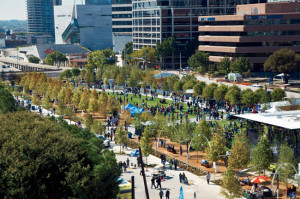
The ambitious Klyde Warren Park covers a 1,200-foot-long stretch of the Woodall Rodgers Freeway. A serene, 2,400-square-foot concert pavilion by Thomas Phifer and Partners is open on all sides Photo: Dillon Diers Photography Source: www.archrecord.construction.com

The ambitious Klyde Warren Park covers a 1,200-foot-long stretch of the Woodall Rodgers Freeway. A serene, 2,400-square-foot concert pavilion by Thomas Phifer and Partners is open on all sides
Photo: Dillon Diers Photography
Source: www.archrecord.construction.com

Decked out in Dallas: A sprawling rectangular park on top of a major freeway unites an up-and-coming residential neighborhood with the burgeoning Arts District.

 As in many American cities, large highways slice through downtown Dallas. Sidewalks seem intermittent, parking lots abundant, and locals respond with strange looks when asked the best way to walk to a nearby bar or restaurant.

But Dallas is pouring millions of dollars into changing all that. In the past decade, the city has quietly inserted a handful of small green gardens between downtown office towers and condos, providing small reprieves from the expanses of asphalt and concrete. As part of this initiative, over ten years ago, local civic leaders began talking to a team of designers and engineers about coming up with a scheme for uniting the city’s fractured downtown by covering over an existing freeway with a park.

Now, $110 million later, the design team, Jacobs Engineering Group, along with landscape architect The Office of James Burnett, has delivered something radical—5.2 acres of green space laid across an eight-lane highway. The Woodall Rodgers Freeway, oriented northeast-southwest and depressed to minimize traffic noise, ran underneath a number of perpendicular at-grade bridges used as cross streets. The park now fills the gaps between the bridges to create a 1,200-by-200-foot three-block-long deck between Pearl and St. Paul streets. “You only realize you’re near a freeway at the ends of the park,” says principal James Burnett. “You can’t hear the roar of traffic below.”

[Read more…]

Eskenazi Hospital prepares to open

by JOHN RUSSELL, The Indianapolis Star, November 16, 2013

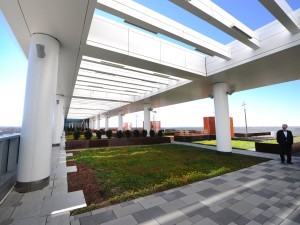
Sky Farm on the roof of the new Eskenazi Health Hospital.  Photo: Matt Kryger / The Star Source: www.indystar.com

Sky Farm on the roof of the new Eskenazi Health Hospital
Photo: Matt Kryger / The Star
Source: www.indystar.com

Rooftop vegetable garden, sculptures add unique touches to Wishard’s replacement

Indiana has never seen a hospital quite like this.

From the spiraling wooden sculpture suspended from the ceiling in the main concourse to the vegetable garden on the roof, the brand-new Eskenazi Hospital keeps you wondering what you will see around the next corner.

The $754 million hospital, which will serve mostly poor and underinsured patients, is nearly ready to open, after four years of planning and construction. The public can tour the hospital from 11 a.m. to 5 p.m. today.

The massive complex, spread out on 37 acres, will replace Wishard Hospital, a deteriorating hodgepodge of buildings, some a century old. On Dec. 7, an army of hospital workers will move patients from the old building to the new one a block away.

The new hospital is the latest addition to Indiana’s hospital construction boom over the last decade, a period in which more than $1 billion in new facilities sprouted up around Central Indiana, from specialty heart clinics to luxurious medical centers in the suburbs.

Each of Indiana’s dozens of hospitals seems to have a distinctive personality, from the luxurious Indiana University Health North Hospital in Carmel, with posh fireplace lounges and cherry wood bassinets, to the kid-friendly Riley Hospital for Children, with its signature red wagons and play rooms.

The feel at Eskenazi Hospital is bright and welcoming. Sunlight pours through windows in every patient room, waiting room and hallway. The public areas are filled with colorful art, from historical oil paintings to whimsical photographs of the city.

The goal, officials say, is to be comforting for people entering the doors for what is often a frightening, high-stress experience.

“We want this to be the most patient-friendly, family-friendly, simple-to-use hospital you can find,” said Matthew R. Gutwein, president and chief executive of Marion County Health and Hospital Corp., which operates the hospital.

[Read more…]