From the Blog

Pop-up hotels: Rooms with a fleeting view

by STEPHANIE ROSENBLOOM, The New York Times, March 19, 2013
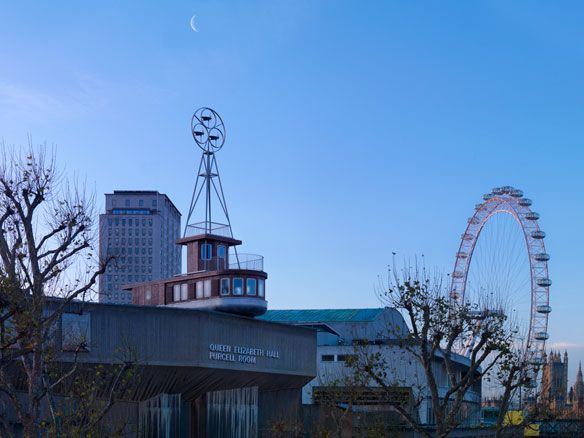
A room for London Photo: Charles Hosea Source: www.aroomforlondon.co.uk

A room for London
Photo: Charles Hosea
Source: www.aroomforlondon.co.uk

POP-UP STORES. Pop-up restaurants. Pop-up lounges. Shouldn’t this fascination with pop-ups — which are by definition ephemeral — have disappeared already?

Hotels offer compelling reasons for the trend to endure. Unlike temporary stores and lounges designed to hawk clothes and cocktails, temporary hotels allow travelers to sleep in unique spaces (boats, tricked-out shipping containers) and forbidden places (public parks, racetracks). The hotels also enable festivalgoers around the world to upgrade from sleeping bags and tents to rooms with beds, rain showers and iPod docking stations. (…)

A Room for London

This one-bedroom hotel (talk about exclusive) is actually a boat balanced atop the roof of Southbank Center, the London art complex onthe bank of the Thames. Inspired by the boat that the author Joseph Conrad navigated up the River Congo in the 19th century before writing “Heart of Darkness,” it has decks that offer views of London icons like Big Ben and St. Paul’s Cathedral.

Read the article…

A room for London website

Living Architecture webiste

Living small Is the best revenge

by ROBIN FINN, The New York Times, February 28, 2013

Looking West Source: nArchitecte.com

Looking West
Source: nArchitecte.com

Despite less-than-rhapsodic memories of miniaturized apartment living, the married architects Mimi Hoang and Eric Bunge designed the winner of the adAPT micro-unit competition sponsored by the New York City Housing and Preservation Department and endorsed by Mayor Michael R. Bloomberg.

Their entry, “My Micro NY,” features 55 prefabricated apartments, of 360 square feet or less, stacked in a 10-story building on East 27th Street in Kips Bay. The building does not stint on amenities, providing a common terrace, a laundry room and a bike room.

The couple’s firm, nArchitects, is based in a Dumbo loft, and they live in a Carroll Gardens town house, but for the competition they drew on their cohabitation in a tenement in Lower Manhattan.

The mission was to seize an opportunity to render a tight space habitable and, if possible, aesthetically pleasing.

“At first blush we weren’t so sure about entering,” Mr. Bunge said, “because we felt people should have more space than this. But that was before we understood that the alternatives out there are far worse. There are people living together in substandard apartments all over the city who would prefer to live alone but can’t afford to. So we said, ‘Wait a minute, let’s make a humane small space where people would want to live.’”

“This is a pilot program, and it doesn’t mean micro-units are going to be sprouting everywhere,” Ms. Hoang said. “But it’s incredibly exciting to be part of a progressive new residential prototype for New York that has social implications and is intended to help solve a social problem.

Read the article…

adAPT NYC Competition, winner announcement

[Read more…]

Solar panels rare amid the steeples

by KATE GALBRAITH, The International Herald Tribune (The New York Times), March 7, 2013

AUSTIN, TEXAS — More than three decades ago, after an energy crisis that gripped the world, a Catholic priest in the Texas city of Lubbock took a stand for the environment. His congregation needed a new church. So the priest, the Rev. Joe James, anchored the building deep in the earth to optimize insulation. He also ordered five wind turbines for the church grounds. The largest was called Big Bird, because it stood 80 feet tall.

“I don’t feel as though we are free to waste,” Father James told a videographer at the time. Staring earnestly into the camera, he argued that saving money was not the only reason for energy conservation.

Father James, who still lives near Lubbock, was an outlier. In the intervening years, few churches have made energy saving a priority. Experts say that churches, like other houses of worship, face particular challenges in going green because of unusual architecture and an often slow decision-making culture. Even Father James’s wind turbines got dismantled in the 1990s, after he had moved on.

Still, as the likely effects of climate change on people and nature become clearer, some religious leaders are increasing their engagement. Pope Benedict XVI, who stepped down last week, has been hailed as the “green pope.” He put solar panels on the roof of a Vatican auditorium, though they are out of sight of the general public. Last year, he also acquired an electric car to get around the grounds of his summer residence. Environmentalists will be eager to see whether the next pope makes green issues a priority.

The Church of England has a goal of reducing its carbon footprint 42 percent by 2020 and 80 percent by 2050.

Read the article… 

Manhattan’s rooftop bars: Heaven’s gates

by FRANK BRUNI, The New York Times, July 22, 2010

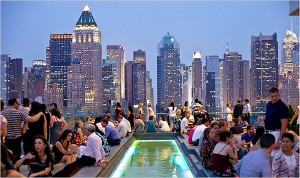
The scene at Press, the rooftop bar of the new Ink48 hotel Photo: Andrew Sullivan for The New York Times Source: The New York Times

The scene at Press, the rooftop bar of the new Ink48 hotel
Photo: Andrew Sullivan for The New York Times
Source: The New York Times

Shaken or stirred? Red or white? Draft or bottled? For most of the year these are the biggest questions confronting the thirsty New Yorker. And no answer is wrong.

But when the sun is strong and the days are long, an additional, equally important pair of options crops up, and the choice between them can make or break a good night.

Stay down or go up?

I speak of the rooftop bar, an institution with special relevance to New York City, where the roofs are higher, the views longer, the promise grander. In this vertical wonderland it seems only right to ascend.

But doing so is dicey, as recent skyward excursions reminded me. On a rooftop bar you indeed inch closer to heaven. But you can also wind up a whole lot closer to hell.

So a primer is in order: a set of instructions on what to hope for, what to brace for, and when, how, why and where a rooftop can be most pleasurable or insufferable. Icarus headed toward the sun in a heedless fashion — and more or less got burned. Don’t make the same mistake.

Know for starters that many of the city’s most vaunted rooftop bars don’t merely have velvet ropes, they have velvet barricades — sometimes in the form of oddly restrictive admission policies, sometimes in the form of random, inexplicable hours. […]

Read the original article

Video: Tipsy Diaries: Rooftop Remedies