From the Blog

Es-Stouh / Les terrasses / The rooftops

Film du réalisateur Merzak Allouache présenté en compétition à la 70ème Mostra de Venise (2013). Le film qui raconte cinq histoires fictives se déroulant sur cinq terrasses dans autant de quartiers d’Alger.

Merzak Allouache au sujet des terrasses d’Alger :

« Alger est construite sur des collines. On voit facilement les terrasses qui ont toujours joué un rôle dans cette ville. J’avais envie de travailler sur cette perspective de hauteur pour parler des problèmes de la société algérienne”, explique Merzak Allouache. “Depuis quelques temps les choses se sont aggravées. On n’en est pas arrivé à la situation égyptienne où les gens habitent dans les cimetières mais on squatte les terrasses, il y a des bidonvilles (…) » (Extrait de “Les Terrasses” : l’Algérie vue par Merzak Allouache s’invite sur la lagune, Le Nouvel Observateur, 6 septembre 2013.

« La terrasse dans les villes comme Alger s’est transformée et est devenue un lieu de vie. C’est aussi grouillant que la rue, car il y a un manque de logements donc beaucoup de monde habite sur les terrasses. Je me suis dit que ce serait bien car ce serait en intérieur/extérieur, avec la ville comme toile de fond. » (Propos du réalisateur tirée d’une entrevue réalisée dans le cadre de la 70ième Mostra de Venise.


Bande annonce du film “Les terrasses” (Es-Stouh)
 

Entrevue avec le réalisateur

A roof grows on Barclays

by ELIOT BROWN, The Wall Street Journal, April 6, 2014

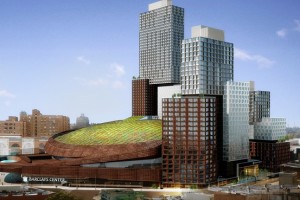
The dome of Barclays Center is going green. Here a rendering of the project, which is still being designed.  Image: Shop Architects PC Source: http://online.wsj.com

The dome of Barclays Center is going green. Here a rendering of the project, which is still being designed.
Image: Shop Architects PC
Source: The Wall Street Journal

Brooklyn’s Barclays Center is slated to get a lot greener on the outside and possibly become a quieter neighbor in the process.

Barclays developer Forest City Ratner Cos. is planning to coat the arena’s giant dome with a 130,000-square-foot “green roof” composed of small plants and a soil-like cover, resurrecting an idea that was cut years ago in an effort to contain costs.

Forest City officials said the effort is being driven by the next development phase at the site, known as Atlantic Yards, which calls for 6,400 apartments to be built in 15 towers—three that would surround the arena. By swapping a sprawling white roof with an expanse of greenery, the apartments should become more marketable, the company believes.

“We wanted to do the amenity for the benefits to the community and the residents that this green roof will bring, rather than having that traditional arena roof,” said Linda Chiarelli, an executive vice president at Forest City.

[Read more…]

Car companies take expertise in battery power beyond the garage

by TOOD WOODY, The New York Times, March 25, 2014

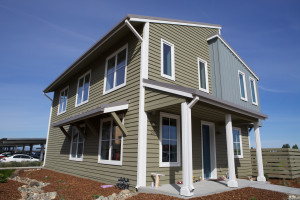
A home by Honda and the University of California, Davis, is expected to make more energy than it consumes. Photo: Thor Swift for The New York Times Source: www.nytimes.com

A home by Honda and the University of California, Davis, is expected to make more energy than it consumes.
Photo: Thor Swift for The New York Times
Source: www.nytimes.com

DAVIS, Calif. — As more homeowners generate their own electricity from solar panels, they still need power from a utility after the sun goes down.

Now, automakers say they may have an answer, by storing that carbon-free energy in electric car batteries for later use.

Honda on Tuesday is introducing an experimental house in this environmentally conscious community to showcase technologies that allow the dwelling to generate more electricity than it consumes.

It is one example of the way solar companies and carmakers are converging on a common goal: to create the self-sufficient home, with a car’s battery as the linchpin.

With buildings and transportation accounting for 44 percent of the United States’ greenhouse gas emissions, car companies increasingly view all-electric and hydrogen fuel-cell cars as vehicles that will meet environmental mandates and lead to development of new energy services and products beyond the garage.

[Read more…]

Terrace for sale, includes condo

by JULIE SATOW, The New York Times, March 20, 2014

The developers of 215 Sullivan Street in the Village promote its “lushly landscaped backyard”. Photo: Watson & Company Source: www.nytimes.com

The developers of 215 Sullivan Street in the Village promote its “lushly landscaped backyard”.
Photo: Watson & Company
Source: www.nytimes.com

After a seemingly endless winter, the first hints of spring have teased us with a day or two of temperatures over 60 degrees. That fleeting glimpse of warmth sent many New Yorkers flying out of doors to enjoy the sunshine. For my part, I sipped my morning coffee at home last week and stared wistfully out the window at a neighbor’s balcony.

In our concrete jungle, there is a hefty dollar value attached to having your own garden oasis — even the smallest of shrubberies carries a price tag. And with so many residents suffering from a vitamin D deficiency these days, brokers are promoting listings that can claim specks of green, even if they’re barely large enough to hold a bonsai.

Yet there are some listings for which the warmer weather was made.

Downtown, the average price of a luxury condominium with a terrace is $8.3 million; that compares with just $6 million for those without terraces, according to Vanderbilt Appraisal. And developers are doing whatever they can to take advantage of that pricing edge.

[Read more…]

Grow a beautiful garden with ecofriendly greywater

by LEIGH JERRARD, Houzz, March 20, 2014

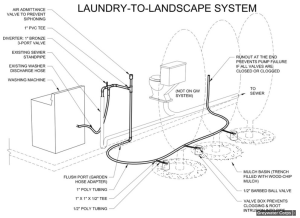
Laundry-to-Landscape System Image: Greywater Corps Source: www.houzz.com

Laundry-to-Landscape System
Image: Greywater Corps
Source: www.houzz.com

You’re probably irrigating your yard with drinking water, since the same water that comes out of your kitchen faucet also comes out of your hose bibs. But do your plants need drinking water? It turns out that most plants are perfectly happy with gently used water from showers, bathtubs, laundry and sinks — or greywater (also “graywater”). This works out well, because the average American household uses about half its water indoors and the other half outside for irrigation. Some households can cut their water bills almost in half by irrigating with greywater.

Now that large swaths of the country are facing historic drought conditions — and the possibility that these droughts are the new normal — it especially doesn’t make sense to send usable water down the drain. You can recapture that water and use it again. There are other benefits to greywater, too. It reduces a home’s carbon footprint, since moving and treating water consumes a tremendous amount of power. It protects the aquatic ecosystems from whence your water comes. It reduces loads on sewage systems (which lowers the carbon footprint) and puts water back into the local aquifer, which is better than dumping it into rivers, lakes and oceans. If you’re on a septic tank, it reduces loads on the system, prolonging your service intervals. And it helps grow a beautiful and bountiful garden.

Greywater systems don’t look like normal irrigation. For one thing, there’s stuff in it — small amounts of soap, hair, laundry lint etc. You can either process the water and try to filter everything out, or you can use larger pipes and emitters and send the water to your garden as is. The latter is the better option — ideally, a greywater system should be low tech and dependable, with a minimum of parts to break and filters to maintain.

[Read more…]

How rooftop farming will change how we eat: Mohamed Hage at TEDx UdeM

Présentation de Mohamed Hage, président fondateur des Fermes Lufa lors de la conférence TEDx UdeM le 11 mars 2012.

Site TEDx UdeM