From the Blog

Un vitrage photovoltaïque, première mondiale sur le campus

par Romane Energie/Mediacom, 5 novembre 2013
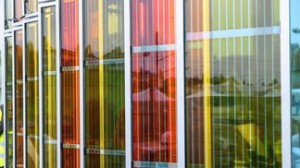
Façade composée de cellules solaires à colorant Photo: École polytechnique fédérale de Lausanne / Alain Herzog Source: http://actu.epfl.ch

Façade composée de cellules solaires à colorant
Photo: École polytechnique fédérale de Lausanne / Alain Herzog
Source: http://actu.epfl.ch

Une façade de 300 m2, composée de cellules solaires à colorant, est en cours de construction sur le Swiss Tech Convention Center. Cette première intégration architecturale constitue une nouvelle concrétisation du partenariat conclu entre Romande Energie et la Haute école pour développer un parc solaire d’envergure et mener des projets de recherche et développement.

Des panneaux photovoltaïques translucides et colorés, fruits de la technologie Graetzel, sont actuellement en cours d’installation sur la façade ouest du futur SwissTech Convention Center de l’EPFL, qui ouvrira ses portes en avril 2014. Ces 1’400 modules solaires de 35 x 50 cm formeront bientôt une surface totale de 300 m2. Ils sont déclinés en 5 tonalités différentes de rouge, vert et orangé, selon un design des artistes Daniel Schlaepfer et Catherine Bolle, qui confère à l’ensemble une esthétique chaleureuse et dynamique.

Ce vitrage solaire appliqué en façade extérieure est une première mondiale. Le projet tire parti du potentiel des cellules de Graetzel, ou cellules solaires à colorant : translucides, elles sont également indifférentes à l’angle d’incidence de la lumière, et peuvent être déployées verticalement sans aucune perte de rendement. En plus de produire de l’électricité d’origine renouvelable, elles protègent le bâtiment de l’ensoleillement direct, et réduisent ainsi le recours à une énergie de refroidissement. Cette installation solaire innovante est intégralement financée par Romande Energie. Elle sera mise en service en décembre prochain.
[Read more…]

Satellites : des panneaux solaires qui font aussi office d’antenne

par Enerzine, 3 décembre 2013

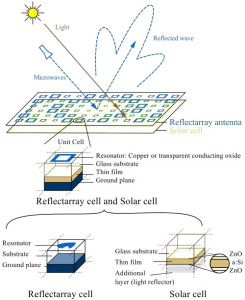
Une surface mixte, qui permet de préserver d'excellentes performances tant pour l'antenne que pour la cellule photovoltaïque<br />  Image: École polytechnique fédérale de Lausanne<br />  Source: www.enerzine.com

Une surface mixte, qui permet de préserver d’excellentes performances tant pour l’antenne que pour la cellule photovoltaïque
Image: École polytechnique fédérale de Lausanne
Source: www.enerzine.com

Les chercheurs de l’EPFL sont parvenus à fusionner antennes et cellules solaires dans un dispositif mixte qui promet une efficacité sans précédent ; Un premier pas vers le développement de satellites plus compacts et plus légers, mais aussi vers l’amélioration des systèmes de communication portables utilisés en cas de catastrophe.

Traditionnellement, antennes de télécommunication et cellules solaires ne font pas bon ménage. Elles doivent fonctionner indépendamment pour ne pas interférer. Cette contrainte a par exemple des répercussions sur le poids et la taille des satellites: ils doivent disposer d’une surface assez grande pour accueillir à la fois un système d’antennes – pour émettre et capter des données -, et à la fois des panneaux solaires, pour l’alimentation en électricité.

Dans le cadre de son projet de master effectué au sein du groupe Perruisseau-Carrier, Philippe Dreyer propose de fusionner cellules solaires et antennes. En collaboration avec le groupe Transparent Conductive Oxides (TCOs) du Laboratoire de photovoltaïque (PV-LAB), il a mis au point une surface mixte, qui permet de préserver d’excellentes performances tant pour l’antenne que pour la cellule photovoltaïque.

De quoi réduire substantiellement le volume, le poids et le coût des satellites. Mais pas seulement. Les stations de communication portatives et autonomes, qui sont souvent utilisées pour établir des contacts lors de catastrophes naturelles, pourraient en bénéficier. Dotée de cette nouvelle technologie, elles pourraient devenir plus légères et donc se déplacer plus aisément. «Notre approche est aussi compatible avec des implémentations flexibles. Il serait donc concevable de plier notre dispositif, afin qu’il ne se déploie qu’une fois arrivé dans les lieux sinistrés», illustre le professeur Perruisseau-Carrier, qui a supervisé le projet.

[Read more…]

Toronto’s leadership for green roofs

by KAID BENFIED, Switchboard, Natural Resources Defense Council staff blog, April 25, 2012

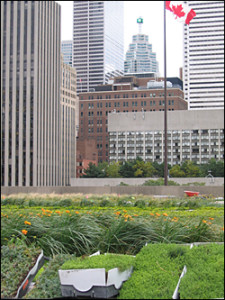
City Hall Podium Source: www1.toronto.ca

City Hall Podium
Source: www1.toronto.ca

In January of 2010, Toronto became the first city in North America to require the installation of green roofs on new commercial, institutional, and multifamily residential developments across the city. Next week, the requirement will expand to apply to new industrial development as well.

Simply put, a “green roof” is a rooftop that is vegetated. Green roofs produce multiple environmental benefits by reducing the urban heat island effect and associated energy demand, absorbing rainwater before it becomes runoff, improving air quality, and bringing nature and natural diversity into urban environments. In many cases, green roofs can also be enjoyed by the public much as a park can be.

Toronto’s requirements are embodied in a municipal bylaw that includes standards for when a green roof is required and what elements are required in the design. Generally speaking, smaller residential and commercial buildings (such as apartment buildings less than six stories tall) are exempt; from there, the larger the building, the larger the vegetated portion of the roof must be. For the largest buildings, 60 percent of available space on the roof must be vegetated.

For industrial buildings, the requirements are not as demanding. The bylaw will require that 10 percent of available roof space on new industrial buildings be covered, unless the building uses “cool roofing materials” for 100 percent of available roof space and has stormwater retention measures sufficient to capture 50 percent of annual rainfall (or the first five mm from each rainfall) on site. For all buildings, variances to compliance (for example, covering a lesser roof area with vegetation) may be requested if accompanied by fees (keyed to building size) that are invested in incentives for green roof development among existing building owners. Variances must be granted by the City Council.

[Read more…]

Corporate roof garden trend gains pace

by SARAH COSGROVE, Hosticulture Week, May 2, 2014

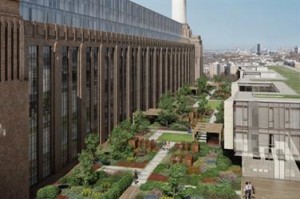
Battersea Power Station office and residential roof gardens Image: Andy Sturgeon Source: www.hortweek.com

Battersea Power Station office and residential roof gardens
Image: Andy Sturgeon
Source: www.hortweek.com

Benefits of green roofs increasingly recognised by developers reinvigorating dead spaces, say leading garden designers.

Businesses are increasingly investing in roof gardens on top of corporate buildings to boost their business and benefit staff.

John Lewis opens a roof garden on its Oxford Street store on 3 May to celebrate its 150th anniversary, while garden designer Andy Sturgeon has revealed his designs for three Battersea Power Station office and residential roof gardens.

Construction is underway for the Gillespies-designed Sky Garden on top of London’s “Walkie Talkie” building (20 Fenchurch Street) and at a public roof garden on the new Canary Wharf Crossrail station.

RHS young designer of the year 2013 Tony Woods designed the John Lewis garden, with his company Garden Club London building it. The garden will be open to the public for 15 weeks for a series of events including a World Cup party.

Woods designed around a pop-up juice bar, restaurants and a kitchen and toilet block that had been airlifted onto the roof, where schoolchildren will grow vegetables and salads. Home-grown strawberries, rosemary and lavender will go to the caterers.

[Read more…]

Urban farms in Taipei and Tokyo improve office life

by WEN-JAY YING, Untapped Cities, February 25, 2014

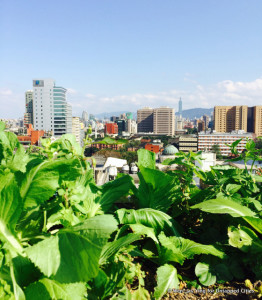
Winkler Partners Law Firm office houses one of the first rooftop gardens in Taipei Photo: Wen-Jay Ying Source: www.untappedcities.com

Winkler Partners Law Firm office houses one of the first rooftop gardens in Taipei
Photo: Wen-Jay Ying
Source: www.untappedcities.com

Walking out onto the roof of Winkler Partners Law Firm, arugula and strawberry plants frame the silhouette of buildings and mountain tops that make up the Taipei skyline. “Here’s my business card. That side is how I make money, the other is how I spend money,” says Robin Winkler, an American expat and our host for the day. The card states Winkler Partners Law Firm and the flip side reads Wild at Heart Legal Defense Association. His hobby, Wild at Heart, is the first environmental legal defense fund in Taipei, but his day job isn’t too bad either. The Winkler Partners office houses one of the first rooftop gardens in Taipei.

Robin shows us three rainwater tanks that are used to water plants during droughts. In Taiwan, precipitation varies dramatically and rainwater tanks are essential to help with both flooding and dry spells. The rooftop also has a compost toilet, which surprisingly has no smell. The matter is stored in tubs that will eventually be used to feed their plants.

There are passionfruit trees, strawberries plants, leafy greens, and about forty other edible plants and 300 other species that find a home on the law firm’s rooftop garden. Employees are encouraged to help out with the garden. Robin and his colleagues wanted a space to share information about plants and to make the office a place where you could take a break from… well, the office. It’s their alternative to the common workplace culture and a symbol for jobs with dignity. Ideas for a greener Taiwan extend further than their urban oasis, with intentions to share horticulture with the community through composting workshops and youth education programs.

[Read more…]

Govt secretaries inspect rooftop farming – KATHMANDU

by Republica, May 3, 2014

To promote the rooftop and terrace farming in Kathmandu city, some government secretaries and high-level officials from concerned government departments have inspected the rooftop farming at some places of the capital.

The inspection team led by secretary of the Prime Minister’s Office Krishna Hari Banskota reached the residences of Litterateur Pawan Alok and Rekha Kandel, a homemaker, where the officials were fascinated to see a wide variety of vegetables growing in clay vessels and plastic drums. They had planted chilies, tomatoes, flowers, guava, mango, pomegranate, oranges, green leaves and fruits and vegetables of many more varieties.

“The rooftop farming we saw left us quite inspired as we witnessed a mausami plant of nearly four inches bearing 12 fruits and a three inches lemon plant producing as many as 100 lemons at times,” said Secretary Banskota.

Executive Chief of the Kathmandu Metropolitan City (KMC) shared with the monitoring team that additional 500 people were going to receive training on rooftop farming this year alone. The authority has already trained 650 families in the past.

The executive director of the Solid Waste Management Committee Sumitra Amatya added that the elderly people who stay at home all the day have a good time by engaging in rooftop farming that does not require much labor.

The committee every year felicitates the best performers in this category of farming and managing the organic waste on the occasion of World Environment Day.

Secretary Banskota stressed on promoting rooftop farming by introducing separate and clear policies.

The monitoring team later went to the Compost Manure Production Center operated by NEPSEMAC at Chovar and inspected the technique and methodology adopted for producing the organic manure. Secretary of the Ministry of Urban Development Kishor Thapa expressed commitment to promote the organic waste production that helps converting waste into money.

Read the original story

Read also:
KMC to promote rooftop farming
Metropolis to help create 500 rooftop gardens
Elderly couple turn rooftop into their vegetable garden