From the Blog

Arizona’s new fee puts a dent in rooftop solar economics

by MATTHEW PHILIPS for Businessweek, Mashable, November 24, 2013
Source: www.mashable.com

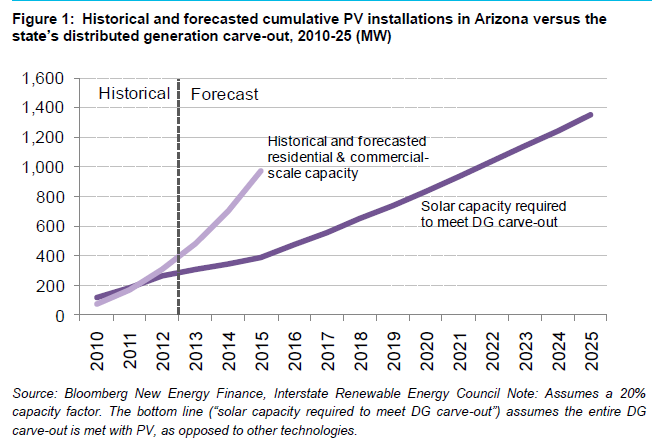
Historical and forecasted cumulative PV installations in Arizona versus the state’s distributed generation carve-outm, 2010-2025 (MW)
Image source: www.mashable.com

Last week, Arizona regulators gave the state’s largest utility, Arizona Public Service, the authority to charge homeowners with solar panels on their roofs a fee for plugging into the grid and in some cases, selling electricity back onto it. Beginning next year, homeowners who install rooftop solar systems will have to pay a monthly levy — the first ever in the U.S. — equal to $0.70 per kilowatt of installed capacity.

That’s well below the $8 per kw that APS had initially sought. Depending on how big their home system is, the fee will end up costing consumers anywhere from $3 to $6 a month, according to a report by Bloomberg New Energy Finance. APS had hoped to be able to charge about $50 a month per home. The 18,000 rooftop solar systems already present in APS’s service territory will be grandfathered; only those installed after Dec. 31 will be subject to the levy.

“This is a body blow for the Arizona solar industry, not a knockout punch,” says Stefan Linder, an analyst with Bloomberg New Energy Finance. “While this fixed fee will cut into the economics of residential solar, for many homeowners it will still make financial sense to go solar.”

The Solar Energy Industries Association claims that a typical rooftop solar system saves a homeowner about $5 to $10 per month; other estimates put it closer to $20.

The decision by the Arizona Corporation Commission is the first stab at resolving a contentious fight that’s been brewing for years between the solar industry and public utilities. Arizona, the second-largest solar market in the U.S., behind California, has been viewed as a critical battleground in deciding whether utilities would be able to squeeze money out of homeowners who no longer buy electricity from them — and in many cases, actually get paid for pushing supplemental power generated by their solar panels back onto the grid.
[Read more…]

Sur les toits de Paris

Sur les toits de ParisDiffusion sur France 5 d’un documentaire sur les toits de Paris le 17 novembre dernier.

Visionnement en ligne disponible jusqu’au 24 novembre (non disponible hors France).

Redifusion

24 novembre 2013, 16h05
16 décembre 2013, 16h35

Résumé

Contrairement aux boulevards et aux monuments, les toits de Paris, loin des images de carte postale, font partie d’un monde méconnu, inaccessible pour la plupart des habitants et des touristes de la ville lumière. Mais quelques privilégiés ont fait de ce jardin secret leur univers quotidien. C’est le cas de Thomas, funambule qui cherche à capter avec son appareil photo l’âme de la capitale. Michaël Blassel est quant à lui l’un des rares à pouvoir accéder au dôme des Invalides. Benjamin Mouton, architecte en chef de Notre-Dame, ouvre les portes de ces lieux interdits au public et raconte l’histoire de la capitale, à travers ses toits, en évoquant leurs couleurs et les matériaux qui les composent. Rencontre également avec ceux qui souhaitent faire des toits un haut lieu de la nuit parisienne.

Klyde Warren Park, Dallas

by LAURA MIRVISS, Architectural Record, August 2013

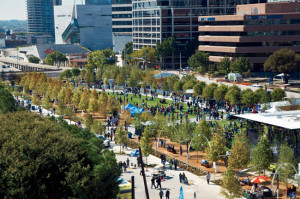
The ambitious Klyde Warren Park covers a 1,200-foot-long stretch of the Woodall Rodgers Freeway. A serene, 2,400-square-foot concert pavilion by Thomas Phifer and Partners is open on all sides Photo: Dillon Diers Photography Source: www.archrecord.construction.com

The ambitious Klyde Warren Park covers a 1,200-foot-long stretch of the Woodall Rodgers Freeway. A serene, 2,400-square-foot concert pavilion by Thomas Phifer and Partners is open on all sides
Photo: Dillon Diers Photography
Source: www.archrecord.construction.com

Decked out in Dallas: A sprawling rectangular park on top of a major freeway unites an up-and-coming residential neighborhood with the burgeoning Arts District.

 As in many American cities, large highways slice through downtown Dallas. Sidewalks seem intermittent, parking lots abundant, and locals respond with strange looks when asked the best way to walk to a nearby bar or restaurant.

But Dallas is pouring millions of dollars into changing all that. In the past decade, the city has quietly inserted a handful of small green gardens between downtown office towers and condos, providing small reprieves from the expanses of asphalt and concrete. As part of this initiative, over ten years ago, local civic leaders began talking to a team of designers and engineers about coming up with a scheme for uniting the city’s fractured downtown by covering over an existing freeway with a park.

Now, $110 million later, the design team, Jacobs Engineering Group, along with landscape architect The Office of James Burnett, has delivered something radical—5.2 acres of green space laid across an eight-lane highway. The Woodall Rodgers Freeway, oriented northeast-southwest and depressed to minimize traffic noise, ran underneath a number of perpendicular at-grade bridges used as cross streets. The park now fills the gaps between the bridges to create a 1,200-by-200-foot three-block-long deck between Pearl and St. Paul streets. “You only realize you’re near a freeway at the ends of the park,” says principal James Burnett. “You can’t hear the roar of traffic below.”

[Read more…]

Solar power begins tovshine as environmental benefits pay off

by DIANA S. POWERS, The New York Times, November 11, 2013

PARIS — Amid polemics over rising electricity prices in Europe and the level of green energy subsidies in various countries, it is easy to lose sight of the fact that the growth in clean-energy generation is a huge success story.

Solar photovoltaic generation, known as PV, like wind power before it, is coming into the mainstream — at great environmental benefit.

Based on comparative life-cycle analyses of power sources, “PV electricity contributes 96 percent to 98 percent less greenhouse gases than electricity generated from 100 percent coal and 92 percent to 96 percent less greenhouse gases than the European electricity mix,” said Carol Olson, a researcher at the Energy Research Center of the Netherlands.

Photovoltaic generation offers several additional environmental advantages, Ms. Olson said in an interview.

“Compared with electricity from coal, PV electricity over its lifetime uses 86 to 89 percent less water, occupies or transforms over 80 percent less land, presents approximately 95 percent lower toxicity to humans, contributes 92 to 97 percent less to acid rain, and 97 to 98 percent less to marine eutrophication,” she said. Eutrophication is the discharge of excess nutrients that causes algal blooms.

Toward the end of last year, installed global photovoltaic generating capacity passed the milestone of 100 gigawatts — enough to meet the energy needs of 30 million households and save more than 53 million tons of carbon dioxide emissions annually, according to a recent report by the European Photovoltaic Industry Association, E.P.I.A., a solar power industry lobby group.

“Right now, today, the world has installed 130 gigawatts of PV, up from 1.4 gigawatts in 2000,” Wolfgang Palz, a former manager of the European Commission’s development program for renewable energies, told a conference organized by France’s National Center for Scientific Research, CNRS, in Paris last month.

Europe alone now has 80 gigawatts of installed photovoltaic capacity, of which 35 gigawatts is in Germany, the European Union leader, providing about 7 percent of the country’s electricity, he said.

Some regions of Germany are even further ahead: “If you buy an Audi today, manufactured in Bavaria, 10 percent of the electricity used to produce it is PV,” Mr. Palz said in an interview.

With large-volume installation, economies of scale have substantially reduced unit costs.

According to a report by the E.P.I.A., the European solar industry’s lobby group, photovoltaic costs have dropped 22 percent with every doubling of production capacity. […]

Read the full story

Eskenazi Hospital prepares to open

by JOHN RUSSELL, The Indianapolis Star, November 16, 2013

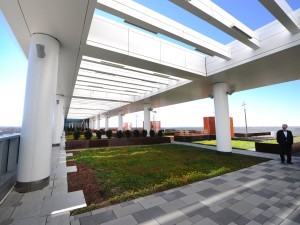
Sky Farm on the roof of the new Eskenazi Health Hospital.  Photo: Matt Kryger / The Star Source: www.indystar.com

Sky Farm on the roof of the new Eskenazi Health Hospital
Photo: Matt Kryger / The Star
Source: www.indystar.com

Rooftop vegetable garden, sculptures add unique touches to Wishard’s replacement

Indiana has never seen a hospital quite like this.

From the spiraling wooden sculpture suspended from the ceiling in the main concourse to the vegetable garden on the roof, the brand-new Eskenazi Hospital keeps you wondering what you will see around the next corner.

The $754 million hospital, which will serve mostly poor and underinsured patients, is nearly ready to open, after four years of planning and construction. The public can tour the hospital from 11 a.m. to 5 p.m. today.

The massive complex, spread out on 37 acres, will replace Wishard Hospital, a deteriorating hodgepodge of buildings, some a century old. On Dec. 7, an army of hospital workers will move patients from the old building to the new one a block away.

The new hospital is the latest addition to Indiana’s hospital construction boom over the last decade, a period in which more than $1 billion in new facilities sprouted up around Central Indiana, from specialty heart clinics to luxurious medical centers in the suburbs.

Each of Indiana’s dozens of hospitals seems to have a distinctive personality, from the luxurious Indiana University Health North Hospital in Carmel, with posh fireplace lounges and cherry wood bassinets, to the kid-friendly Riley Hospital for Children, with its signature red wagons and play rooms.

The feel at Eskenazi Hospital is bright and welcoming. Sunlight pours through windows in every patient room, waiting room and hallway. The public areas are filled with colorful art, from historical oil paintings to whimsical photographs of the city.

The goal, officials say, is to be comforting for people entering the doors for what is often a frightening, high-stress experience.

“We want this to be the most patient-friendly, family-friendly, simple-to-use hospital you can find,” said Matthew R. Gutwein, president and chief executive of Marion County Health and Hospital Corp., which operates the hospital.

[Read more…]

Rooftopping: Tom Ryaboi & Almost (I’ll make ya) Famous

by DEBS SLATER, 500px, April 24, 2012

Photo: Tom Ryaboi Source: www.500px.com

Photo: Tom Ryaboi
Source: www.500px.com

A year has passed since Tom Ryaboi clicked the shutter, captured a photo, and with it changed the course of his life. Here he is to tell us the story about the incredible response to one single shot.

One year ago today I took a photograph that would change my life. A single frame turned my whole world upside down, and brought on a storm of media attention, praise, criticism, confusion, wonder, and doubt. After one hell of a ride this past year, I think today is a good day to finally tell this photo’s story…

The birth of a movement?

I guess this all started in 2007, when photography became a full time obsession for me. That summer I returned from Europe where I learned to use my first DSLR (Canon Rebel XT), and leaving the house without a camera was just not an option anymore.

I was shooting some street just before sunset when I came across a construction site on a busy Toronto intersection. It didn’t seem like there were any workers around, but the gate was wide open. I thought I could get a cool vantage point to shoot the skyline so I just went for it, found the stairs and climbed to the very top.

The building wasn’t very high, perhaps 15 or 16 storeys, but when I got to the top and opened the door to the roof I got an instant rush of adrenaline, like I just opened the door to a secret world of wonder. The city was right in my face, like I’ve never seen it before; the sun was setting and all the lights were starting to turn on. The noise from the street was muted, the cars and people moved about in what seemed like slow motion, it was like a Eric Satie song. It was magical.

[Read more…]