From the Blog

Toronto’s leadership for green roofs

by KAID BENFIED, Switchboard, Natural Resources Defense Council staff blog, April 25, 2012
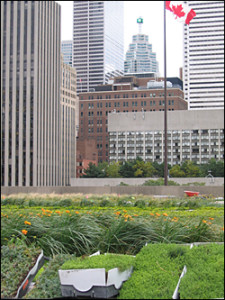
City Hall Podium Source: www1.toronto.ca

City Hall Podium
Source: www1.toronto.ca

In January of 2010, Toronto became the first city in North America to require the installation of green roofs on new commercial, institutional, and multifamily residential developments across the city. Next week, the requirement will expand to apply to new industrial development as well.

Simply put, a “green roof” is a rooftop that is vegetated. Green roofs produce multiple environmental benefits by reducing the urban heat island effect and associated energy demand, absorbing rainwater before it becomes runoff, improving air quality, and bringing nature and natural diversity into urban environments. In many cases, green roofs can also be enjoyed by the public much as a park can be.

Toronto’s requirements are embodied in a municipal bylaw that includes standards for when a green roof is required and what elements are required in the design. Generally speaking, smaller residential and commercial buildings (such as apartment buildings less than six stories tall) are exempt; from there, the larger the building, the larger the vegetated portion of the roof must be. For the largest buildings, 60 percent of available space on the roof must be vegetated.

For industrial buildings, the requirements are not as demanding. The bylaw will require that 10 percent of available roof space on new industrial buildings be covered, unless the building uses “cool roofing materials” for 100 percent of available roof space and has stormwater retention measures sufficient to capture 50 percent of annual rainfall (or the first five mm from each rainfall) on site. For all buildings, variances to compliance (for example, covering a lesser roof area with vegetation) may be requested if accompanied by fees (keyed to building size) that are invested in incentives for green roof development among existing building owners. Variances must be granted by the City Council.
[Read more…]

Hedge two-way mirror walkabout, Metropolitan Museum, New York – review

by Ariella Budick, Financial Times, May 5, 2014

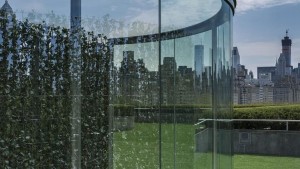
'Hedge Two-Way Mirror Walkabout' sits on the roof of the Metropolitan Museum in New York Photo: Hyle Skopitz Source: www.ft.com

‘Hedge Two-Way Mirror Walkabout’ sits on the roof of the Metropolitan Museum in New York
Photo: Hyle Skopitz
Source: www.ft.com

A seriously charming and richly allusive installation has appeared on the roof of the Met

The Metropolitan Museum’s remote rooftop garden has always offered savvy visitors respite from hall after hall of sublime majesty. Right now, it opens on to an artificial-grass oasis that hovers like a magic carpet above the edge of Central Park. Lawn chairs are temptingly scattered about. The view beckons. And off to one side, a mirrored pavilion perches on its glowing patch of green, catching the kaleidoscopic tumult of the city and playfully casting it back.

Dan Graham collaborated with landscape architect Günther Vogt to transform the Met’s severe space into “Hedge Two-Way Mirror Walkabout”, a seriously charming funhouse. It’s a mind-bending piece of walk-in sculpture, a two-chambered bubble of mirrored glass and steel that invites viewers to glimpse themselves in its reflective surfaces. However we look at it, we see ourselves askew – here, sleekly thin; there, grotesquely fat, mixed up with the people on the other side of the transparent wall and a flickering melange of sky, leaves, buildings and passing clouds.

Graham’s rooftop pavilion teems with allusions. It invokes, first of all, the extravagantly ornamental structures – faux Greek temples, mock gothic ruins – designed as picturesque points of interest in 18th-century English gardens. At Stowe, Lord Cobham hid a “Temple of Ancient Virtue” among the vegetation, honouring the greatest Greeks and expressing his yearning for Hellenic antiquity. Graham has fallen under a more modern version of the neoclassical spell: he finds inspiration in the stripped-down austerity of Mies van der Rohe’s Barcelona Pavilion, which he admires both because it was always meant to be temporary, and because it effectively blends vegetation and reflective glass.

Read the full story

Rooftop dog park in NW provides unique amenity

by STEPHEN TSCHIDA, April 28, 2014

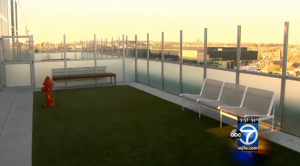
Rooftop dog park of the City Market at O apartment complex in Northwest Washington
Source: WJLA / ABC 7

WASHINGTON (WJLA) – The first Erin Siegel does when she gets home is walk her dogs Darla and Theo. But the three of them don’t want to head for the street. Instead, they aim for the sky.

Siegel is a resident of the City Market at O apartment complex in Northwest Washington. It’s a dazzling new development over a once grungy parking lot. What was it that really hooked Siegel on this complex? The roof.

“You get the views of the city and you get the ability to play with your dogs, socialize them, get exercise,” she said.

The complex’s developers wondered what to do with a large roof area before deciding to let it go to the dogs. The ultimate amenity is the rooftop dog park. There are special areas for big dogs and little dogs, as well as lookout so that tenants’ four-legged friends can take in the spectacular view.

“It’s been fabulous,” City Market at O developer Richard Lake said. “It’s been absolutely amazing. Nearly forty percent of our renters have dogs.”

Just off the top-floor doggie playground is another special room with dog washing equipment for both large and small canines.

“This was a huge deciding factor in us coming here,” tenant Abby Slitor said. “It was relatively the same price as for amenities and everything else, and this is obviously an awesome amenity to have in the city.”

While the area around the apartment complex at 7th and O NW has improved, the neighborhood that was once a hotbed for drug and gang activity can still be a bit rough around the edges. City Market tenant Christin Carey said her dog Bogey’s occasional need for a night time bathroom trip is much safer on the roof than the street.

“As a woman I don’t want to be out in the dark alone,” she said.

Read the original story


Terrace for sale, includes condo

by JULIE SATOW, The New York Times, March 20, 2014

The developers of 215 Sullivan Street in the Village promote its “lushly landscaped backyard”. Photo: Watson & Company Source: www.nytimes.com

The developers of 215 Sullivan Street in the Village promote its “lushly landscaped backyard”.
Photo: Watson & Company
Source: www.nytimes.com

After a seemingly endless winter, the first hints of spring have teased us with a day or two of temperatures over 60 degrees. That fleeting glimpse of warmth sent many New Yorkers flying out of doors to enjoy the sunshine. For my part, I sipped my morning coffee at home last week and stared wistfully out the window at a neighbor’s balcony.

In our concrete jungle, there is a hefty dollar value attached to having your own garden oasis — even the smallest of shrubberies carries a price tag. And with so many residents suffering from a vitamin D deficiency these days, brokers are promoting listings that can claim specks of green, even if they’re barely large enough to hold a bonsai.

Yet there are some listings for which the warmer weather was made.

Downtown, the average price of a luxury condominium with a terrace is $8.3 million; that compares with just $6 million for those without terraces, according to Vanderbilt Appraisal. And developers are doing whatever they can to take advantage of that pricing edge.

[Read more…]

Pullman factory to feature rooftop greenhouses, solar panels, wind turbine

by QUINN FORD, DNAinfo Chicago, March 4, 2014

Rendering of the factory Renderings: William McDonough+Partners Source: www.chicago.curbed.com

The factory will include a wind turbine, solar panels and rooftop greenhouse
Renderings: William McDonough+Partners
Source: www.chicago.curbed.com

Construction on an environmentally-friendly manufacturing plant is officially underway on the city’s South Side.

Method, a company which boasts natural, nontoxic cleaning products, held an official groundbreaking ceremony for a $33 million plant being built in the Pullman neighborhood.

The plant, which was announced in July, is scheduled to open early next year and will be the company’s first manufacturing facility in the United States.

The company was lured to the South Side neighborhood in part by $9 million in city Tax Increment Financing funds as well as $1.1 million in state tax credits over 10 years.

The project will evenutally create nearly 100 jobs in the area once the factory is complete. Ald. Anthony Beale (9th) said the plant will provide a big economic boost to a neighborhood originally developed as a factory town.

“There hasn’t been a manufacturing company on the South Side in the city of Chicago for almost 30 years,” Beale said, prompting applause.

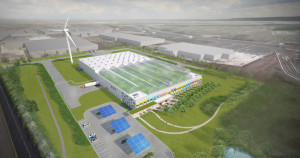
The plant’s plans call for a 230-foot wind turbine and solar panels that the company said will meet half the plant’s energy needs. Plans also call for greenhouses to cover the building’s roof, which company officials said will be rented out to vendors to grow fresh fruit and vegetables.

[Read more…]

EnviPark in Turin

About the park

Turin Environment Park was founded in 1996 on the initiative of the Piedmont Region, the Province of Turin, the Municipality of Turin and the European Union. It represents an original experience among the science and technology parks of Europe in the sense that it combines innovation technology with eco-efficiency. As a whole, Environment Park covers an area of about 30.000 square meters consisting of laboratories, offices and service centers in a building environment that uses low environmental impact solutions. (source: www.envipark.com/en)

PDF presentation

Visit EnviPark website