by MATTHEW PHILIPS for Businessweek, Mashable, November 24, 2013
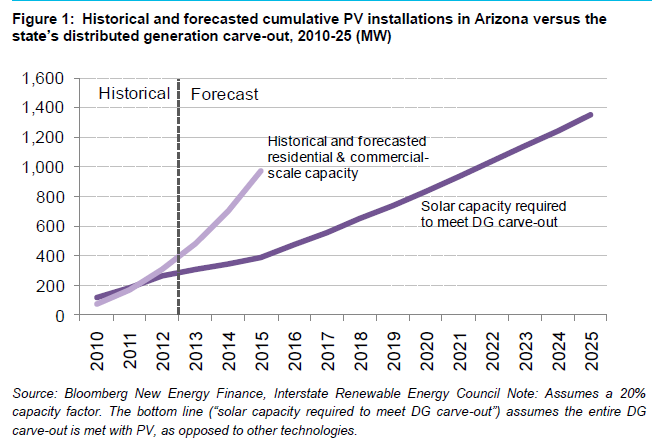
Historical and forecasted cumulative PV installations in Arizona versus the state’s distributed generation carve-outm, 2010-2025 (MW)
Image source: www.mashable.com
Last week, Arizona regulators gave the state’s largest utility, Arizona Public Service, the authority to charge homeowners with solar panels on their roofs a fee for plugging into the grid and in some cases, selling electricity back onto it. Beginning next year, homeowners who install rooftop solar systems will have to pay a monthly levy — the first ever in the U.S. — equal to $0.70 per kilowatt of installed capacity.
That’s well below the $8 per kw that APS had initially sought. Depending on how big their home system is, the fee will end up costing consumers anywhere from $3 to $6 a month, according to a report by Bloomberg New Energy Finance. APS had hoped to be able to charge about $50 a month per home. The 18,000 rooftop solar systems already present in APS’s service territory will be grandfathered; only those installed after Dec. 31 will be subject to the levy.
“This is a body blow for the Arizona solar industry, not a knockout punch,” says Stefan Linder, an analyst with Bloomberg New Energy Finance. “While this fixed fee will cut into the economics of residential solar, for many homeowners it will still make financial sense to go solar.”
The Solar Energy Industries Association claims that a typical rooftop solar system saves a homeowner about $5 to $10 per month; other estimates put it closer to $20.
The decision by the Arizona Corporation Commission is the first stab at resolving a contentious fight that’s been brewing for years between the solar industry and public utilities. Arizona, the second-largest solar market in the U.S., behind California, has been viewed as a critical battleground in deciding whether utilities would be able to squeeze money out of homeowners who no longer buy electricity from them — and in many cases, actually get paid for pushing supplemental power generated by their solar panels back onto the grid.