Learning from Chicago, Montréal, Paris

Could a ‘green roof’ solve Brooklyn’s toxic waste woes?

by MARK SVENVOLD, Samsung Voice, Forbes, February 12, 2013

When Hurricane Sandy devastated New York in 2012, it created a uniquely nasty “perfect storm” in the Gowanus section of Brooklyn. In the aftermath of the floods, rainwater overwhelmed the municipal water treatment systems, dumping millions of gallons of raw sewage into the Gowanus Canal–already a federal Superfund toxic site.

For middle school teacher Lynn Shon, the problem hit home for several reasons. She’d already been investigating the phenomenon of water runoff with her science class at the Peter Rouget Middle School, (M.S. 88) in Park Slope, which borders Gowanus.

However, Shon had first heard about the issue two years ago as part of a curriculum development program at The Earth Institute at Columbia University. In urban areas, the asphalt and concrete that make up so much of these landscapes do not absorb water. During heavy rains, water runoff overwhelms municipal water treatment facilities; and when storms hit, these systems are forced to dump waste directly into rivers and streams like the Gowanus Canal.

The hazards of storm water runoff often go unnoticed, even in areas most affected by them. “I had no idea that the whole problem existed,” says Shon.

Wanting to explore the issue further, she entered her science class’s project in Samsung’s Solve for Tomorrow contest, which challenges classrooms around the country to use science, technology, engineering and math (STEM) to help solve environmental issues in communities.

As Shon’s class was working on a solution, the problem came right to their doorstep. Hurricane Sandy swamped the city’s water treatment systems. Sewage began pouring into the Gowanus Canal and surrounding rivers and beaches. “That storm really made the issue of sewage overflow relevant to our students,” says Shon.

[Read more…]

California installed more rooftop solar in 2013 than previous 30 years combined

by KILEY KROH, ThinkProgress, January 2, 2014

2013 was a banner year for clean energy and the U.S. solar industry was no exception. California, the nation’s solar standout, more than doubled its rooftop solar installations last year from 1,000 megawatts (MW) to 2,000 MW. To put this number in perspective, writes Bernadette Del Chiaro of the California Solar Energy Industries Association, it took California over 30 years to build the first 1,000 MW of rooftop solar.

“When utility-scale solar projects are added in, California’s total solar power picture well-exceeds 4,000 MW today — nearly twice as much installed capacity as exists at California’s last remaining nuclear power plant, Diablo Canyon,” according to Del Chiaro.

And California isn’t alone in its rooftop solar surge. “About 200,000 U.S. homes and businesses added rooftop solar in the past two years alone — about 3 gigawatts of power and enough to replace four or five conventionally-sized coal plants,” Bloomberg reported.

As record numbers of homes and businesses decide to go solar, utility companies are growing increasingly uneasy about the threat it poses to their existing business model. If more customers install solar panels or adopt energy efficiency measures, a utility will sell fewer units of energy — especially during peak demand when energy costs are the highest. Therefore, utilities will increase their energy prices to cover costs such as grid maintenance and labor and as prices go up, more customers will look to energy efficiency and distributed energy resources to reduce their energy bills, perpetuating the cycle.

[Read more…]

Rooftop gardens are the future of farming

by AL SHAY, Statesman Journal, January 2, 2014

Maya Donelson tends the rooftop garden of Glide Memorial Church in San Francisco Photo: Peter DaSilva for The New York Times Source: www.nytimes.com

Maya Donelson tends the rooftop garden of Glide Memorial Church in San Francisco
Photo: Peter DaSilva for The New York Times
Source: www.nytimes.com

So many of our horticulture students at Oregon State University are enthralled with the thought of becoming organic farmers despite the fact there seems to be an overabundance in the Willamette Valley already.

I encourage them to look at the new urban environment, you know the one that covers only 2 to 3 percent of the earth’s surface but consumes nearly 70 percent of its resources. This particular model also predicts that the urban environment is poised to house and accommodate the needs of seven out of every 10 inhabitants by 2050. I recently examined a rooftop gardening operation on the east coast and was simply amazed at what they are doing.

I was thumbing my way through the 355 page Whole Seed catalog from Baker Creek Heirloom Seeds when an article entitled the Brooklyn Grange Farm caught my attention. It is the largest rooftop farming operation in America. They have two sites, one at the old Brooklyn navy yard and one in Queens, NY. Together there is a combined area of 108,000 square feet. This is nearly 2½ acres from which they produce nearly 20,000 pounds of produce per acre.

[Read more…]

Vegies with a higher purpose

by INDIRA NAIDOO, The Sydney Morning Herald, December 29, 2013

The Big Apple’s hotels are sprouting gardens.

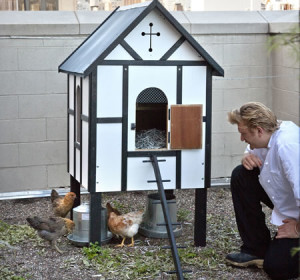
Crosby St Hotel chef Anthony Paris checks the chooks Source: www.firmdalehotels.com

Crosby St Hotel chef Anthony Paris checks the chooks
Source: www.firmdalehotels.com

You know the grow-your-own movement has crossed over into the mainstream when some of New York’s hottest hotels start growing vegies on their roofs.

More than 20 Manhattan hotels now have productive rooftop vegetable gardens. Some have their own beehives producing honey – and some even have chickens laying eggs.

So why give vegie patches million-dollar views in a city where real estate is at a premium?

The trend is two-fold: travellers are expecting more organic, seasonal and local ingredients on hotel menus. And when a hotel guest wants to know the provenance of the food, it doesn’t get any more local than this. Rooftop herbs and vegetables aren’t bruised by transportation and storage, and retain more of their nutrients. And the hotels limit their carbon footprint.

There are financial benefits as well. Green roofs reduce heating and cooling cost for large buildings and mitigate against rain and stormwater damage.

Here’s a look at four New York hotels with impressive gardens.

[Read more…]

Une prairie émerge du chantier des Halles

par MARIE-DOUCE ALBERT, LeMoniteur.fr, 12 décembre 2013

Des « Atolls » plantés ponctuent la prairie qui commence à s’étendre devant la Bourse du commerce à Paris Photo: Marie-Douce Albert Source:www.lemoniteur.fr

Des « Atolls » plantés ponctuent la prairie qui commence à s’étendre devant la Bourse du commerce à Paris
Photo: Marie-Douce Albert
Source:www.lemoniteur.fr

Le 19 décembre 2013, quelque 9 000 m² du grand jardin de 4,3 ha qui s’étend au-dessus du Forum seront inaugurés au cœur de Paris. Ce nouveau parc aménagé par Seura Architectes commence à révéler la simplicité de sa composition… Inversement proportionnelle à la complexité du site. Il portera le nom de Nelson Mandela.

Ne parlez pas de leur « gazon » aux architectes de l’agence Seura. A quelques jours de l’inauguration, prévue le 19 décembre 2013, d’une portion d’environ 9 000 m² du nouveau jardin des Halles, la pelouse n’est peut-être pas très touffue, mais quand graminées et vivaces auront prospéré, c’est une prairie qui doit émerger du cœur de Paris. Ce nouveau paysage portera le nom de l’ancien président sud-africain Nelson Mandela. A la suite du décès du héros de la lutte anti-apartheid, le 5 décembre dernier, la décision de lui dédier ce jardin sera en effet soumise aux élus de la capitale lors du conseil de Paris de décembre.

Alors qu’à quelques mètres de là, la structure de la Canopée imaginée par l’agence Berger-Anziutti s’est imposée en quelques mois et que la pose des verres de la grande couverture centrale a débuté, le jardin commence ainsi à réapparaître. Seura Architectes, équipe chargée depuis 2004 de la reconfiguration d’ensemble du site des Halles, tant en surface qu’en souterrain, a totalement repensé cet espace vert de 4,3 ha avec le paysagiste Philippe Raguin.

[Read more…]

Analysis: Clouds over Hawaii’s rooftop solar growth hint at U.S. battle

by NICHOLA GROOM, Reuters, via Chicago Tribune, December 16, 2013

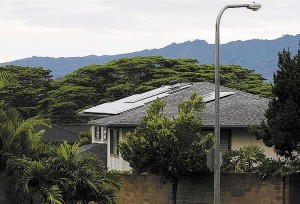
A view of houses with solar panels in the Mililani neighbourhood on the island of Oahu in Mililani, Hawaii  Photo: Hugh Gentry, Reuters Source: www.chicagotribune.com

A view of houses with solar panels in the Mililani neighbourhood on the island of Oahu in Mililani, Hawaii
Photo: Hugh Gentry, Reuters
Source: www.chicagotribune.com

(Reuters) – When Gloria Adams signed a contract to install a rooftop solar power system on her Oahu home in late August, she looked forward to lower electric bills and a return on her investment in the years ahead.

She never dreamed that she would have to stop the project, get the Hawaiian Electric Company’s permission before she could proceed, and possibly help pay for any upgrades to her neighborhood’s electricity circuits to handle the extra load.

Her home improvement ran afoul of a rule that went into effect in September.

The regulation requires homeowners on Oahu – Hawaii’s most populous island – to get the utility’s approval before installing photovoltaic (PV) rooftop solar systems.

In areas like Mililani, where Adams lives, the utility’s power circuits have reached a threshold where it would be dangerous to add PV systems without investing in upgrades to the distribution system.

“We didn’t anticipate having to pay HECO when we took this on,” Adams said. “They are acting like they got caught with their pants down, saying, ‘We don’t know how to deal with this.'”

What’s happening in Hawaii is a sign of battles to come in the rest of the United States, solar industry and electric utility executives said. The conflict is the latest variation on what was a controversial issue this year in top solar markets California and Arizona. It was a hot topic at a solar industry conference last week: how to foster the growth of rooftop solar power while easing the concerns of regulated utilities that see its rise as a threat.

[Read more…]