From the Blog

Comment ça marche: énergie éolienne

par lemoniteur.fr, 19 avril 2013

Principe d'un aérogénérateur Image: Editions du Moniteur Source: www.moniteur.fr

Principe d’un aérogénérateur
Image: Editions du Moniteur
Source: www.moniteur.fr

L’énergie éolienne permet de convertir le déplacement de l’air en force motrice. L’aérogénérateur transforme cette force motrice en énergie électrique et l’éolienne de pompage mécanique transforme la rotation du rotor en mouvement de translation alternatif qui active une pompe à piston. Un permis de construire est obligatoire pour toute installation d’une hauteur supérieure à 12 m.

Principe d’un aérogénérateur

Le vent fait tourner les pales (a), puis l’énergie mécanique est transformée en énergie électrique (b) ; l’énergie produite est consommée par les utilisateurs (c) ou revendue au réseau (d).

[Read more…]

Buildings and skies transformed into playful line drawings

by KATIE HOSMER, My Modern Met, April 11, 2013

Oeuvre de Thomas Lamadieu Source: www.tlamadieu.wix.com/roots-art

Oeuvre de Thomas Lamadieu
Source: www.tlamadieu.wix.com/roots-art

It’s always fun to look up in a big city and to observe the towering buildings overhead. While most of us are in awe of the architecture and blue skies, French artist Thomas Lamadieu sees a fresh, blank canvas for his illustrations. In his SkyArt, Lamadieu transforms the shapes of cascading buildings into funny creations that interact with the space.

His simple line drawings, which include things like a chicken playing a guitar, a man eating his dinner, an owl with a stretched out neck, and a group of guys hanging out, are visually striking against the colorful landscape photographs. Through this work, Lamadieu invites us to use our imaginations and to see the world around us with fresh eyes. He brings to life the child within, using silly faces and simple sketches to captivate his audience.

View the original post

Roots Art website

Atelier International du Grand Paris – Revue de presse du 19 avril 2013

Revue de presse sur  le thème “Habiter le Grand Paris”.

Document PDF


Les nouveaux projets iconoclastes des architectes du Grand Paris

par BEATRICE JEROME, Le Monde.fr, 20 avril 2013

Christian de Portzamparc le dit sans colère. “Le Grand Paris ne peut pas se résumer à un projet de grand métro enterré. Il faut inventer un projet intelligent en surface.” Jean Nouvel est plus amer : “Sarkozy s’est laissé enfermer dans le grand métro de Christian Blanc [ex-secrétaire d’Etat au Grand Paris] qui s’est livré à un sabotage évident du travail des architectes.” L’urbaniste Michel Cantal-Dupart l’affirme sans détour : “Les architectes sont les cocus du Grand Paris.” “Il y avait un rêve formidable. Il a disparu”, lâche, dépité, Roland Castro.

Les grands noms de l’architecture française ne cachaient pas leurs désillusions, vendredi 19 avril, dans les couloirs du Palais de Tokyo, dans le 16e arrondissement. Quatre ans après la “consultation internationale” lancée à la demande de Nicolas Sarkozy sur le Grand Paris, à laquelle ils avaient pour la plupart participé, ils ont pourtant accepté de remettre leur ouvrage sur le métier. A la demande de l’Atelier international du grand Paris (AIGP), ils ont présenté leurs idées pour “habiter le grand Paris”. Quinze agences d’architectes ont rendu publiques leurs solutions pour produire 70 000 logements par an soit un doublement de l’effort actuel, en Ile-de-France.

L’arrière-pays francilien sera le laboratoire du Grand Paris : la plupart des architectes en sont convaincus. Si l’architecte hollandais Winy Maas propose de surélever les toits des immeubles hausmanniens parisiens ; si Roland Castro reste un ardent militant de la la requalification des quartiers sensibles de banlieue ; ou si Richard Rogers et Elisabeth de Portzamparc promeuvent chacun les gratte-ciels comme antidote à l’étalement urbain, la majorité des architectes s’aventure sur un autre terrain : la Grande Couronne et le péri-urbain sont les territoires d’avenir, disent-ils, pour inventer un nouveau modèle de métropole.

[Read more…]

BIG voit grand pour Europa City

par NATHALIE MOUTARDE, lemoniteur.fr, 12 avril 2013

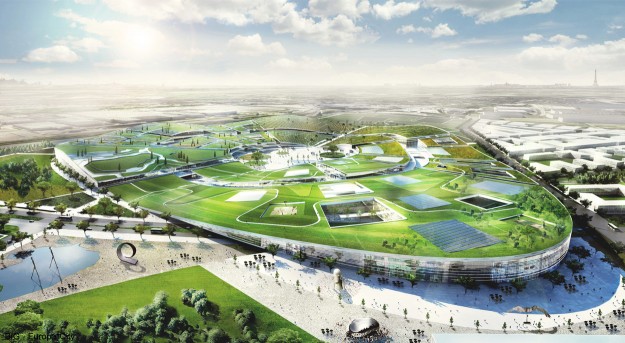
Europa City Image: BIG Source: www.lemoniteur.com

Europa City
Image: BIG
Source: www.lemoniteur.com

L’agence danoise d’architecture Bjarke Ingels Group (BIG) élaborera le master plan du projet Europa City. Ce complexe de près de 700 000 m2, implanté au cœur du Triangle de Gonesse (Val d’Oise), à proximité de l’aéroport de Roissy, regroupera commerces, hôtels, équipements culturels et de loisirs. Les premiers travaux pourraient démarrer en 2017.

Immochan, filiale immobilière du groupe Auchan, a retenu l’agence danoise d’architecture Bjarke Ingels Group (BIG) pour la réalisation du futur complexe commercial et de loisirs, Europa City, sur le Triangle de Gonesse (Val d’Oise), entre Paris et l’aéroport de Roissy. Ce choix a été entériné, le 12 avril, par un comité de pilotage co-présidé par le préfet de la région Ile-de-France, Jean Daubigny et le député-maire de Gonesse, Jean-Pierre Blazy. Il fait suite à une consultation internationale lancée en avril 2011 à laquelle ont également participé Manuelle Gautrand, Valode & Pistre et l’équipe norvégienne Snohetta (voir leurs propositions en images). « La force du projet de BIG est de concevoir Europa City comme un quartier de ville vivant, accessible, alliant centralité urbaine et paysage et offrant des espaces ouverts à tous de qualité. Nous avons aussi été séduits par la forme très douce du projet et sa grande modularité », déclare Christophe Dalstein, directeur d’Europa City.

[Read more…]

A building not just green, but practically self-sustaining

by BRYN NELSON, The New York Times, April 2, 2013

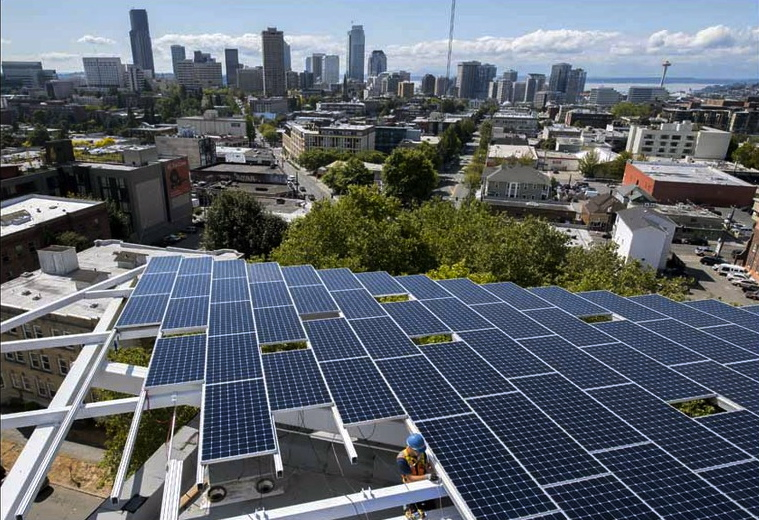
Solar roof under construction Photo: John Stamets Source: www.bullitcenter.org

Solar roof under construction
Photo: John Stamets
Source: www.bullitcenter.org

SEATTLE — When an office building here that bills itself as the world’s greenest officially opens later this month, it will present itself as a “living building zoo,” with docents leading tours and smartphone-wielding tourists able to scan bar codes to learn about the artfully exposed mechanical and electrical systems.

Tenants have already begun moving into the six-story Bullitt Center, in advance of its grand opening on Earth Day, April 22. With the final touches nearly complete on the 50,000-square-foot office building at 1501 East Madison Street, at the edge of the city’s Capitol Hill neighborhood, its occupants are about to embark upon an unparalleled — and very public — experiment in sustainability.

Once settled in, they will be guinea pigs in a $30 million living laboratory distinguished by its composting toilets, strict energy and water budgets and a conspicuous lack of on-site parking. To earn its environmental bragging rights, the Bullitt Center must complete a rigorous one-year certification process called the Living Building Challenge, which requires both water and energy self-sufficiency, among a list of 20 demands.

Provided that the building clears a few remaining regulatory hurdles, all its water will be supplied by rainwater collected in a 56,000-gallon cistern before being filtered and disinfected. A rooftop array of photovoltaic panels, extending beyond the building like the brim of a graduation mortarboard, will produce an estimated 230,000 kilowatt-hours a year, hopefully just enough to break even for a building that is 83 percent more efficient than the city’s typical commercial site. […]

Read the original story

Slide show

From Bullitt Center website: