From the Blog

Corporate roof garden trend gains pace

by SARAH COSGROVE, Hosticulture Week, May 2, 2014
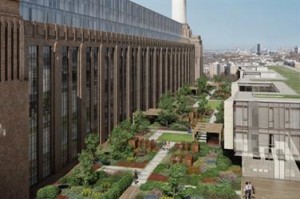
Battersea Power Station office and residential roof gardens Image: Andy Sturgeon Source: www.hortweek.com

Battersea Power Station office and residential roof gardens
Image: Andy Sturgeon
Source: www.hortweek.com

Benefits of green roofs increasingly recognised by developers reinvigorating dead spaces, say leading garden designers.

Businesses are increasingly investing in roof gardens on top of corporate buildings to boost their business and benefit staff.

John Lewis opens a roof garden on its Oxford Street store on 3 May to celebrate its 150th anniversary, while garden designer Andy Sturgeon has revealed his designs for three Battersea Power Station office and residential roof gardens.

Construction is underway for the Gillespies-designed Sky Garden on top of London’s “Walkie Talkie” building (20 Fenchurch Street) and at a public roof garden on the new Canary Wharf Crossrail station.

RHS young designer of the year 2013 Tony Woods designed the John Lewis garden, with his company Garden Club London building it. The garden will be open to the public for 15 weeks for a series of events including a World Cup party.

Woods designed around a pop-up juice bar, restaurants and a kitchen and toilet block that had been airlifted onto the roof, where schoolchildren will grow vegetables and salads. Home-grown strawberries, rosemary and lavender will go to the caterers.

[Read more…]

Urban farms in Taipei and Tokyo improve office life

by WEN-JAY YING, Untapped Cities, February 25, 2014

Winkler Partners Law Firm office houses one of the first rooftop gardens in Taipei Photo: Wen-Jay Ying Source: www.untappedcities.com

Winkler Partners Law Firm office houses one of the first rooftop gardens in Taipei
Photo: Wen-Jay Ying
Source: www.untappedcities.com

Walking out onto the roof of Winkler Partners Law Firm, arugula and strawberry plants frame the silhouette of buildings and mountain tops that make up the Taipei skyline. “Here’s my business card. That side is how I make money, the other is how I spend money,” says Robin Winkler, an American expat and our host for the day. The card states Winkler Partners Law Firm and the flip side reads Wild at Heart Legal Defense Association. His hobby, Wild at Heart, is the first environmental legal defense fund in Taipei, but his day job isn’t too bad either. The Winkler Partners office houses one of the first rooftop gardens in Taipei.

Robin shows us three rainwater tanks that are used to water plants during droughts. In Taiwan, precipitation varies dramatically and rainwater tanks are essential to help with both flooding and dry spells. The rooftop also has a compost toilet, which surprisingly has no smell. The matter is stored in tubs that will eventually be used to feed their plants.

There are passionfruit trees, strawberries plants, leafy greens, and about forty other edible plants and 300 other species that find a home on the law firm’s rooftop garden. Employees are encouraged to help out with the garden. Robin and his colleagues wanted a space to share information about plants and to make the office a place where you could take a break from… well, the office. It’s their alternative to the common workplace culture and a symbol for jobs with dignity. Ideas for a greener Taiwan extend further than their urban oasis, with intentions to share horticulture with the community through composting workshops and youth education programs.

[Read more…]

Govt secretaries inspect rooftop farming – KATHMANDU

by Republica, May 3, 2014

To promote the rooftop and terrace farming in Kathmandu city, some government secretaries and high-level officials from concerned government departments have inspected the rooftop farming at some places of the capital.

The inspection team led by secretary of the Prime Minister’s Office Krishna Hari Banskota reached the residences of Litterateur Pawan Alok and Rekha Kandel, a homemaker, where the officials were fascinated to see a wide variety of vegetables growing in clay vessels and plastic drums. They had planted chilies, tomatoes, flowers, guava, mango, pomegranate, oranges, green leaves and fruits and vegetables of many more varieties.

“The rooftop farming we saw left us quite inspired as we witnessed a mausami plant of nearly four inches bearing 12 fruits and a three inches lemon plant producing as many as 100 lemons at times,” said Secretary Banskota.

Executive Chief of the Kathmandu Metropolitan City (KMC) shared with the monitoring team that additional 500 people were going to receive training on rooftop farming this year alone. The authority has already trained 650 families in the past.

The executive director of the Solid Waste Management Committee Sumitra Amatya added that the elderly people who stay at home all the day have a good time by engaging in rooftop farming that does not require much labor.

The committee every year felicitates the best performers in this category of farming and managing the organic waste on the occasion of World Environment Day.

Secretary Banskota stressed on promoting rooftop farming by introducing separate and clear policies.

The monitoring team later went to the Compost Manure Production Center operated by NEPSEMAC at Chovar and inspected the technique and methodology adopted for producing the organic manure. Secretary of the Ministry of Urban Development Kishor Thapa expressed commitment to promote the organic waste production that helps converting waste into money.

Read the original story

Read also:
KMC to promote rooftop farming
Metropolis to help create 500 rooftop gardens
Elderly couple turn rooftop into their vegetable garden

Historic hotel likely to become top spot

by CLAIRE TYRRELL, The West Australian, May 5, 2014

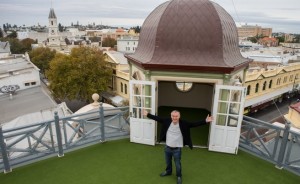
National Hotel’s Karl Bullers who will be conducting tours of the National Hotel as part of Fremantle Heritage week, people will get access to the rooftop where he plans to open a rooftop bar Photo: Mogens Johansen, The West Australian Source: https://au.news.yahoo.com/thewest/

National Hotel’s Karl Bullers who will be conducting tours of the National Hotel as part of Fremantle Heritage week, people will get access to the rooftop where he plans to open a rooftop bar
Photo: Mogens Johansen, The West Australian
Source: https://au.news.yahoo.com/thewest/

It is a million-dollar view of Fremantle not seen by the public for almost a century.

The National Hotel rooftop is one of the few places you can experience 360-degree views of the historic port.

Sailor’s wives used the vantage point in the 19th century to watch for ships arriving, when it was dubbed “widows’ walk”.

Only accessible by ladder, the space was used by select hotel guests as a walkway.

When Karl Bullers took over the hotel in 2010, public access to the iconic space became a priority.

“It was a U-shaped walkway but we filled in the courtyard and made the staircase through the hotel so it is one big open area,” he said.

“We have got planning approval to put a bar and restaurant on the roof.”

Though regular public access to the rooftop is at least a year away, people can get a glimpse of the space on tours during Fremantle Heritage week, which runs from Friday to May 18.

As well as the National Hotel, owners and architects at Fremantle’s Bread in Common and Hougoumont Hotel will explain the process of transforming heritage buildings into modern venues.

“I will talk about history of the building, the challenges I faced getting the venue open again and why it is designed the way it is,” Mr Bullers said.

Fire has ravaged the National Hotel at least twice. Mr Bullers said fire protection was a major challenge of redesigning the rooftop.

Read the original story

Hedge two-way mirror walkabout, Metropolitan Museum, New York – review

by Ariella Budick, Financial Times, May 5, 2014

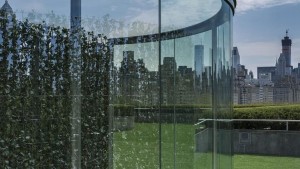
'Hedge Two-Way Mirror Walkabout' sits on the roof of the Metropolitan Museum in New York Photo: Hyle Skopitz Source: www.ft.com

‘Hedge Two-Way Mirror Walkabout’ sits on the roof of the Metropolitan Museum in New York
Photo: Hyle Skopitz
Source: www.ft.com

A seriously charming and richly allusive installation has appeared on the roof of the Met

The Metropolitan Museum’s remote rooftop garden has always offered savvy visitors respite from hall after hall of sublime majesty. Right now, it opens on to an artificial-grass oasis that hovers like a magic carpet above the edge of Central Park. Lawn chairs are temptingly scattered about. The view beckons. And off to one side, a mirrored pavilion perches on its glowing patch of green, catching the kaleidoscopic tumult of the city and playfully casting it back.

Dan Graham collaborated with landscape architect Günther Vogt to transform the Met’s severe space into “Hedge Two-Way Mirror Walkabout”, a seriously charming funhouse. It’s a mind-bending piece of walk-in sculpture, a two-chambered bubble of mirrored glass and steel that invites viewers to glimpse themselves in its reflective surfaces. However we look at it, we see ourselves askew – here, sleekly thin; there, grotesquely fat, mixed up with the people on the other side of the transparent wall and a flickering melange of sky, leaves, buildings and passing clouds.

Graham’s rooftop pavilion teems with allusions. It invokes, first of all, the extravagantly ornamental structures – faux Greek temples, mock gothic ruins – designed as picturesque points of interest in 18th-century English gardens. At Stowe, Lord Cobham hid a “Temple of Ancient Virtue” among the vegetation, honouring the greatest Greeks and expressing his yearning for Hellenic antiquity. Graham has fallen under a more modern version of the neoclassical spell: he finds inspiration in the stripped-down austerity of Mies van der Rohe’s Barcelona Pavilion, which he admires both because it was always meant to be temporary, and because it effectively blends vegetation and reflective glass.

Read the full story

Arizona rooftop solar customers could face new tax

by  AMANDA H. MILLER, CleanEnergyAuthority, May 6, 2014

Solar in Arizona Photo: Arizona Republic Source: www.cleanenergyauthority.com

Solar in Arizona
Photo: Arizona Republic
Source: www.cleanenergyauthority.com

Homeowners who are leasing rooftop solar arrays in Arizona could be hit with an average $152 a year property tax bill they weren’t counting on when they decide to go solar.

The state department of revenue recently reinterpreted a tax policy that exempts rooftop solar equipment from property tax, determining that the exemption only applies to those who own their solar arrays, not people who lease solar panels.

The state Department of Revenue said the leased panels are merchant power plants and the leasing companies should pay tax on them.

Those taxes would flow through to customers.

Solar leasing accounts for the majority of the distributed solar generation in Arizona and is widely adopted by middle class residents who can’t afford to buy complete systems outright.

Most who lease rooftop solar systems save $60 to $120 a year over buying all of their power from Arizona Public Service. The new property tax would erase the cost benefit of going solar, solar advocates say.

“Arizona is breaking new ground for being an extremely strange political environment,” said Bryan Miller, vice president of public policy for solar leasing company Sunrun and president of The Alliance for Solar Choice.

[Read more…]