From the Blog

Les grandes villes du monde: Chicago

par Maude Cournoyer-Gendron, Villes Régions Monde, février 2013

1. Introduction

Depuis les dernières années, différentes firmes privées ou organismes internationaux ont mis en place des palmarès afin de classer les villes du monde (consulter la capsule introductive pour plus de détails sur les palmarès et la méthodologie menant aux choix des villes retenues). L’objectif poursuivi dans cette série de capsules est d’explorer les réalités historiques, géographiques, économiques, sociales et urbaines de différentes grandes villes du monde qui se retrouvent dans les grands palmarès de ville. La notion de ville mondiale sous-entend à la fois une grande relation avec les autres villes du globe, avec un rôle de point de relai dans l’économie mondiale, mais aussi une importance sur différents plans soit économique, culturel ou politique (Braudel 1979; Friedmann 1986; Dolfus 1996; Sassen 2001).

Cet intérêt pour les villes mondiales dépasse la sphère académique. Depuis les dernières années, plusieurs grandes firmes font à leur tour un exercice de hiérarchisation des villes du monde en publiant différents palmarès. Dans le cadre de ces capsules, la ville de Chicago a été sélectionnée puisque, bien qu’elle ne soit pas une des plus grandes villes en termes de population, elle a une place dans différents palmarès, en plus d’être la troisième ville en importance aux États-Unis, avec Los Angeles et New York.

Pour faire état de cette grande ville du monde, Chicago est d’abord parmi les autres villes mondiales à l’aide des six palmarès retenus pour cette série de capsules. Un survol des données factuelles de la ville est ensuite fait, combiné à une description sommaire de son histoire, de sa géographie, et de son économie. Les principaux enjeux urbains qui prennent forme dans la ville sont par la suite identifiés, et finalement une revue de la littérature récente, portant spécifiquement sur la ville ou la région, est faite. Cette capsule, comme l’ensemble de celles qui font partie de cette série, veut être un document introductif, dressant des pistes de recherche pour qui voudra entreprendre une étude plus approfondie. Les matériaux et analyses dont il est fait mention sont le résultat d’une recherche documentaire sur internet, combinée à une recherche d’articles scientifiques et de monographies sur les principales bases de données.
Lire la suite…

Version PDF

Manhattan’s rooftop bars: Heaven’s gates

by FRANK BRUNI, The New York Times, July 22, 2010

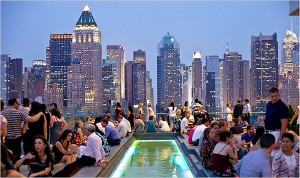
The scene at Press, the rooftop bar of the new Ink48 hotel Photo: Andrew Sullivan for The New York Times Source: The New York Times

The scene at Press, the rooftop bar of the new Ink48 hotel
Photo: Andrew Sullivan for The New York Times
Source: The New York Times

Shaken or stirred? Red or white? Draft or bottled? For most of the year these are the biggest questions confronting the thirsty New Yorker. And no answer is wrong.

But when the sun is strong and the days are long, an additional, equally important pair of options crops up, and the choice between them can make or break a good night.

Stay down or go up?

I speak of the rooftop bar, an institution with special relevance to New York City, where the roofs are higher, the views longer, the promise grander. In this vertical wonderland it seems only right to ascend.

But doing so is dicey, as recent skyward excursions reminded me. On a rooftop bar you indeed inch closer to heaven. But you can also wind up a whole lot closer to hell.

So a primer is in order: a set of instructions on what to hope for, what to brace for, and when, how, why and where a rooftop can be most pleasurable or insufferable. Icarus headed toward the sun in a heedless fashion — and more or less got burned. Don’t make the same mistake.

Know for starters that many of the city’s most vaunted rooftop bars don’t merely have velvet ropes, they have velvet barricades — sometimes in the form of oddly restrictive admission policies, sometimes in the form of random, inexplicable hours. […]

Read the original article

Video: Tipsy Diaries: Rooftop Remedies

Huge rooftop farm is set for Brooklyn

LISA W. FODERARO, The New York Times, April 5, 2012

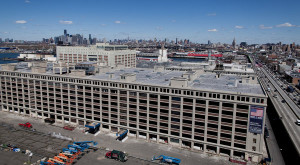
An old Navy warehouse in Sunset Park will be home to a hydroponic greenhouse of up to 100,000 square feet. The developer says it will be the largest such greenhouse in the country Photo: Eric Michael Johnson for The New York Times Source: The New York Times

An old Navy warehouse in Sunset Park will be home to a hydroponic greenhouse of up to 100,000 square feet. The developer says it will be the largest such greenhouse in the country
Photo: Eric Michael Johnson for The New York Times
Source: The New York Times

Brooklyn is fast becoming the borough of farms. On Thursday, Bright Farms, a private company that develops greenhouses, announced plans to create a sprawling greenhouse on a roof in Sunset Park that is expected to yield a million pounds of produce a year — without using any dirt.

The hydroponic greenhouse, at a former Navy warehouse that the city’s Economic Development Corporation acquired last year, will occupy up to 100,000 square feet of rooftop space. Construction is scheduled to start in the fall, with the first harvest expected next spring.

When finished, the greenhouse will rank as the largest rooftop farm in the United States — and possibly the world, Bright Farms officials say. This spring, Brooklyn Grange, another rooftop farm developer, is set to open a 45,000-square-foot commercial operation at the Brooklyn Navy Yard.

“Brooklyn was an agricultural powerhouse in the 19th century, and it has now become a local food scene second to none,” said Paul Lightfoot, the chief executive of Bright Farms. “We’re bringing a business model where food is grown and sold right in the community.”

Mr. Lightfoot said that the company was in talks with supermarket chains that would potentially commit to buying produce from the Sunset Park farm, which will include a variety of lettuces, tomatoes and herbs. “We’re looking for a long-term contract with one client who operates grocery stores,” he said.

Read the article…

Challenging the reputation of hospital food on a rooftop farm

by ANEMONA HARTOCOLLIS, The New York Times, October 18, 2012

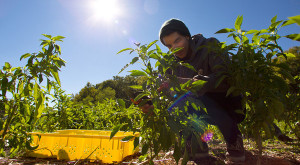
At Stony Brook University Hospital, a farm has been a team effort. Interns like Nadeem Marghoob plant and harvest the crops Photo: Uli Seit for The New York Times Source: The New York Times

At Stony Brook University Hospital, a farm has been a team effort. Interns like Nadeem Marghoob plant and harvest the crops
Photo: Uli Seit for The New York Times
Source: The New York Times

STONY BROOK, N.Y. — The weather report said the first frost was coming, and the farmer and her three helpers skittered around the rooftop garden snipping the tenderest plants — basil, green peppers, a few heirloom tomatoes — so they would not be ruined. Over the next few days, they would be chopped into sauces and garnishes and served up in covered dishes by room service waiters wearing dapper black suits.

But this was not a hotel in the more trendy precincts of Manhattan or San Francisco. It was Stony Brook University Hospital, in the middle of Suffolk County, Long Island, where a rooftop farm is feeding patients and challenging the reputation of hospital food as mushy, tasteless and drained of nutrients. (No, Jell-O is not growing on the roof.) But the sick, who have bigger problems than whether their broccoli is local and sustainable, can be tough customers.

“Swiss chard went over well, kale maybe not so much,” said Josephine Connolly-Schoonen, executive director of the nutrition division at the hospital. “When people are not feeling well, they want their comfort foods.”

Hundreds of hospitals across the country host a farmer’s market, have a garden on their grounds that supplies fresh produce or buy at least some of their food from local farms, ranches and cooperatives, according to a survey by Health Care Without Harm, an international coalition of health care groups.

Read the article…