From the Blog

Lufa Farms launches second rooftop greenhouse

Press release via Reuters

43,000-square-foot greenhouse represents scalable approach for feeding cities

MONTREAL, QUEBEC–(Marketwired – Sept. 23, 2013) – Lufa Farms, which built the world’s first commercial rooftop greenhouse in early 2011, today unveiled its second greenhouse atop a newly constructed office building in the Montreal metropolitan area.

The greenhouse, located in Laval, will provide fresh produce to more than 6,000 people year round – about two times the yield of Lufa Farms’ first greenhouse in the Ahuntsic-Cartierville borough of Montreal. The company’s greenhouse system is scalable and can be replicated on new rooftops in any city.

“This greenhouse puts high-yield, rooftop agriculture within the reach of any new building development, in any city, on spaces public or private, anyplace in the world,” said Mohamed Hage, founder and president of Lufa Farms. “After almost five years of focus on the main issues of urban rooftop agriculture, we have solved how to cost-effectively grow food, distribute it, integrate it with local farming efforts, and do it all in an environmentally conscious, sustainable way. This doesn’t just change how food is grown, it changes how cities eat.”

Construction of the 43,000 square-foot greenhouse, visible from the 440 highway atop a new mixed-use commercial building, was the result of a collaboration between Lufa Farms, Le Groupe Montoni Division Construction, Inc. of Laval, and the Dutch company KUBO, a world-renowned greenhouse designer and manufacturer. The structure uses an innovative venting system to control pests and temperature and to optimize vital sunlight. The greenhouse also has a recirculating irrigation system for water and surface condensation.

[Read more…]

Edible algae — coming to a rooftop near you?

by AFP, August 27, 2013

Fresh spirulina paste being put into jars in Bangkok.  Photo: AFP Source: www.news.com.au

Jars of fresh spirulina paste, Bangkok
Photo: AFP
Source: www.news.com.au

On a hotel rooftop in Bangkok, dozens of barrels of green liquid bubble under the sun — the latest innovation in urban farming. It may not look like it, but this green goo is an algae called spirulina — a rich source of protein, antioxidants and nutrients.

Watch the video


Bastille’s booming blooming rooftop garden

by MELISSA PETERMAN, Eater Seattle, July 11, 2013

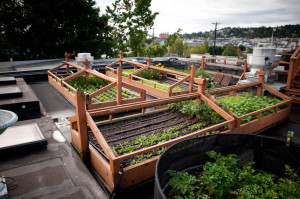
Photo: Geoffrey Smith/LookatLao Studio Source: www.seattle.eater.com

Photo: Geoffrey Smith/LookatLao Studio
Source: www.seattle.eater.com

Welcome back to Up on the Rooftop, a monthly column by Seattle Slow Food board member and writer Melissa Peterman, who gets up close and personal with Seattle’s mile-high club in the form of (mostly) rooftop gardens.

With the incredible spring weather we had, and what’s shaping up to be a summer to match, diners can expect to see more rooftop garden produce taking center stage on Seattle menus. This month, we talk to Jason Stoneburner about how things have been progressing with his rooftop garden at Bastille and what he’s most excited about this summer (like, those awesome rooftop dinners). It should be noted that at the time of this interview, Stoneburner had not yet opened, but chef Jason says that he is definitely sharing produce from Bastille’s rooftop garden with his namesake restaurant, especially when it’s in full-swing like it is right now.

[Read more…]

New Seasons Market roof now home to bee colonies

by STOVER E. HARGER III, The Columbian, July 10, 2013

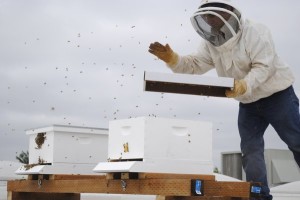
Portland beekeeper Damian Magista taps a container on July 8 to persuade thousands of honey bees to enter their new home on the roof of the Fisher's Landing New Seasons Market Photo: Stover E. Harger III Source: www.columbian.com

Portland beekeeper Damian Magista taps a container on July 8 to persuade thousands of honey bees to enter their new home on the roof of the Fisher’s Landing New Seasons Market
Photo: Stover E. Harger III
Source: www.columbian.com

Honey, they’re home.

Two honeybee colonies — made up of nearly 50,000 pollinators — now live on the roof of the Fisher’s Landing New Seasons Market, part of the regional chain’s new “Bee Part of the Solution” campaign. The company did the same in April at its store in Happy Valley, Ore.

The goal is not only to provide the bees with a safe place to raise their brood and make honey, but spark further dialogue on the precarious plight of the important insects. By next spring, the rooftop bees’ ranks could grow to more than 120,000.

The Portland beekeeper who was hired to help kick-start the campaign said it might just raise awareness about dwindling bee populations and ongoing threats to their survival, such as pesticides, parasites and disease.

“A piece like this is a great way to start that conversation,” said Damian Magista, owner of honey company Bee Local.

[Read more…]

Milwaukee: Comment reconvertir son usine en ferme écologique ?

par SOPHIE CHAPELLE, bastamag.net, 9 septembre 2010

Que faire des friches industrielles laissées en désuétude ? Aux États-Unis, plusieurs usines abandonnées sont reconverties en ferme d’agriculture urbaine. Objectif : produire des aliments sains à proximité des villes et de manière quasi auto-suffisante, tout en créant des emplois. Reportage à Milwaukee dans une ferme en aquaculture.

Consommer du poisson provenant du lac Michigan comporte un « risque élevé ». En cause : le haut niveau de pollution des grands lacs nord-américains, hérité de l’activité industrielle. Les perches ont même disparu de l’écosystème du lac. Pourtant, certains restaurants de Milwaukee (Wisconsin) sont désormais en mesure d’en proposer des fraîches issues d’une ancienne usine… reconvertie en ferme.

À proximité de l’immense lac Michigan, une ferme urbaine s’est lancée en 2009 dans l’élevage de poissons et de légumes en aquaculture. Le lieu est improbable – une ancienne usine rachetée à un fabricant d’équipementier minier au sud du centre-ville – mais le potentiel de production est considérable. Entre ces quatre murs de béton, James Godsil est un homme heureux. « Nous avons reproduit une véritable zone humide », se félicite l’un des fondateurs de Sweet Water Organics, qui signifie « Eaux douces biologiques ».

[Read more…]

A Montréal, les jardins autonomes squattent les toits

par SOPHIE CHAPELLE, bastamag.net, 29 juin 2010

À Montréal, les habitants investissent les toits bétonnés pour construire des serres, faire pousser des plantes potagères, tropicales ou médicinales. Une effervescence qui permet de développer des projets sociaux, éducatifs ou scientifiques, et de se réapproprier l’espace urbain. Petite visite guidée dans ce nouveau monde vert.

Douzième étage. Une affiche indique la direction du « projet Greenhouse ». Une volée de marches à gravir et l’on débouche sur un petit paradis vert au milieu de la ville, une serre posée sur les toits de l’université de Concordia à Montréal. Arlène y jardine. Passionnée par ce projet, elle nous promène le long du jardin suspendu, divisé en plusieurs carrés. L’un est réservé aux plantes tropicales, un autre aux plantes aquatiques et à l’écologie forestière. L’espace dans lequel Arlène s’est beaucoup investie ces dernières semaines est quasiment vide. Et pour cause : « Nous avons produit ici 15.000 plants de semis, qui ont été distribués dans plus d’une trentaine de jardins, explique t-elle. Des jardins cultivés par des familles, des personnes âgées, des étudiants, qui durant tout l’été vont en récolter les fruits. »

[Read more…]