From the Blog

Hong Kong’s fish farms in the sky

by PETER SHADBOLT, BBC News, April 2, 2014
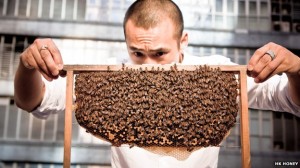
Michael Leung’s honey commands a premium price Photo: HK Honey Source: www.bbc.com/news

Michael Leung’s honey commands a premium price
Photo: HK Honey
Source: www.bbc.com/news

Under eerie blue lights designed to simulate the ocean depths, hundreds of fish swim serenely through the bubbling waters of their circular tanks, 15 floors up in the sky.

There are 11 plastic tanks in total, holding a combined 80,000 litres of salt water.

They are full of grouper, a white-fleshed fish, which are all destined to end up on the plates of restaurant-goers across Hong Kong.

This is the scene at Oceanethix, one of the numerous so-called “vertical fish farms” in the special administrative region, which have become a key fixture of its supply chain.

For while most fish farms around the world are at sea, or at least, land level, in Hong Kong it is more often a necessity to put them many floors up in tall buildings.

This is because as one of the most densely populated places in the world, there is simply very little spare space. So fish farms have to fit in where they can.

For the small firms that dominate the industry, it is worth the effort, as Hong Kong has an insatiable appetite for fish and seafood. It consumes more than 70kg (11 stone) per capita every year, 10 times more than in the US.
[Read more…]

Urban gardening for city slickers

by MICHAEL KELLY, Independent.ie, February 25, 2013

Photo: Urban Farm Source: www.urbanfarm.ie

Photo: Urban Farm
Source: www.urbanfarm.ie

There is always a tendency to consider food growing as something that always has to happen in a field or large garden – GIYing is, unfortunately, often considered the preserve of country people or farmers. In reality, it’s an equally viable hobby in an urban environment.

In fact, if we are to provide a genuine alternative to the modern food chain, then food growing is something that is going to have to happen in much smaller spaces.

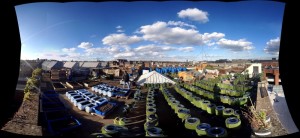
I visited two projects in Dublin recently that really challenge your assumptions about where food can be produced. The first is Kaethe Burt O’Dea’s blink-and-you-miss-it community garden on Sitric Road in Stoneybatter. The second is what you might call a ‘hyper-urban’ food growing space on the roof of the Chocolate Factory on Kings Inn Street, a stone’s throw from O’Connell St.

The Sitric Community Garden is literally a street corner, a sliver of green space at the end of a terrace of two-up/two-down houses.

[Read more…]

You won’t believe what passengers are doing on the roof of this Tokyo train station, but it will make you green with envy

by Derek Markham, TreeHugger, March 26, 2014

The plot thickens at Tokyo train stations, as passengers grow on the go with these rooftop garden allotments Photo: Soradofarm Source: www.treehugger.com

The plot thickens at Tokyo train stations, as passengers grow on the go with these rooftop garden allotments
Photo: Soradofarm
Source: www.treehugger.com

The plot thickens at Tokyo train stations, as passengers grow on the go with these rooftop garden allotments.

It’s one thing to start and tend a garden if you have plenty of space at home, as well as the time to care for it, and another thing entirely to do so if you spend a good chunk of your day commuting, and lack a place at home for even a tiny garden.

But an ingenious solution is cropping up in Japan, where the East Japan Railway Company has collaborated with a station entertainment company to create a series of rooftop gardens on train stations, where commuters can create their own tiny gardens and tend to them while they wait for their train to arrive.

The Soradofarm project, which currently has five locations, including at Tokyo’s JR Ebisu station, allows people to rent their own garden allotment measuring just 3 square meters (tools, water, and garden equipment, and even seeds are included) to try their hand at growing food, flowers, and more.

The price isn’t cheap, as some of the plots cost 100,440 JPY per year (~$960 USD), but considering that it may be the best option for many of the people who are interested in it, due to space issues, these urban rooftop garden allotments could be a viable way to get some green in their busy lives.

Aside from the possibility of growing even a tiny amount of fresh food for themselves, these innovative urban gardens may be an effective solution for decreasing stress and increasing the amount of time spent out in the fresh air and sunshine, especially in areas where outdoor space is at a premium, and having a place to call your own is hard to come by.

Although there are just five urban rooftop gardens installed at the train stations so far, according to Springwise, East Japan Railways plans to open up more of these garden allotments “on top of or near to each one of its stations” in the future.

Read the original story

How rooftop farming will change how we eat: Mohamed Hage at TEDx UdeM

Présentation de Mohamed Hage, président fondateur des Fermes Lufa lors de la conférence TEDx UdeM le 11 mars 2012.

Site TEDx UdeM


Salad from a car park

by CHERYL FAITH WEE, The Star Online, March 10, 2014

Rooftop farms in Singapore are sprouting greens.
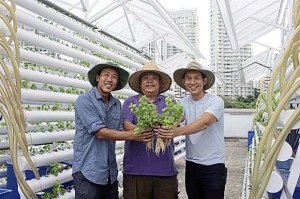
Urban farmers: Three of the four founders of ComCrop (from left) Kuah Zhen Shan, Allan Lim and Keith Loh, with vegetables from the urban farm at *Scape rooftop in Orchard Link, Singapore. Photo: SPH Source: www.thestar.com.my

Urban farmers: Three of the four founders of ComCrop (from left) Kuah Zhen Shan, Allan Lim and Keith Loh, with vegetables from the urban farm at *Scape rooftop in Orchard Link, Singapore.
Photo: SPH
Source: www.thestar.com.my

Since the start of the year, Bjorn Low and his team of five have been growing small test batches of organic vegetables that can be used in mixed leaf salads – giant red mustard, mizuna, bok choy – and herbs such as basil and mint.

Like most farmers, they deal with pests such as pigeons nibbling on the plants. Team member Robert Pearce, 37, says jokingly: “I squirt the birds with water whenever I see them doing that.”

But unlike most farmers, the team’s plots are on the roof of People’s Park Complex car park – the latest rooftop farm to sprout in Singapore. Surrounded by high-rise buildings, the vegetables and herbs are a part of an urban farm, about 2,787sq m, slated to open on the sixth floor of the car park this year.

Last year, urban farming consultancy Edible Gardens, which helps restaurants and institutions build gardens, was approached by the car park’s re-development manager, Goldhill Developments, to see what could be done with the under-utilised space.

Low, 33, who co-founded Edible Gardens with Pearce in late 2012, says: “We’ve always been looking for a space like this to set up a commercially viable rooftop urban farm. This is our dream.”

[Read more…]

NTU students bring green thumb to gray concrete of Taipei rooftop

by KATHERINE WEI, The China Post, March 10, 2014

Vickie C. Yang, Mica Hsiao et Wan Lin Chen Photo: Daniel Garcia Source: www.elviajero.elpais.com

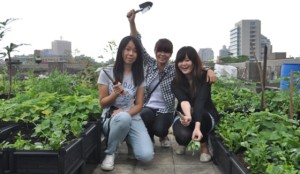
Vickie C. Yang, Mica Hsiao and Wan Lin Chen on the roof of the university’s Sociology Department
Photo: Daniel Garcia
Source: www.elviajero.elpais.com

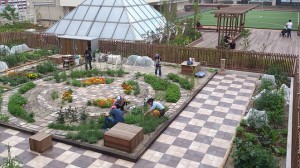
TAIPEI, Taiwan — Around 60 ping of lush green covers the rooftop of National Taiwan University’s Sociology Department building, with strawberries predominant among the many rows. The notion of growing your own food in the concrete jungles of the city has long been a fantasy of urban dwellers, many of whom have sworn to devote themselves to a healthier, organic way of living.

Whimsical fantasies, it seemed, as concrete rooftops were less than ideal for growing, as the material absorbs and radiates excess heat in a way unhelpful to gardening. But a group of college students are now proud veterans of the gardening struggle between urban farmer and the limited environment.

The garden sprung from the course “Innovation and Design of Socio-economic Organizations,” in which a group of eight students decided that they were fed up with the money-driven flow that escalated housing prices outrageously in Taiwan, especially in the Wenlin Yuan case. When the Wang family accused the government of confiscating its land unlawfully, the students thought: aside from providing shelter, what else can “home” represent to people?

[Read more…]