From the Blog

At Met, park views big and small

by CAROL VOGEL, The New York Times, May 10, 2013

Source: www.metmuseum.org

Source: www.metmuseum.org

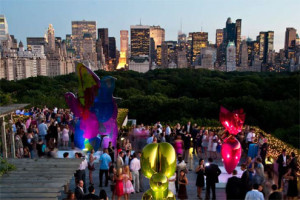
In 1998 when Ellsworth Kelly became the first living artist to exhibit on the roof of the Metropolitan Museum of Art, he called the picture-postcard setting “an instant background.” When his sculptures — as tall as 14 feet — were installed there they looked enormous and the skyscrapers behind them tiny. Mr. Kelly compared this reversal of scale to Chinese landscape painting in the way it played with perspective.

This year’s exhibition on the Met’s roof garden, which opens Tuesday, is also a study in perspective, but this time the beauty and impact will be the diminutive nature of its creation. The Pakistani artist Imran Qureshi, who is known for his painstaking brushwork in the style of the 16th- and 17th-century Mughal miniaturists, is conceiving a site-specific painting that will be directly on the surface of the roof garden. His creation will relate not only to some of his earlier work, but also to the nature he has discovered in Central Park, whose vistas are an integral part of the setting. (Through Nov. 3, 212-535-7710, metmuseum.org)

 Read the original story


The Roof Garden Commission: Imran Qureshi

Source: The Metropolitan Museum of Art

Other story about the installation : Savagery, Mulled in Airy Precincts
Naturopolis: New York, la révolution verte (épisode 1)

extrait de arte.tv

New York, la révolution verte Photo: Docside Source: www.arte.tv

New York, la révolution verte
Photo: Docside
Source: www.arte.tv

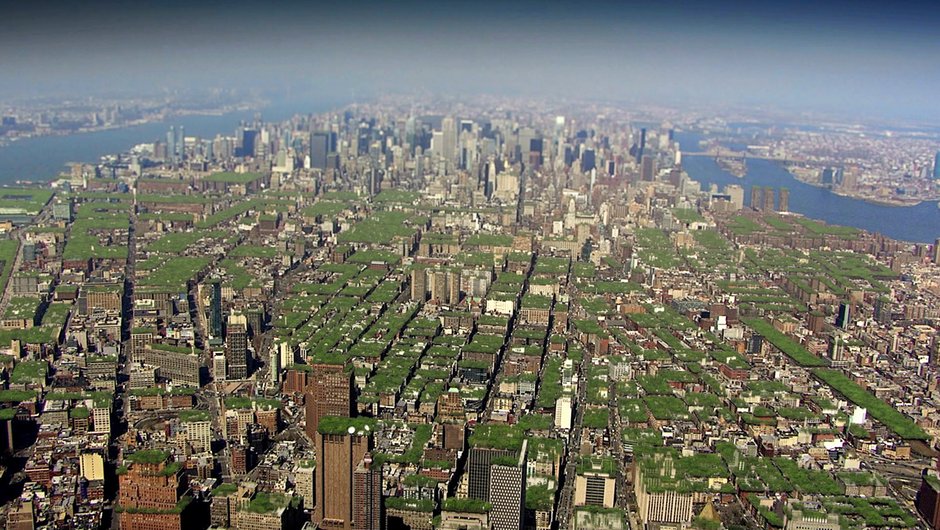
Comment les mégalopoles tentent de se réconcilier avec la nature. En quatre volets, une vaste réflexion sur les défis environnementaux qui nous attendent. Ce premier volet propose de découvrir New York avec une grille de lecture inhabituelle : celle de la nature.

Plus de la moitié de l’humanité vit désormais en ville. Parallèlement, la faune et la flore investissent de plus en plus les milieux urbains. Avec une conséquence surprenante : les relations entre les animaux et les hommes n’ont jamais été aussi nombreuses, denses et riches ! Pour la première fois, l’exploration de la biodiversité est placée au cœur de la ville et des activités humaines. Et pour la première fois, la ville est appréhendée au travers de la nature qui s’y déploie. Dans Naturopolis, acteurs, penseurs, scientifiques, rêveurs et bâtisseurs de demain nous invitent à explorer les richesses naturelles méconnues de quatre mégalopoles : New York, Paris, Rio de Janeiro et Tokyo. Cet épisode emboîte le pas d’un personnage hors-norme, Frédéric Durand, à la fois scientifique, naturaliste, poète et visionnaire. C’est à travers ses yeux que nous explorons la Grosse Pomme : un regard proche de celui des naturalistes d’antan, capables à la fois de déchiffrer les énigmes scientifiques, de se passionner pour les hommes, de vibrer à la poésie du monde.

Page Internet de l’épisode 1

Dossier Naturopolis sur arte.tv

France: Arte

  • mercredi 24 avril à 14h20 (rediffusion)
  • samedi 27.04 à 16h10  (rediffusion)
  • sur Internet 

Montréal: Cinéma du parc

  • Jeudi le 25 avril 18h30 (dans le cadre du 5e Festival du film sur l’environnement de Montréal)


Breeding pigeons on rooftops, and crossing racial lines

by JOSEPH BERGER, The New York Times, April 3, 2013

Delroy Sampson breeds his own birds Photo: Todd Heisler for The new York Times Source: www.nytimes.com

Delroy Sampson breeds his own birds
Photo: Todd Heisler for The new York Times
Source: www.nytimes.com

When New Yorkers consider the subculture of people who raise pigeons on rooftops, many are likely to think of Terry Malloy, the longshoreman in the 1954 film “On the Waterfront” played by Marlon Brando. He was a classic rooftop breeder, rough-hewed, working-class and white ethnic to his toes.

But that image has long needed some alteration because in the dwindling world of rooftop fliers, as they are known, the men are as likely to be working-class blacks or Hispanics. Many were introduced to the hobby by Irish, Italian and other fliers of European descent, an unlikely camaraderie that evolved in neighborhoods like Bushwick, Canarsie and Ozone Park that were undergoing gradual racial shifts.

Ike Jones, an African-American who manages one of the last pigeon supply stores for its Italian-Jewish owner, Joey Scott, said he learned much of the craft when he was about 12. He then became a helper to George Coppola, an Italian rooftop breeder in Bedford-Stuyvesant.

“I was amazed at his coop,” said Mr. Jones, now 65. “He had electricity and running water, and I only had a box made of scrap wood. On Sunday his wife would cook spaghetti and meatballs and I would eat with them because I was always there.”

A new book, “The Global Pigeon,” by Colin Jerolmack, an assistant professor of sociology at New York University who spent three years hanging out with pigeon fliers, makes the point that pigeon breeding brought Italian-Americans and other ethnic whites “into contact with people of a different ethnic and age cohort with whom they were not voluntarily associating before.” […]

Read the original story

The Global Pigeon, by Colin Jerolmack

Top 5 des bars sur les toits de New York

nyhabitat.com, 12 septembre 2012

Le Iris & B. Gerald Cantor Roof Garden Source: www.metmuseum.org

Le Iris & B. Gerald Cantor Roof Garden
Source: www.metmuseum.org

A New York, tout est toujours un peu plus extravagant et imposant qu’ailleurs. Les buildings sont plus hauts, les magasins plus grands et la ville elle-même ne peut être comparée avec aucune autre. Il n’est donc pas surprenant de voir qu‘il en va de même pour la vie nocturne.

La ville de New York fourmille de boîtes de nuits spectaculaires, de lounges et de bars. Le plus impressionnant est sans doute que quelques uns des meilleurs bars et terrasses ne se trouvent pas au niveau de la mer, mais dans les airs ! Si il y a quelque chose qui manque à Manhattan, c’est l’espace, et c’est là que les bars sur les toits new-yorkais entrent en jeu. Ces bars occupent souvent toute la longueur du toit, utilisant l’espace disponible, et disposent même de patios où vous pouvez vous rafraîchir pendant l’été, loin au dessus des rues de la ville. Au fil des ans, beaucoup de ces bars sont apparus aux quatre coins de la ville.

Pour vous aider à trouver les meilleurs bars de New York, nous avons élaboré un Top 5 des meilleurs rooftop bars de Manhattan !

[Read more…]

Living small Is the best revenge

by ROBIN FINN, The New York Times, February 28, 2013

Looking West Source: nArchitecte.com

Looking West
Source: nArchitecte.com

Despite less-than-rhapsodic memories of miniaturized apartment living, the married architects Mimi Hoang and Eric Bunge designed the winner of the adAPT micro-unit competition sponsored by the New York City Housing and Preservation Department and endorsed by Mayor Michael R. Bloomberg.

Their entry, “My Micro NY,” features 55 prefabricated apartments, of 360 square feet or less, stacked in a 10-story building on East 27th Street in Kips Bay. The building does not stint on amenities, providing a common terrace, a laundry room and a bike room.

The couple’s firm, nArchitects, is based in a Dumbo loft, and they live in a Carroll Gardens town house, but for the competition they drew on their cohabitation in a tenement in Lower Manhattan.

The mission was to seize an opportunity to render a tight space habitable and, if possible, aesthetically pleasing.

“At first blush we weren’t so sure about entering,” Mr. Bunge said, “because we felt people should have more space than this. But that was before we understood that the alternatives out there are far worse. There are people living together in substandard apartments all over the city who would prefer to live alone but can’t afford to. So we said, ‘Wait a minute, let’s make a humane small space where people would want to live.’”

“This is a pilot program, and it doesn’t mean micro-units are going to be sprouting everywhere,” Ms. Hoang said. “But it’s incredibly exciting to be part of a progressive new residential prototype for New York that has social implications and is intended to help solve a social problem.

Read the article…

adAPT NYC Competition, winner announcement

[Read more…]

In the book bag, more garden tools

by LISA W. FODERARO, The New York Times, November 23, 2012

Children at the 2,400-square-foot Fifth Street Farm, a garden atop three East Village schools Photo: Ángel Franco Source: The New York Times

Children at the 2,400-square-foot Fifth Street Farm, a garden atop three East Village schools
Photo: Ángel Franco for The New York Times
Source: The New York Times

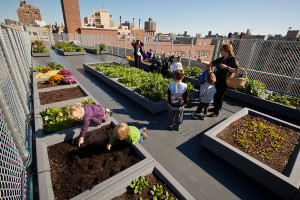
In the East Village, children planted garlic bulbs and harvested Swiss chard before Thanksgiving. On the other side of town, in Greenwich Village, they learned about storm water runoff, solar energy and wind turbines. And in Queens, students and teachers cultivated flowers that attract butterflies and pollinators.

Across New York City, gardens and miniature farms — whether on rooftops or at ground level — are joining smart boards and digital darkrooms as must-have teaching tools. They are being used in subjects as varied as science, art, mathematics and social studies. In the past two years, the number of school-based gardens registered with the city jumped to 232, from 40, according to GreenThumb, a division of the parks department that provides schools with technical support.

But few of them come with the credential of the 2,400-square-foot garden at Avenue B and Fifth Street in the East Village, on top of a red-brick building that houses three public schools: the Earth School, Public School 64 and Tompkins Square Middle School. Michael Arad, the architect who designed the National September 11 Memorial in Lower Manhattan, was a driving force behind the garden, called the Fifth Street Farm.

The idea took shape four years ago among parents and teachers, when Mr. Arad’s son was still a student at the Earth School. The family has since moved from the neighborhood to Queens, but Mr. Arad, president of a nonprofit corporation that oversaw the garden, stayed on. The farm, with dozens of plants ranging from leeks to lemon balm, opened Oct. 19. Already, students have learned about bulbs and tubers, soil science and nutrition, while the cafeteria has cooked up fresh kale and spinach for lunch.

Read the article…