From the Blog

Vegies with a higher purpose

by INDIRA NAIDOO, The Sydney Morning Herald, December 29, 2013

The Big Apple’s hotels are sprouting gardens.
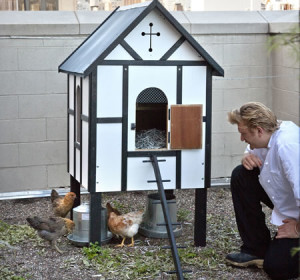
Crosby St Hotel chef Anthony Paris checks the chooks Source: www.firmdalehotels.com

Crosby St Hotel chef Anthony Paris checks the chooks
Source: www.firmdalehotels.com

You know the grow-your-own movement has crossed over into the mainstream when some of New York’s hottest hotels start growing vegies on their roofs.

More than 20 Manhattan hotels now have productive rooftop vegetable gardens. Some have their own beehives producing honey – and some even have chickens laying eggs.

So why give vegie patches million-dollar views in a city where real estate is at a premium?

The trend is two-fold: travellers are expecting more organic, seasonal and local ingredients on hotel menus. And when a hotel guest wants to know the provenance of the food, it doesn’t get any more local than this. Rooftop herbs and vegetables aren’t bruised by transportation and storage, and retain more of their nutrients. And the hotels limit their carbon footprint.

There are financial benefits as well. Green roofs reduce heating and cooling cost for large buildings and mitigate against rain and stormwater damage.

Here’s a look at four New York hotels with impressive gardens.
[Read more…]

Farmer proves potential of rooftop planting

by Zhu Ningzhu (editor), English, news.cn, November 20, 2013

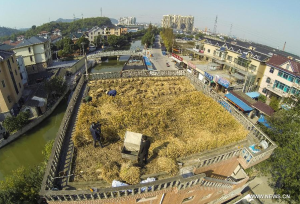
Farmers help villager Peng Qiugen harvest rice on the roof of Peng's house which had been converted into a rice field at Qilin Village of Shaoxing CitySource: www.news.cn

Farmers help villager Peng Qiugen harvest rice on the roof of Peng’s house which had been converted into a rice field at Qilin Village of Shaoxing City
Source: www.news.cn

Hangzhou (Xinhua) — In Chinese language, most farmers go “down” to the field to harvest crops, but one farmer from an eastern village in China goes “up” to the roof to reap rice.

Peng Qiugen, a “landless” farmer who transferred his land to a gardening company seven years ago, just harvested over 100 kg of rough rice on his 120-square-meter rooftop this week.

“My greatest wish is to save more land for China by promoting rooftop farming to more households,” Peng told Xinhua.

He calculated that a roof as large as his, if used for growing vegetables, can meet the daily demands of 20 people.

In Peng’s village, Qilin in east China’s Zhejiang Province, most farmers have circulated their land to scale planting individuals and companies in exchange for a steady income and an opportunity to try out other jobs that would presumably bring more economic gains.

Some have become factory workers, others have started businesses. For Peng, he has tried both and more, saying, “I accept any jobs within my ability that can improve the living conditions for my family.”

A wealthier material life, however, has never changed his passion for land and farming.

When he started to build his four-story house in 2006, he thought about transforming the roof into a piece of arable land.

[Read more…]

Eskenazi Hospital prepares to open

by JOHN RUSSELL, The Indianapolis Star, November 16, 2013

Sky Farm on the roof of the new Eskenazi Health Hospital.  Photo: Matt Kryger / The Star Source: www.indystar.com

Sky Farm on the roof of the new Eskenazi Health Hospital
Photo: Matt Kryger / The Star
Source: www.indystar.com

Rooftop vegetable garden, sculptures add unique touches to Wishard’s replacement

Indiana has never seen a hospital quite like this.

From the spiraling wooden sculpture suspended from the ceiling in the main concourse to the vegetable garden on the roof, the brand-new Eskenazi Hospital keeps you wondering what you will see around the next corner.

The $754 million hospital, which will serve mostly poor and underinsured patients, is nearly ready to open, after four years of planning and construction. The public can tour the hospital from 11 a.m. to 5 p.m. today.

The massive complex, spread out on 37 acres, will replace Wishard Hospital, a deteriorating hodgepodge of buildings, some a century old. On Dec. 7, an army of hospital workers will move patients from the old building to the new one a block away.

The new hospital is the latest addition to Indiana’s hospital construction boom over the last decade, a period in which more than $1 billion in new facilities sprouted up around Central Indiana, from specialty heart clinics to luxurious medical centers in the suburbs.

Each of Indiana’s dozens of hospitals seems to have a distinctive personality, from the luxurious Indiana University Health North Hospital in Carmel, with posh fireplace lounges and cherry wood bassinets, to the kid-friendly Riley Hospital for Children, with its signature red wagons and play rooms.

The feel at Eskenazi Hospital is bright and welcoming. Sunlight pours through windows in every patient room, waiting room and hallway. The public areas are filled with colorful art, from historical oil paintings to whimsical photographs of the city.

The goal, officials say, is to be comforting for people entering the doors for what is often a frightening, high-stress experience.

“We want this to be the most patient-friendly, family-friendly, simple-to-use hospital you can find,” said Matthew R. Gutwein, president and chief executive of Marion County Health and Hospital Corp., which operates the hospital.

[Read more…]

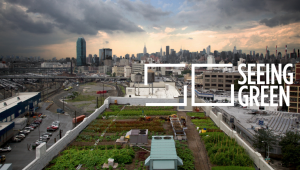
Seeing green: Urban agriculture as green infrastructure

by CASSIM SHEPARD, Urban Omnibus, February 1st, 2012

Image: Seein Green Source: www.urbanomnibus.net

Image: Seeing Green
Source: www.urbanomnibus.net

It’s easy to list the reasons why we are supposed to love urban agriculture: the food it yields is fresh and local; the farming it requires is fun and social; the effect on neighborhoods is revitalizing and healthy. Critics point to its inability to replace existing production and distribution channels for produce, but what if its impact extended beyond the small farm or immediate community? What if it could solve other problems? One of New York’s greatest environmental challenges is its combined sewage overflow (CSO) problem. Our outdated sewer system is designed to collect stormwater runoff, domestic sewage, and industrial wastewater in the same pipe on its way to a sewage treatment plant. When the rain is heavy, though, volume exceeds capacity and untreated wastewater flows right into our waterways. Green infrastructure is a term that refers to a wide range of technologies and systems to improve water quality through the capture and reuse of stormwater. But the policies that incentivize green infrastructure and those that govern urban agriculture are not coordinated. In some cases, urban agriculture is actively excluded from official definitions of green infrastructure. In an effort to support farming in the city and help scale it up, Tyler Caruso and Erik Facteau set out to prove scientifically the environmental benefits of rooftop and other urban farms, in particular their ability to manage stormwater, with their research project Seeing Green. In describing this project, Caruso and Facteau touch on issues that range from the effect of scientific research on public policy, the shift towards a definition of sustainability that includes performance alongside design, and the need to layer different registers of analysis in efforts to bring about a city that is more responsive to natural systems. […]

Read the original story

‘Innovative’ housing with rooftop farms set for southside

by EMILIE RAGUSO, Berkeleyside, October 17, 2013

A photo simulation of what the project’s rooftop farms could look like Image: Stanley Saitowitz / Natoma Architects Source: www.berkeleyside.com

A photo simulation of what the project’s rooftop farms could look like
Image: Stanley Saitowitz / Natoma Architects
Source: www.berkeleyside.com

City zoning board members approved a 77-unit mixed-use housing development near downtown Berkeley late last week, expressing excitement about a “unique” design set to include more than a dozen working rooftop farm plots and a novel approach to parking.

“Garden Village,” at 2201 Dwight Way at Fulton Street, brings with it a number of innovative features, from its composition — it’s made up of 18 distinct but connected “volumes,” or towers, that range in height from 3 to 5 stories and are connected by open-air walkways; its more than 12,000 square feet of rooftop farming plots; and its small garage, which offers just enough space for a fleet of shared vehicles that will be rentable by tenants.

Without the car-sharing idea, the project would have required room for 71 vehicles. Instead, Berkeley-based developer Nautilus Group decided it would purchase a fleet of four to 10 automobiles and contract with a car-sharing operator called Getaround to run the “car-share pod” operation. (The city required Nautilus to pay for a parking demand study to bolster the justification for that approach.)

Zoning board Commissioner Shoshana O’Keefe described the concept as potentially “genius,” adding that the notion of projects that fold effective car-sharing programs into their plans “might be the magic solution” to the hairy issue of meeting parking demand efficiently in a densely-populated community.

[Read more…]

Tamil Nadu government pushes green thumb rule

by JULIE MARIAPPAN, Times News Network, September 23, 2013

CHENNAI: The soaring price of vegetables has caused much heartburn, but people in the state may soon get their greens for free.

If the state government has its way, residents could soon be plucking fresh vegetables from their own rooftop gardens. As part of the plan to soften the blow of food inflation, the government will distribute do-it-yourself rooftop garden kits to residents.

Encouraged by a few individuals who have responded to rising prices by growing vegetables on their balconies, the government plans to introduce the scheme in Chennai and Coimbatore to begin with.

“The opportunity to beat rising prices by growing vegetables at home has led to people trying their luck with gardening. The government wants to chip in with support,” a horticulture officer said. The horticulture department will roll out the scheme with support from Tamil Nadu Agriculture University.

People interested can apply online and the government will supply them with 20 UV stabilised 200 micron thickness polythene bags, 15kg of coir pith and manure, seeds for vegetables and greens, besides instruments, organic fertiliser and a 20sqm polythene sheet. It will make 20 bags available for each person at a subsidised price. Indian Overseas Bank offers loans to individuals for rooftop gardening.

[Read more…]