From the Blog

Légumes et sols contaminés, une cohabitation difficile

par DAPHNÉE HACKER-B., Métro, 31 janvier 2014
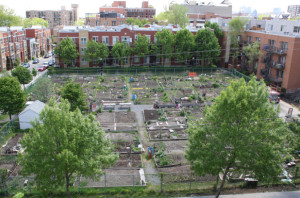
Jardin communautaire Mile End Photo: Josie Desmarais / Métro Source: www.journalmetro.com

Jardin communautaire Mile End
Photo: Josie Desmarais / Métro
Source: www.journalmetro.com

Des 97 jardins communautaires montréalais ensevelis en ce moment sous la neige, mais très populaires en été, 20 ont été identifiés comme ayant des terres dangereusement contaminées. Si les arrondissements ont tenté depuis de pallier le problème de différentes façons, la décontamination a été la solution la moins retenue.

Les potagers situés au sein d’une métropole comme Mont­réal sont directement soumis aux contaminations multiples issues des anciennes activités industrielles. C’est ce qui ressort d’une étude de toxicité des jardins communautaires menée par la Direction de la santé publique de Montréal (DSP), en 2009. Parmi les 20 jardins présentant une problématique de contamination, 9 cas touchent l’ensemble du jardin, tandis que dans les 11 autres, une section du terrain a été identifiée comme contaminée.

Grâce à une mise à jour effectuée par Métro, on constate que sept jardins ont été complètement ou partiellement fermés, tandis que seulement trois ont été décontaminés.
[Read more…]

Angel city brewery raising rooftop hops for special brew

The garden atop Angel City Brewery Photo: Ray Narkevicius Source: www.laweekly.com

The garden atop Angel City Brewery
Photo: Ray Narkevicius
Source: www.laweekly.com

by SEAN J. MILLER, LA Weekly, January 7, 2014

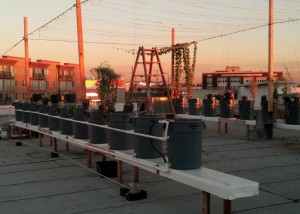
Angel City Brewery is taking the farm-to-table concept to new heights with a rooftop hops garden whose harvest has yielded a unique brew only available in downtown L.A.

The craft brewery’s urban garden is a work in progress, but Dieter Foerstner, Angel City’s brewmaster, expects that by next fall patrons at the Angel City’s public house will be able to enjoy its (copyrighted) “rooftop” brew.

“We’ve played around with some cask beers — beers we’ve already had brewed — and we’ll pitch fresh hops into a cask, let it condition for a week or so and then turn around and sell them traditional-style,” Foerstner says. “By using those fresh hops, you get this really beautiful, almost resinous aroma and really great hops flavor.”

Some breweries use fresh hops in “harvest style” or “wet hop” beers, but those operations are generally located in rural areas, close to the source. For an urban brewery — particularly one located in the country’s second biggest city — growing your own is unique.

[Read more…]

Could a ‘green roof’ solve Brooklyn’s toxic waste woes?

by MARK SVENVOLD, Samsung Voice, Forbes, February 12, 2013

When Hurricane Sandy devastated New York in 2012, it created a uniquely nasty “perfect storm” in the Gowanus section of Brooklyn. In the aftermath of the floods, rainwater overwhelmed the municipal water treatment systems, dumping millions of gallons of raw sewage into the Gowanus Canal–already a federal Superfund toxic site.

For middle school teacher Lynn Shon, the problem hit home for several reasons. She’d already been investigating the phenomenon of water runoff with her science class at the Peter Rouget Middle School, (M.S. 88) in Park Slope, which borders Gowanus.

However, Shon had first heard about the issue two years ago as part of a curriculum development program at The Earth Institute at Columbia University. In urban areas, the asphalt and concrete that make up so much of these landscapes do not absorb water. During heavy rains, water runoff overwhelms municipal water treatment facilities; and when storms hit, these systems are forced to dump waste directly into rivers and streams like the Gowanus Canal.

The hazards of storm water runoff often go unnoticed, even in areas most affected by them. “I had no idea that the whole problem existed,” says Shon.

Wanting to explore the issue further, she entered her science class’s project in Samsung’s Solve for Tomorrow contest, which challenges classrooms around the country to use science, technology, engineering and math (STEM) to help solve environmental issues in communities.

As Shon’s class was working on a solution, the problem came right to their doorstep. Hurricane Sandy swamped the city’s water treatment systems. Sewage began pouring into the Gowanus Canal and surrounding rivers and beaches. “That storm really made the issue of sewage overflow relevant to our students,” says Shon.

[Read more…]

Rooftop gardens are the future of farming

by AL SHAY, Statesman Journal, January 2, 2014

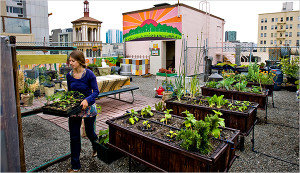
Maya Donelson tends the rooftop garden of Glide Memorial Church in San Francisco Photo: Peter DaSilva for The New York Times Source: www.nytimes.com

Maya Donelson tends the rooftop garden of Glide Memorial Church in San Francisco
Photo: Peter DaSilva for The New York Times
Source: www.nytimes.com

So many of our horticulture students at Oregon State University are enthralled with the thought of becoming organic farmers despite the fact there seems to be an overabundance in the Willamette Valley already.

I encourage them to look at the new urban environment, you know the one that covers only 2 to 3 percent of the earth’s surface but consumes nearly 70 percent of its resources. This particular model also predicts that the urban environment is poised to house and accommodate the needs of seven out of every 10 inhabitants by 2050. I recently examined a rooftop gardening operation on the east coast and was simply amazed at what they are doing.

I was thumbing my way through the 355 page Whole Seed catalog from Baker Creek Heirloom Seeds when an article entitled the Brooklyn Grange Farm caught my attention. It is the largest rooftop farming operation in America. They have two sites, one at the old Brooklyn navy yard and one in Queens, NY. Together there is a combined area of 108,000 square feet. This is nearly 2½ acres from which they produce nearly 20,000 pounds of produce per acre.

[Read more…]

Farmer proves potential of rooftop planting

by Zhu Ningzhu (editor), English, news.cn, November 20, 2013

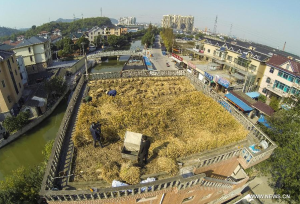
Farmers help villager Peng Qiugen harvest rice on the roof of Peng's house which had been converted into a rice field at Qilin Village of Shaoxing CitySource: www.news.cn

Farmers help villager Peng Qiugen harvest rice on the roof of Peng’s house which had been converted into a rice field at Qilin Village of Shaoxing City
Source: www.news.cn

Hangzhou (Xinhua) — In Chinese language, most farmers go “down” to the field to harvest crops, but one farmer from an eastern village in China goes “up” to the roof to reap rice.

Peng Qiugen, a “landless” farmer who transferred his land to a gardening company seven years ago, just harvested over 100 kg of rough rice on his 120-square-meter rooftop this week.

“My greatest wish is to save more land for China by promoting rooftop farming to more households,” Peng told Xinhua.

He calculated that a roof as large as his, if used for growing vegetables, can meet the daily demands of 20 people.

In Peng’s village, Qilin in east China’s Zhejiang Province, most farmers have circulated their land to scale planting individuals and companies in exchange for a steady income and an opportunity to try out other jobs that would presumably bring more economic gains.

Some have become factory workers, others have started businesses. For Peng, he has tried both and more, saying, “I accept any jobs within my ability that can improve the living conditions for my family.”

A wealthier material life, however, has never changed his passion for land and farming.

When he started to build his four-story house in 2006, he thought about transforming the roof into a piece of arable land.

[Read more…]

Eskenazi Hospital prepares to open

by JOHN RUSSELL, The Indianapolis Star, November 16, 2013

Sky Farm on the roof of the new Eskenazi Health Hospital.  Photo: Matt Kryger / The Star Source: www.indystar.com

Sky Farm on the roof of the new Eskenazi Health Hospital
Photo: Matt Kryger / The Star
Source: www.indystar.com

Rooftop vegetable garden, sculptures add unique touches to Wishard’s replacement

Indiana has never seen a hospital quite like this.

From the spiraling wooden sculpture suspended from the ceiling in the main concourse to the vegetable garden on the roof, the brand-new Eskenazi Hospital keeps you wondering what you will see around the next corner.

The $754 million hospital, which will serve mostly poor and underinsured patients, is nearly ready to open, after four years of planning and construction. The public can tour the hospital from 11 a.m. to 5 p.m. today.

The massive complex, spread out on 37 acres, will replace Wishard Hospital, a deteriorating hodgepodge of buildings, some a century old. On Dec. 7, an army of hospital workers will move patients from the old building to the new one a block away.

The new hospital is the latest addition to Indiana’s hospital construction boom over the last decade, a period in which more than $1 billion in new facilities sprouted up around Central Indiana, from specialty heart clinics to luxurious medical centers in the suburbs.

Each of Indiana’s dozens of hospitals seems to have a distinctive personality, from the luxurious Indiana University Health North Hospital in Carmel, with posh fireplace lounges and cherry wood bassinets, to the kid-friendly Riley Hospital for Children, with its signature red wagons and play rooms.

The feel at Eskenazi Hospital is bright and welcoming. Sunlight pours through windows in every patient room, waiting room and hallway. The public areas are filled with colorful art, from historical oil paintings to whimsical photographs of the city.

The goal, officials say, is to be comforting for people entering the doors for what is often a frightening, high-stress experience.

“We want this to be the most patient-friendly, family-friendly, simple-to-use hospital you can find,” said Matthew R. Gutwein, president and chief executive of Marion County Health and Hospital Corp., which operates the hospital.

[Read more…]