From the Blog

Govt secretaries inspect rooftop farming – KATHMANDU

by Republica, May 3, 2014

To promote the rooftop and terrace farming in Kathmandu city, some government secretaries and high-level officials from concerned government departments have inspected the rooftop farming at some places of the capital.

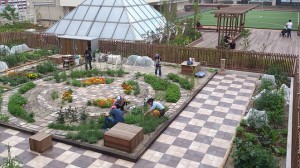
The inspection team led by secretary of the Prime Minister’s Office Krishna Hari Banskota reached the residences of Litterateur Pawan Alok and Rekha Kandel, a homemaker, where the officials were fascinated to see a wide variety of vegetables growing in clay vessels and plastic drums. They had planted chilies, tomatoes, flowers, guava, mango, pomegranate, oranges, green leaves and fruits and vegetables of many more varieties.

“The rooftop farming we saw left us quite inspired as we witnessed a mausami plant of nearly four inches bearing 12 fruits and a three inches lemon plant producing as many as 100 lemons at times,” said Secretary Banskota.

Executive Chief of the Kathmandu Metropolitan City (KMC) shared with the monitoring team that additional 500 people were going to receive training on rooftop farming this year alone. The authority has already trained 650 families in the past.

The executive director of the Solid Waste Management Committee Sumitra Amatya added that the elderly people who stay at home all the day have a good time by engaging in rooftop farming that does not require much labor.

The committee every year felicitates the best performers in this category of farming and managing the organic waste on the occasion of World Environment Day.

Secretary Banskota stressed on promoting rooftop farming by introducing separate and clear policies.

The monitoring team later went to the Compost Manure Production Center operated by NEPSEMAC at Chovar and inspected the technique and methodology adopted for producing the organic manure. Secretary of the Ministry of Urban Development Kishor Thapa expressed commitment to promote the organic waste production that helps converting waste into money.

Read the original story

Read also:
KMC to promote rooftop farming
Metropolis to help create 500 rooftop gardens
Elderly couple turn rooftop into their vegetable garden

A Farm Grows in Brooklyn – on the Roof

by MARK J. MILLER, for National Geographic, April 29, 2014

This story is part of National Geographic‘s special eight-month “Future of Food” series.

U.S. cities lead a rooftop-farming movement that’s spreading around the globe.

For most urban dwellers, visiting a working farm requires a journey into the countryside. But in a growing number of world capitals, a farm is just a short elevator ride away—on the roof.

In Singapore, Amsterdam, Hong Kong, Tokyo, and Montreal as well as several U.S. cities, farms have been built atop multistory buildings.

“Five years ago, there were virtually no rooftop farms,” Steven Peck, founder and president of Green Roofs for Healthy Cities, told National Geographic. “Now they are starting to appear across the globe.”

Peck says that as fossil fuels become more expensive and the number of urban dwellers continues to rise, urban farming will help feed the population without increasing the cost and pollution of food transport.

Rooftop farming was born out of the green-roof movement, in which building owners partially or completely cover roofs with vegetation atop special waterproof membranes. Green roofs use plants and flowers to provide insulation, create a habitat for local wildlife, help control runoff, put more oxygen into the atmosphere—and provide a welcome, verdant break from urban drabness.

Rooftop farms take the green-roof concept a step further, with plots that provide fruits and vegetables for local residents and the chance for urban volunteers to become part-time farmers.

[Read more…]

Can Mexico City’s roof gardens help the metropolis shrug off its smog?

by SAM JONES, theguardian.com, April 24, 2014

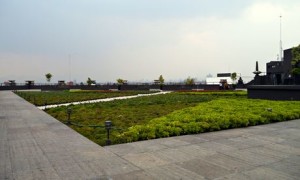
A garden on the roof of the environment secretary's air-monitoring labs in Mexico City Source: www.theguardian.com

A garden on the roof of the environment secretary’s air-monitoring labs in Mexico City
Source: www.theguardian.com

Green roofs sprouting across Mexican capital not only purify the air but aid recovery of hospital patients, says environment chief.

In a sheltered corner of one of the greatest megacities on Earth, there is a place where lizards careen around tree trunks, butterflies drink nectar from vermillion flowers and hummingbirds whisk the heavy air with their wings.

Stand in the botanical gardens of the Bosque de Chapultepec (the Chapultepec forest) and listen carefully enough, and something remarkable happens: birdsong begins to pierce the groan of trucks and the screech of taxi horns from the long avenue that bisects the park.

The gardens are home to one of a growing number of azoteas verdes – or green roofs – that are springing up around Mexico City as part of the metropolis’s efforts to purge its air of the pollution that has long been among its least-desired claims to fame.

The azotea verde atop the circular single-story offices of the botanical gardens, is planted with hardy stonecrop, which can withstand the Mexico City summer, but which also produces oxygen and serves as a filter to draw out the carbon dioxide and heavy metal particles in the air. As well as providing the park’s squirrels with an arena in which to practise their parkour, the roof help regulates the temperature of the offices below and soaks up rainwater to keep the building dry.

[Read more…]

Hong Kong’s fish farms in the sky

by PETER SHADBOLT, BBC News, April 2, 2014

Michael Leung’s honey commands a premium price Photo: HK Honey Source: www.bbc.com/news

Michael Leung’s honey commands a premium price
Photo: HK Honey
Source: www.bbc.com/news

Under eerie blue lights designed to simulate the ocean depths, hundreds of fish swim serenely through the bubbling waters of their circular tanks, 15 floors up in the sky.

There are 11 plastic tanks in total, holding a combined 80,000 litres of salt water.

They are full of grouper, a white-fleshed fish, which are all destined to end up on the plates of restaurant-goers across Hong Kong.

This is the scene at Oceanethix, one of the numerous so-called “vertical fish farms” in the special administrative region, which have become a key fixture of its supply chain.

For while most fish farms around the world are at sea, or at least, land level, in Hong Kong it is more often a necessity to put them many floors up in tall buildings.

This is because as one of the most densely populated places in the world, there is simply very little spare space. So fish farms have to fit in where they can.

For the small firms that dominate the industry, it is worth the effort, as Hong Kong has an insatiable appetite for fish and seafood. It consumes more than 70kg (11 stone) per capita every year, 10 times more than in the US.

[Read more…]

Urban gardening for city slickers

by MICHAEL KELLY, Independent.ie, February 25, 2013

Photo: Urban Farm Source: www.urbanfarm.ie

Photo: Urban Farm
Source: www.urbanfarm.ie

There is always a tendency to consider food growing as something that always has to happen in a field or large garden – GIYing is, unfortunately, often considered the preserve of country people or farmers. In reality, it’s an equally viable hobby in an urban environment.

In fact, if we are to provide a genuine alternative to the modern food chain, then food growing is something that is going to have to happen in much smaller spaces.

I visited two projects in Dublin recently that really challenge your assumptions about where food can be produced. The first is Kaethe Burt O’Dea’s blink-and-you-miss-it community garden on Sitric Road in Stoneybatter. The second is what you might call a ‘hyper-urban’ food growing space on the roof of the Chocolate Factory on Kings Inn Street, a stone’s throw from O’Connell St.

The Sitric Community Garden is literally a street corner, a sliver of green space at the end of a terrace of two-up/two-down houses.

[Read more…]

You won’t believe what passengers are doing on the roof of this Tokyo train station, but it will make you green with envy

by Derek Markham, TreeHugger, March 26, 2014

The plot thickens at Tokyo train stations, as passengers grow on the go with these rooftop garden allotments Photo: Soradofarm Source: www.treehugger.com

The plot thickens at Tokyo train stations, as passengers grow on the go with these rooftop garden allotments
Photo: Soradofarm
Source: www.treehugger.com

The plot thickens at Tokyo train stations, as passengers grow on the go with these rooftop garden allotments.

It’s one thing to start and tend a garden if you have plenty of space at home, as well as the time to care for it, and another thing entirely to do so if you spend a good chunk of your day commuting, and lack a place at home for even a tiny garden.

But an ingenious solution is cropping up in Japan, where the East Japan Railway Company has collaborated with a station entertainment company to create a series of rooftop gardens on train stations, where commuters can create their own tiny gardens and tend to them while they wait for their train to arrive.

The Soradofarm project, which currently has five locations, including at Tokyo’s JR Ebisu station, allows people to rent their own garden allotment measuring just 3 square meters (tools, water, and garden equipment, and even seeds are included) to try their hand at growing food, flowers, and more.

The price isn’t cheap, as some of the plots cost 100,440 JPY per year (~$960 USD), but considering that it may be the best option for many of the people who are interested in it, due to space issues, these urban rooftop garden allotments could be a viable way to get some green in their busy lives.

Aside from the possibility of growing even a tiny amount of fresh food for themselves, these innovative urban gardens may be an effective solution for decreasing stress and increasing the amount of time spent out in the fresh air and sunshine, especially in areas where outdoor space is at a premium, and having a place to call your own is hard to come by.

Although there are just five urban rooftop gardens installed at the train stations so far, according to Springwise, East Japan Railways plans to open up more of these garden allotments “on top of or near to each one of its stations” in the future.

Read the original story