From the Blog

Capitol Hill’s Northwest School unveils new gymnasium +theater +cafeteria +sports field above E Pike

by jseattle, Capital Hill Seattl Blog, January 7, 2014
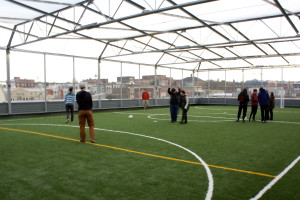
Rooftop Sports Field Photo: CHS Source: www.capitolhillseattle.com

Rooftop Sports Field
Photo: CHS
Source: www.capitolhillseattle.com

There is a new sports field at the unlikely location of E Pike and Bellevue. Look up.

Monday morning, the 6th through 12th graders at Capitol Hill’s Northwest School explored their new 38,300 square-foot facility at 401 E Pike that somehow houses “a league-size Gymnasium, 175-seat Black Box Theatre, two-tiered Dining Room, and a 6,000 square foot Rooftop Sports Field.”

“We used every inch from basement to roof,” Head of School Mike McGill told CHS as he watched students take their first kicks on the new rooftop turf and cork pellet field.

500 students currently attend classes at Northwest including 50 in the school’s international boarding program, the only one of its kind in Seattle.

The $19 million project designed by Mithun is one of a wave of big-money construction projects planned and underway for the doing very well, thank you roster of private schools on Capitol Hill. The Northwest project broke ground in September 2012 and was completed ahead of schedule and slightly under budget thanks to incentives for contractor Exxel Pacific to bring the job in on time.
[Read more…]

Angel city brewery raising rooftop hops for special brew

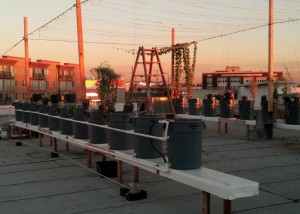
The garden atop Angel City Brewery Photo: Ray Narkevicius Source: www.laweekly.com

The garden atop Angel City Brewery
Photo: Ray Narkevicius
Source: www.laweekly.com

by SEAN J. MILLER, LA Weekly, January 7, 2014

Angel City Brewery is taking the farm-to-table concept to new heights with a rooftop hops garden whose harvest has yielded a unique brew only available in downtown L.A.

The craft brewery’s urban garden is a work in progress, but Dieter Foerstner, Angel City’s brewmaster, expects that by next fall patrons at the Angel City’s public house will be able to enjoy its (copyrighted) “rooftop” brew.

“We’ve played around with some cask beers — beers we’ve already had brewed — and we’ll pitch fresh hops into a cask, let it condition for a week or so and then turn around and sell them traditional-style,” Foerstner says. “By using those fresh hops, you get this really beautiful, almost resinous aroma and really great hops flavor.”

Some breweries use fresh hops in “harvest style” or “wet hop” beers, but those operations are generally located in rural areas, close to the source. For an urban brewery — particularly one located in the country’s second biggest city — growing your own is unique.

[Read more…]

Chatsworth’s rooftop additions take a beating at landmarks

by TOBIAS SALINGER, Curbed NY, January 8, 2014

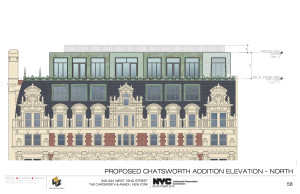
Proposed Chatsworth addition elevation North Image: Montroy Andersen Demarco Source: www.nyc.com

Proposed Chatsworth addition elevation North
Image: Montroy Andersen Demarco
Source: www.nyc.gov

Developer HFZ Capital picked up the iconic Chatsworth apartments at 340 West 72nd Street for a cool $150 million in 2012 and announced plans for a penthouse addition in October. Yesterday, representatives for the developer shared with the Landmarks Preservation Commission the plans by Montroy Anderson Demarco for two new floors atop the main building of the 1904 Beaux Arts structure and one extra floor on its annex building next door. But the team pushing for the rooftop additions, an external facelift for the façade, 24 new windows, and extra entrances could only sit and watch in silence as a dozen community members and preservation advocates bashed the design and representatives for three elected officials registered their bosses’ disapproval. The commissioners pointed out that it’s even more difficult to get approval for work on an individually landmarked building. “That really says to me that we need to scrutinize any changes more carefully,” said Commissioner Elizabeth Ryan of that designation.

[Read more…]

Could a ‘green roof’ solve Brooklyn’s toxic waste woes?

by MARK SVENVOLD, Samsung Voice, Forbes, February 12, 2013

When Hurricane Sandy devastated New York in 2012, it created a uniquely nasty “perfect storm” in the Gowanus section of Brooklyn. In the aftermath of the floods, rainwater overwhelmed the municipal water treatment systems, dumping millions of gallons of raw sewage into the Gowanus Canal–already a federal Superfund toxic site.

For middle school teacher Lynn Shon, the problem hit home for several reasons. She’d already been investigating the phenomenon of water runoff with her science class at the Peter Rouget Middle School, (M.S. 88) in Park Slope, which borders Gowanus.

However, Shon had first heard about the issue two years ago as part of a curriculum development program at The Earth Institute at Columbia University. In urban areas, the asphalt and concrete that make up so much of these landscapes do not absorb water. During heavy rains, water runoff overwhelms municipal water treatment facilities; and when storms hit, these systems are forced to dump waste directly into rivers and streams like the Gowanus Canal.

The hazards of storm water runoff often go unnoticed, even in areas most affected by them. “I had no idea that the whole problem existed,” says Shon.

Wanting to explore the issue further, she entered her science class’s project in Samsung’s Solve for Tomorrow contest, which challenges classrooms around the country to use science, technology, engineering and math (STEM) to help solve environmental issues in communities.

As Shon’s class was working on a solution, the problem came right to their doorstep. Hurricane Sandy swamped the city’s water treatment systems. Sewage began pouring into the Gowanus Canal and surrounding rivers and beaches. “That storm really made the issue of sewage overflow relevant to our students,” says Shon.

[Read more…]

Rooftop gardens are the future of farming

by AL SHAY, Statesman Journal, January 2, 2014

Maya Donelson tends the rooftop garden of Glide Memorial Church in San Francisco Photo: Peter DaSilva for The New York Times Source: www.nytimes.com

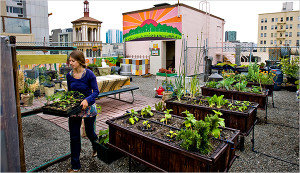
Maya Donelson tends the rooftop garden of Glide Memorial Church in San Francisco
Photo: Peter DaSilva for The New York Times
Source: www.nytimes.com

So many of our horticulture students at Oregon State University are enthralled with the thought of becoming organic farmers despite the fact there seems to be an overabundance in the Willamette Valley already.

I encourage them to look at the new urban environment, you know the one that covers only 2 to 3 percent of the earth’s surface but consumes nearly 70 percent of its resources. This particular model also predicts that the urban environment is poised to house and accommodate the needs of seven out of every 10 inhabitants by 2050. I recently examined a rooftop gardening operation on the east coast and was simply amazed at what they are doing.

I was thumbing my way through the 355 page Whole Seed catalog from Baker Creek Heirloom Seeds when an article entitled the Brooklyn Grange Farm caught my attention. It is the largest rooftop farming operation in America. They have two sites, one at the old Brooklyn navy yard and one in Queens, NY. Together there is a combined area of 108,000 square feet. This is nearly 2½ acres from which they produce nearly 20,000 pounds of produce per acre.

[Read more…]

Vegies with a higher purpose

by INDIRA NAIDOO, The Sydney Morning Herald, December 29, 2013

The Big Apple’s hotels are sprouting gardens.

Crosby St Hotel chef Anthony Paris checks the chooks Source: www.firmdalehotels.com

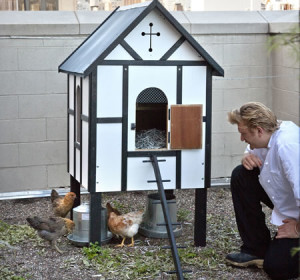
Crosby St Hotel chef Anthony Paris checks the chooks
Source: www.firmdalehotels.com

You know the grow-your-own movement has crossed over into the mainstream when some of New York’s hottest hotels start growing vegies on their roofs.

More than 20 Manhattan hotels now have productive rooftop vegetable gardens. Some have their own beehives producing honey – and some even have chickens laying eggs.

So why give vegie patches million-dollar views in a city where real estate is at a premium?

The trend is two-fold: travellers are expecting more organic, seasonal and local ingredients on hotel menus. And when a hotel guest wants to know the provenance of the food, it doesn’t get any more local than this. Rooftop herbs and vegetables aren’t bruised by transportation and storage, and retain more of their nutrients. And the hotels limit their carbon footprint.

There are financial benefits as well. Green roofs reduce heating and cooling cost for large buildings and mitigate against rain and stormwater damage.

Here’s a look at four New York hotels with impressive gardens.

[Read more…]