From the Blog

Grow a beautiful garden with ecofriendly greywater

by LEIGH JERRARD, Houzz, March 20, 2014
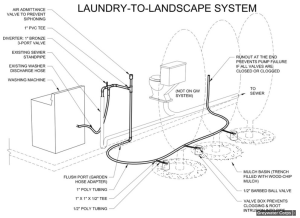
Laundry-to-Landscape System Image: Greywater Corps Source: www.houzz.com

Laundry-to-Landscape System
Image: Greywater Corps
Source: www.houzz.com

You’re probably irrigating your yard with drinking water, since the same water that comes out of your kitchen faucet also comes out of your hose bibs. But do your plants need drinking water? It turns out that most plants are perfectly happy with gently used water from showers, bathtubs, laundry and sinks — or greywater (also “graywater”). This works out well, because the average American household uses about half its water indoors and the other half outside for irrigation. Some households can cut their water bills almost in half by irrigating with greywater.

Now that large swaths of the country are facing historic drought conditions — and the possibility that these droughts are the new normal — it especially doesn’t make sense to send usable water down the drain. You can recapture that water and use it again. There are other benefits to greywater, too. It reduces a home’s carbon footprint, since moving and treating water consumes a tremendous amount of power. It protects the aquatic ecosystems from whence your water comes. It reduces loads on sewage systems (which lowers the carbon footprint) and puts water back into the local aquifer, which is better than dumping it into rivers, lakes and oceans. If you’re on a septic tank, it reduces loads on the system, prolonging your service intervals. And it helps grow a beautiful and bountiful garden.

Greywater systems don’t look like normal irrigation. For one thing, there’s stuff in it — small amounts of soap, hair, laundry lint etc. You can either process the water and try to filter everything out, or you can use larger pipes and emitters and send the water to your garden as is. The latter is the better option — ideally, a greywater system should be low tech and dependable, with a minimum of parts to break and filters to maintain.
[Read more…]

How rooftop farming will change how we eat: Mohamed Hage at TEDx UdeM

Présentation de Mohamed Hage, président fondateur des Fermes Lufa lors de la conférence TEDx UdeM le 11 mars 2012.

Site TEDx UdeM


Salad from a car park

by CHERYL FAITH WEE, The Star Online, March 10, 2014

Rooftop farms in Singapore are sprouting greens.
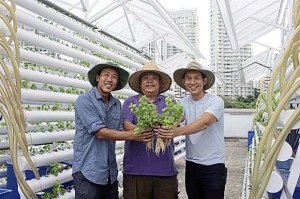
Urban farmers: Three of the four founders of ComCrop (from left) Kuah Zhen Shan, Allan Lim and Keith Loh, with vegetables from the urban farm at *Scape rooftop in Orchard Link, Singapore. Photo: SPH Source: www.thestar.com.my

Urban farmers: Three of the four founders of ComCrop (from left) Kuah Zhen Shan, Allan Lim and Keith Loh, with vegetables from the urban farm at *Scape rooftop in Orchard Link, Singapore.
Photo: SPH
Source: www.thestar.com.my

Since the start of the year, Bjorn Low and his team of five have been growing small test batches of organic vegetables that can be used in mixed leaf salads – giant red mustard, mizuna, bok choy – and herbs such as basil and mint.

Like most farmers, they deal with pests such as pigeons nibbling on the plants. Team member Robert Pearce, 37, says jokingly: “I squirt the birds with water whenever I see them doing that.”

But unlike most farmers, the team’s plots are on the roof of People’s Park Complex car park – the latest rooftop farm to sprout in Singapore. Surrounded by high-rise buildings, the vegetables and herbs are a part of an urban farm, about 2,787sq m, slated to open on the sixth floor of the car park this year.

Last year, urban farming consultancy Edible Gardens, which helps restaurants and institutions build gardens, was approached by the car park’s re-development manager, Goldhill Developments, to see what could be done with the under-utilised space.

Low, 33, who co-founded Edible Gardens with Pearce in late 2012, says: “We’ve always been looking for a space like this to set up a commercially viable rooftop urban farm. This is our dream.”

[Read more…]

NTU students bring green thumb to gray concrete of Taipei rooftop

by KATHERINE WEI, The China Post, March 10, 2014

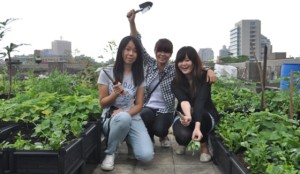
Vickie C. Yang, Mica Hsiao et Wan Lin Chen Photo: Daniel Garcia Source: www.elviajero.elpais.com

Vickie C. Yang, Mica Hsiao and Wan Lin Chen on the roof of the university’s Sociology Department
Photo: Daniel Garcia
Source: www.elviajero.elpais.com

TAIPEI, Taiwan — Around 60 ping of lush green covers the rooftop of National Taiwan University’s Sociology Department building, with strawberries predominant among the many rows. The notion of growing your own food in the concrete jungles of the city has long been a fantasy of urban dwellers, many of whom have sworn to devote themselves to a healthier, organic way of living.

Whimsical fantasies, it seemed, as concrete rooftops were less than ideal for growing, as the material absorbs and radiates excess heat in a way unhelpful to gardening. But a group of college students are now proud veterans of the gardening struggle between urban farmer and the limited environment.

The garden sprung from the course “Innovation and Design of Socio-economic Organizations,” in which a group of eight students decided that they were fed up with the money-driven flow that escalated housing prices outrageously in Taiwan, especially in the Wenlin Yuan case. When the Wang family accused the government of confiscating its land unlawfully, the students thought: aside from providing shelter, what else can “home” represent to people?

[Read more…]

Tales from the field: Up on the roof

by SCOTT SPECTOR, The New York Observer, February 10, 2014

Over the last few weeks, I’ve shared different “Tales from the Field,” each of which included a lesson I’ve learned while on the job. This week, in the fourth installment of this five-part series, I’m going to use an increasingly popular trend to illustrate a very valuable point: if you’re going to do something, do it right.

Lately more and more companies – from boutique firms to multinational corporations – are embracing rooftop terraces. However, utilizing your roof space is hardly a new trend. In fact, roof terraces began coming into favor four to five years ago, starting mainly with major, iconic buildings such as the Empire State Building and Rockefeller Center. Fast forward to 2014 and things have changed. Roof terraces are now being frequently incorporated as a design “must” by tenants of all sizes, as well as landlords who are using them as a feature to attract tenants.

Their popularity is undeniable; I am asked about roof terraces on a nearly daily basis. A couple of weeks ago, I had a walk-through with a landlord client in Long Island City and we discussed taking advantage of his building’s 360-degree views of Manhattan and Long Island by creating an enormous rooftop terrace. I also recently worked with an established hedge fund client who enthusiastically collaborated with us to create a green lounge to enhance the work environment and build some stress relief in for his employees.

[Read more…]

Rooftop farm produces up to 10 times more than traditional farms

by EILEEN POH, Channel NewsAsia, February 14, 2014

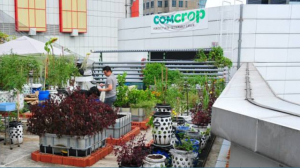
Comcrop is a vegetable and fish farm located on the rooftop of *SCAPE. (Photo: Photo: Comcrop Source: www.channelnewsasia.com

Comcrop is a vegetable and fish farm located on the rooftop of *SCAPE.
Photo: Comcrop
Source: www.channelnewsasia.com

Tucked away in the heart of Orchard Road is a vegetable and fish farm called Comcrop located on the rooftop of *SCAPE. With 6,000 square feet of space, it can produce eight to 10 times more than traditional farms over the same area by using vertical farming techniques.

Tucked away in the heart of Orchard Road is a uncommon sight for Singapore’s main shopping belt.

A vegetable and fish farm called Comcrop is located on the rooftop of *SCAPE.

With 6,000 square feet of space, it can produce eight to 10 times more than traditional farms over the same area by using vertical farming techniques.

The farm also uses aquaponics, a self-sustaining system that breaks down by-products from tilapia, a type of fish, which are utilised by plants as nutrients. The clean water is then fed back to the plants.

[Read more…]