From the Blog

Rooftopping: Tom Ryaboi & Almost (I’ll make ya) Famous

by DEBS SLATER, 500px, April 24, 2012

Photo: Tom Ryaboi Source: www.500px.com

Photo: Tom Ryaboi
Source: www.500px.com

A year has passed since Tom Ryaboi clicked the shutter, captured a photo, and with it changed the course of his life. Here he is to tell us the story about the incredible response to one single shot.

One year ago today I took a photograph that would change my life. A single frame turned my whole world upside down, and brought on a storm of media attention, praise, criticism, confusion, wonder, and doubt. After one hell of a ride this past year, I think today is a good day to finally tell this photo’s story…

The birth of a movement?

I guess this all started in 2007, when photography became a full time obsession for me. That summer I returned from Europe where I learned to use my first DSLR (Canon Rebel XT), and leaving the house without a camera was just not an option anymore.

I was shooting some street just before sunset when I came across a construction site on a busy Toronto intersection. It didn’t seem like there were any workers around, but the gate was wide open. I thought I could get a cool vantage point to shoot the skyline so I just went for it, found the stairs and climbed to the very top.

The building wasn’t very high, perhaps 15 or 16 storeys, but when I got to the top and opened the door to the roof I got an instant rush of adrenaline, like I just opened the door to a secret world of wonder. The city was right in my face, like I’ve never seen it before; the sun was setting and all the lights were starting to turn on. The noise from the street was muted, the cars and people moved about in what seemed like slow motion, it was like a Eric Satie song. It was magical.
[Read more…]

Green roof fad comes to town

by HELEN YOUNG, The Australian, August, 18, 2012

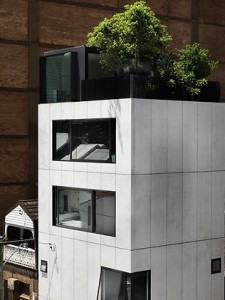
The Small House in Sydeny's Surry Hills. Photo: Trevor Mein Source: Supplied via The Australian

The Small House in Sydeny’s Surry Hills
Photo: Trevor Mein
Source: Supplied via The Australian

Imagine flying over a city where the rooftops below are living green, where plants and even vegetable gardens transform the lost spaces on top of buildings. It’s already happening around the world, and Australia is embracing the trend.

In Sydney’s Pyrmont, we’re standing on the rooftop of a heritage-listed building, surrounded by a vast garden sitting in the sky. M Central is an apartment block whose 2005 resurrection as a hip inner-city residence came a century after its construction as a wool store. Landscape architect Daniel Baffsky of 360 Degrees, who designed the 3000sq m communal garden, says the brief was to surprise rather than “have the ubiquitous pool and huge deck”.

Swaths of native foxtail grass lend an almost rural ambience at one end, their furry plumes swaying with the breeze. Bold succulents give textural contrast, while the centrepiece of a small lawn is a magnificent dragon’s blood tree. On the upper level, vine-covered arbours and wide timber boardwalks, shaded by tall tuckeroo trees, flank a covered events area. The sound of water tinkles gently.

The garden is beautiful, but also a social hub for M Central’s 400 residents, offering opportunities for interaction, from barbecues to dog walking.

“There’s no question about the environmental benefits of green roofs but the social benefits are not yet fully explored. Up on the roof everyone is equal,” Baffsky says.

[Read more…]

Seeing green: Urban agriculture as green infrastructure

by CASSIM SHEPARD, Urban Omnibus, February 1st, 2012

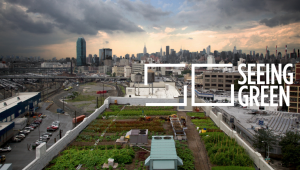
Image: Seein Green Source: www.urbanomnibus.net

Image: Seeing Green
Source: www.urbanomnibus.net

It’s easy to list the reasons why we are supposed to love urban agriculture: the food it yields is fresh and local; the farming it requires is fun and social; the effect on neighborhoods is revitalizing and healthy. Critics point to its inability to replace existing production and distribution channels for produce, but what if its impact extended beyond the small farm or immediate community? What if it could solve other problems? One of New York’s greatest environmental challenges is its combined sewage overflow (CSO) problem. Our outdated sewer system is designed to collect stormwater runoff, domestic sewage, and industrial wastewater in the same pipe on its way to a sewage treatment plant. When the rain is heavy, though, volume exceeds capacity and untreated wastewater flows right into our waterways. Green infrastructure is a term that refers to a wide range of technologies and systems to improve water quality through the capture and reuse of stormwater. But the policies that incentivize green infrastructure and those that govern urban agriculture are not coordinated. In some cases, urban agriculture is actively excluded from official definitions of green infrastructure. In an effort to support farming in the city and help scale it up, Tyler Caruso and Erik Facteau set out to prove scientifically the environmental benefits of rooftop and other urban farms, in particular their ability to manage stormwater, with their research project Seeing Green. In describing this project, Caruso and Facteau touch on issues that range from the effect of scientific research on public policy, the shift towards a definition of sustainability that includes performance alongside design, and the need to layer different registers of analysis in efforts to bring about a city that is more responsive to natural systems. […]

Read the original story

‘Innovative’ housing with rooftop farms set for southside

by EMILIE RAGUSO, Berkeleyside, October 17, 2013

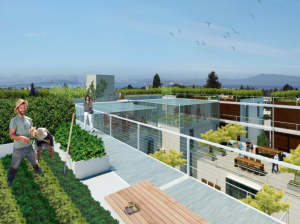
A photo simulation of what the project’s rooftop farms could look like Image: Stanley Saitowitz / Natoma Architects Source: www.berkeleyside.com

A photo simulation of what the project’s rooftop farms could look like
Image: Stanley Saitowitz / Natoma Architects
Source: www.berkeleyside.com

City zoning board members approved a 77-unit mixed-use housing development near downtown Berkeley late last week, expressing excitement about a “unique” design set to include more than a dozen working rooftop farm plots and a novel approach to parking.

“Garden Village,” at 2201 Dwight Way at Fulton Street, brings with it a number of innovative features, from its composition — it’s made up of 18 distinct but connected “volumes,” or towers, that range in height from 3 to 5 stories and are connected by open-air walkways; its more than 12,000 square feet of rooftop farming plots; and its small garage, which offers just enough space for a fleet of shared vehicles that will be rentable by tenants.

Without the car-sharing idea, the project would have required room for 71 vehicles. Instead, Berkeley-based developer Nautilus Group decided it would purchase a fleet of four to 10 automobiles and contract with a car-sharing operator called Getaround to run the “car-share pod” operation. (The city required Nautilus to pay for a parking demand study to bolster the justification for that approach.)

Zoning board Commissioner Shoshana O’Keefe described the concept as potentially “genius,” adding that the notion of projects that fold effective car-sharing programs into their plans “might be the magic solution” to the hairy issue of meeting parking demand efficiently in a densely-populated community.

[Read more…]

One photographer’s three year tour of NYC’s best rooftops

by KELSEY CAMPBELL-DOLLAGHAN, Gizmodo India, October 18, 2013

155 E 55th Street from 17th floor, 130 E 57th Street Photo: Stewart Mader Source: www.storiesaboveny.com

155 E 55th Street from 17th floor, 130 E 57th Street
Photo: Stewart Mader
Source: www.storiesaboveny.com

Even if you’ve lived in New York for decades, gaining access to a rooftop you’ve never explored can still be surprisingly fun: The burst of wind, the sound of traffic, and an entirely new vantage point on a city you’d think you’d be sick of after so many years. That’s the basic concept behind Stories Above New York, a visual archive of New York’s rooftop views that’s three years in the making.

SANY is the work of Stewart Mader, a photographer who started the project in early 2011. He shoots from a new rooftop roughly every week, picking unusual or hard-to-access spots he’s never been to. Those include the top of One World Trade Center and the Columbus Circle monument of Christopher Columbus, shot during the temporary installation of scaffolding around the statue. “New York is a giant city,” he said over email. “Even with 230 published photos so far, I haven’t even scratched the surface. I could be doing this five or ten years from now.”

Does Mader have a favorite? 550 Grand St, an apartment building that flanks the Williamsburg Bridge. It was built by workers’ unions to replace 65 tenements, and his wife’s parents lived there for 50 years. “The whole history of these buildings is emblematic of the kind of ingenuity that has made New York what it is today,” he adds. “We should be looking more closely at their history to solve the current, growing housing supply crisis.”

Read the original story

Stories Above New York website

Tamil Nadu government pushes green thumb rule

by JULIE MARIAPPAN, Times News Network, September 23, 2013

CHENNAI: The soaring price of vegetables has caused much heartburn, but people in the state may soon get their greens for free.

If the state government has its way, residents could soon be plucking fresh vegetables from their own rooftop gardens. As part of the plan to soften the blow of food inflation, the government will distribute do-it-yourself rooftop garden kits to residents.

Encouraged by a few individuals who have responded to rising prices by growing vegetables on their balconies, the government plans to introduce the scheme in Chennai and Coimbatore to begin with.

“The opportunity to beat rising prices by growing vegetables at home has led to people trying their luck with gardening. The government wants to chip in with support,” a horticulture officer said. The horticulture department will roll out the scheme with support from Tamil Nadu Agriculture University.

People interested can apply online and the government will supply them with 20 UV stabilised 200 micron thickness polythene bags, 15kg of coir pith and manure, seeds for vegetables and greens, besides instruments, organic fertiliser and a 20sqm polythene sheet. It will make 20 bags available for each person at a subsidised price. Indian Overseas Bank offers loans to individuals for rooftop gardening.

[Read more…]